| Record Information |
|---|
| Version | 5.0 |
|---|
| Status | Detected and Quantified |
|---|
| Creation Date | 2005-11-16 15:48:42 UTC |
|---|
| Update Date | 2022-03-07 02:49:09 UTC |
|---|
| HMDB ID | HMDB0001403 |
|---|
| Secondary Accession Numbers | |
|---|
| Metabolite Identification |
|---|
| Common Name | Prostaglandin D2 |
|---|
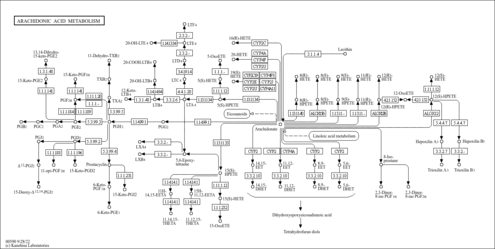
| Description | Prostaglandin D2 (or PGD2) is a prostaglandin that is actively produced in various organs such as the brain, spleen, thymus, bone marrow, uterus, ovary, oviduct, testis, prostate and epididymis, and is involved in many physiological events. PGD2 binds to the prostaglandin D2 receptor (PTGDR) which is a G-protein-coupled receptor. Its activity is mainly mediated by G-S proteins that stimulate adenylate cyclase resulting in an elevation of intracellular cAMP and Ca2+. PGD2 promotes sleep; regulates body temperature, olfactory function, hormone release, and nociception in the central nervous system; prevents platelet aggregation; and induces vasodilation and bronchoconstriction. PGD2 is also released from mast cells as an allergic and inflammatory mediator. Prostaglandin H2 is an unstable intermediate formed from PGG2 by the action of cyclooxygenase (COX) in the arachidonate cascade. In mammalian systems, it is efficiently converted into more stable arachidonate metabolites, such as PGD2, PGE2, PGF2a by the action of three groups of enzymes, PGD synthases (PGDS), PGE synthases and PGF synthases, respectively. PGDS catalyzes the isomerization of PGH2 to PGD2. Two types of PGD2 synthase are known. Lipocalin-type PGD synthase is present in cerebrospinal fluid, seminal plasma and may play an important role in male reproduction. Another PGD synthase, hematopoietic PGD synthase is present in the spleen, fallopian tube, endometrial gland cells, extravillous trophoblasts and villous trophoblasts, and perhaps plays an important role in female reproduction. Recent studies demonstrate that PGD2 is probably involved in multiple aspects of inflammation through its dual receptor systems, DP and CRTH2. (PMID:12148545 )Prostaglandins are eicosanoids. The eicosanoids consist of the prostaglandins (PGs), thromboxanes (TXs), leukotrienes (LTs), and lipoxins (LXs). The PGs and TXs are collectively identified as prostanoids. Prostaglandins were originally shown to be synthesized in the prostate gland, thromboxanes from platelets (thrombocytes), and leukotrienes from leukocytes, hence the derivation of their names. All mammalian cells except erythrocytes synthesize eicosanoids. These molecules are extremely potent, able to cause profound physiological effects at very dilute concentrations. All eicosanoids function locally at the site of synthesis, through receptor-mediated G-protein linked signalling pathways. | Read more...
|---|
| Structure | [H][C@](O)(CCCCC)\C=C\[C@@]1([H])C(=O)C[C@]([H])(O)[C@]1([H])C\C=C/CCCC(O)=O InChI=1S/C20H32O5/c1-2-3-6-9-15(21)12-13-17-16(18(22)14-19(17)23)10-7-4-5-8-11-20(24)25/h4,7,12-13,15-18,21-22H,2-3,5-6,8-11,14H2,1H3,(H,24,25)/b7-4-,13-12+/t15-,16+,17+,18-/m0/s1 |
|---|
| Synonyms | | Value | Source |
|---|
| (5Z,13E)-(15S)-9alpha,15-Dihydroxy-11-oxoprosta-5,13-dienoate | ChEBI | | (5Z,13E,15S)-9alpha,15-Dihydroxy-11-oxoprosta-5,13-dienoate | ChEBI | | 11-Dehydroprostaglandin F2-alpha | ChEBI | | PGD2 | ChEBI | | (5Z,13E)-(15S)-9a,15-Dihydroxy-11-oxoprosta-5,13-dienoate | Generator | | (5Z,13E)-(15S)-9a,15-Dihydroxy-11-oxoprosta-5,13-dienoic acid | Generator | | (5Z,13E)-(15S)-9alpha,15-Dihydroxy-11-oxoprosta-5,13-dienoic acid | Generator | | (5Z,13E)-(15S)-9Α,15-dihydroxy-11-oxoprosta-5,13-dienoate | Generator | | (5Z,13E)-(15S)-9Α,15-dihydroxy-11-oxoprosta-5,13-dienoic acid | Generator | | (5Z,13E,15S)-9a,15-Dihydroxy-11-oxoprosta-5,13-dienoate | Generator | | (5Z,13E,15S)-9a,15-Dihydroxy-11-oxoprosta-5,13-dienoic acid | Generator | | (5Z,13E,15S)-9alpha,15-Dihydroxy-11-oxoprosta-5,13-dienoic acid | Generator | | (5Z,13E,15S)-9Α,15-dihydroxy-11-oxoprosta-5,13-dienoate | Generator | | (5Z,13E,15S)-9Α,15-dihydroxy-11-oxoprosta-5,13-dienoic acid | Generator | | 11-Dehydroprostaglandin F2-a | Generator | | 11-Dehydroprostaglandin F2-α | Generator | | (5Z,13E)-(15S)-9,15-Dihydroxy-11-oxoprosta-5,13-dienoate | HMDB | | (5Z,13E)-(15S)-9,15-Dihydroxy-11-oxoprosta-5,13-dienoic acid | HMDB | | (5Z,13E)-(15S)-9-alpha,15-Dihydroxy-11-oxoprosta-5,13-dienoate | HMDB | | (5Z,13E)-(15S)-9-alpha,15-Dihydroxy-11-oxoprosta-5,13-dienoic acid | HMDB | | (5Z,13E,15S)-9-alpha,15-Dihydroxy-11-oxoprosta-5,13-dienoate | HMDB | | (5Z,13E,15S)-9-alpha,15-Dihydroxy-11-oxoprosta-5,13-dienoic acid | HMDB | | (5Z,13E,15S)-9a,15-Dihydroxy-11-oxoprosta-5,13-dien-1-Oate | HMDB | | (5Z,13E,15S)-9a,15-Dihydroxy-11-oxoprosta-5,13-dien-1-Oic acid | HMDB | | (5Z,9-alpha,13E,15S)-9,15-Dihydroxy-11-oxo-prosta-5,13-dien-1-Oate | HMDB | | (5Z,9-alpha,13E,15S)-9,15-Dihydroxy-11-oxo-prosta-5,13-dien-1-Oic acid | HMDB | | (5Z,9alpha,13E,15S)-9,15-Dihydroxy-11-oxo-prosta-5,13-dien-1-Oate | HMDB | | (5Z,9alpha,13E,15S)-9,15-Dihydroxy-11-oxo-prosta-5,13-dien-1-Oic acid | HMDB | | 11-Dehydroprostaglandin F2alpha | HMDB | | 9S,15S-Dihydroxy-11-oxo-5Z,13E-prostadienoate | HMDB | | 9S,15S-Dihydroxy-11-oxo-5Z,13E-prostadienoic acid | HMDB | | F2alpha, 11-Dehydroprostaglandin | HMDB | | 11 Dehydroprostaglandin F2alpha | HMDB | | 11 Dehydroprostaglandin F2 alpha | HMDB | | D2, Prostaglandin | HMDB | | F2 alpha, 11-Dehydroprostaglandin | HMDB | | alpha, 11-Dehydroprostaglandin F2 | HMDB | | 11-Dehydroprostaglandin F2 alpha | HMDB |
| Show more...
|---|
| Chemical Formula | C20H32O5 |
|---|
| Average Molecular Weight | 352.4651 |
|---|
| Monoisotopic Molecular Weight | 352.224974134 |
|---|
| IUPAC Name | (5Z)-7-[(1R,2R,5S)-5-hydroxy-2-[(1E,3S)-3-hydroxyoct-1-en-1-yl]-3-oxocyclopentyl]hept-5-enoic acid |
|---|
| Traditional Name | prostaglandin D2 |
|---|
| CAS Registry Number | 41598-07-6 |
|---|
| SMILES | [H][C@](O)(CCCCC)\C=C\[C@@]1([H])C(=O)C[C@]([H])(O)[C@]1([H])C\C=C/CCCC(O)=O |
|---|
| InChI Identifier | InChI=1S/C20H32O5/c1-2-3-6-9-15(21)12-13-17-16(18(22)14-19(17)23)10-7-4-5-8-11-20(24)25/h4,7,12-13,15-18,21-22H,2-3,5-6,8-11,14H2,1H3,(H,24,25)/b7-4-,13-12+/t15-,16+,17+,18-/m0/s1 |
|---|
| InChI Key | BHMBVRSPMRCCGG-OUTUXVNYSA-N |
|---|
| Chemical Taxonomy |
|---|
| Description | Belongs to the class of organic compounds known as prostaglandins and related compounds. These are unsaturated carboxylic acids consisting of a 20 carbon skeleton that also contains a five member ring, and are based upon the fatty acid arachidonic acid. |
|---|
| Kingdom | Organic compounds |
|---|
| Super Class | Lipids and lipid-like molecules |
|---|
| Class | Fatty Acyls |
|---|
| Sub Class | Eicosanoids |
|---|
| Direct Parent | Prostaglandins and related compounds |
|---|
| Alternative Parents | |
|---|
| Substituents | - Prostaglandin skeleton
- Long-chain fatty acid
- Hydroxy fatty acid
- Cyclopentanol
- Fatty acid
- Unsaturated fatty acid
- Cyclic alcohol
- Ketone
- Cyclic ketone
- Secondary alcohol
- Carboxylic acid
- Carboxylic acid derivative
- Monocarboxylic acid or derivatives
- Alcohol
- Hydrocarbon derivative
- Organic oxide
- Organic oxygen compound
- Organooxygen compound
- Carbonyl group
- Aliphatic homomonocyclic compound
|
|---|
| Molecular Framework | Aliphatic homomonocyclic compounds |
|---|
| External Descriptors | |
|---|
| Ontology |
|---|
| Physiological effect | Not Available |
|---|
| Disposition | |
|---|
| Process | |
|---|
| Role | Not Available |
|---|
| Physical Properties |
|---|
| State | Solid |
|---|
| Experimental Molecular Properties | | Property | Value | Reference |
|---|
| Melting Point | 56 - 57 °C | Not Available | | Boiling Point | Not Available | Not Available | | Water Solubility | Not Available | Not Available | | LogP | Not Available | Not Available |
|
|---|
| Experimental Chromatographic Properties | Experimental Collision Cross Sections |
|---|
| Predicted Molecular Properties | | Show more...
|---|
| Predicted Chromatographic Properties | Predicted Collision Cross SectionsPredicted Kovats Retention IndicesUnderivatizedDerivatized| Derivative Name / Structure | SMILES | Kovats RI Value | Column Type | Reference |
|---|
| Prostaglandin D2,1TMS,isomer #1 | CCCCC[C@@H](/C=C/[C@H]1C(=O)C[C@H](O)[C@@H]1C/C=C\CCCC(=O)O)O[Si](C)(C)C | 2836.1 | Semi standard non polar | 33892256 | | Prostaglandin D2,1TMS,isomer #2 | CCCCC[C@H](O)/C=C/[C@H]1C(=O)C[C@H](O[Si](C)(C)C)[C@@H]1C/C=C\CCCC(=O)O | 2763.8 | Semi standard non polar | 33892256 | | Prostaglandin D2,1TMS,isomer #3 | CCCCC[C@H](O)/C=C/[C@H]1C(=O)C[C@H](O)[C@@H]1C/C=C\CCCC(=O)O[Si](C)(C)C | 2783.4 | Semi standard non polar | 33892256 | | Prostaglandin D2,1TMS,isomer #4 | CCCCC[C@H](O)/C=C/C1=C(O[Si](C)(C)C)C[C@H](O)[C@@H]1C/C=C\CCCC(=O)O | 2866.1 | Semi standard non polar | 33892256 | | Prostaglandin D2,1TMS,isomer #5 | CCCCC[C@H](O)/C=C/[C@H]1C(O[Si](C)(C)C)=C[C@H](O)[C@@H]1C/C=C\CCCC(=O)O | 2727.9 | Semi standard non polar | 33892256 | | Prostaglandin D2,2TMS,isomer #1 | CCCCC[C@@H](/C=C/[C@H]1C(=O)C[C@H](O[Si](C)(C)C)[C@@H]1C/C=C\CCCC(=O)O)O[Si](C)(C)C | 2738.1 | Semi standard non polar | 33892256 | | Prostaglandin D2,2TMS,isomer #2 | CCCCC[C@@H](/C=C/[C@H]1C(=O)C[C@H](O)[C@@H]1C/C=C\CCCC(=O)O[Si](C)(C)C)O[Si](C)(C)C | 2795.5 | Semi standard non polar | 33892256 | | Prostaglandin D2,2TMS,isomer #3 | CCCCC[C@@H](/C=C/C1=C(O[Si](C)(C)C)C[C@H](O)[C@@H]1C/C=C\CCCC(=O)O)O[Si](C)(C)C | 2924.4 | Semi standard non polar | 33892256 | | Prostaglandin D2,2TMS,isomer #4 | CCCCC[C@@H](/C=C/[C@H]1C(O[Si](C)(C)C)=C[C@H](O)[C@@H]1C/C=C\CCCC(=O)O)O[Si](C)(C)C | 2759.6 | Semi standard non polar | 33892256 | | Prostaglandin D2,2TMS,isomer #5 | CCCCC[C@H](O)/C=C/[C@H]1C(=O)C[C@H](O[Si](C)(C)C)[C@@H]1C/C=C\CCCC(=O)O[Si](C)(C)C | 2725.9 | Semi standard non polar | 33892256 | | Prostaglandin D2,2TMS,isomer #6 | CCCCC[C@H](O)/C=C/C1=C(O[Si](C)(C)C)C[C@H](O[Si](C)(C)C)[C@@H]1C/C=C\CCCC(=O)O | 2840.7 | Semi standard non polar | 33892256 | | Prostaglandin D2,2TMS,isomer #7 | CCCCC[C@H](O)/C=C/[C@H]1C(O[Si](C)(C)C)=C[C@H](O[Si](C)(C)C)[C@@H]1C/C=C\CCCC(=O)O | 2757.8 | Semi standard non polar | 33892256 | | Prostaglandin D2,2TMS,isomer #8 | CCCCC[C@H](O)/C=C/C1=C(O[Si](C)(C)C)C[C@H](O)[C@@H]1C/C=C\CCCC(=O)O[Si](C)(C)C | 2867.9 | Semi standard non polar | 33892256 | | Prostaglandin D2,2TMS,isomer #9 | CCCCC[C@H](O)/C=C/[C@H]1C(O[Si](C)(C)C)=C[C@H](O)[C@@H]1C/C=C\CCCC(=O)O[Si](C)(C)C | 2736.1 | Semi standard non polar | 33892256 | | Prostaglandin D2,3TMS,isomer #1 | CCCCC[C@@H](/C=C/[C@H]1C(=O)C[C@H](O[Si](C)(C)C)[C@@H]1C/C=C\CCCC(=O)O[Si](C)(C)C)O[Si](C)(C)C | 2718.4 | Semi standard non polar | 33892256 | | Prostaglandin D2,3TMS,isomer #2 | CCCCC[C@@H](/C=C/C1=C(O[Si](C)(C)C)C[C@H](O[Si](C)(C)C)[C@@H]1C/C=C\CCCC(=O)O)O[Si](C)(C)C | 2852.7 | Semi standard non polar | 33892256 | | Prostaglandin D2,3TMS,isomer #3 | CCCCC[C@@H](/C=C/[C@H]1C(O[Si](C)(C)C)=C[C@H](O[Si](C)(C)C)[C@@H]1C/C=C\CCCC(=O)O)O[Si](C)(C)C | 2776.2 | Semi standard non polar | 33892256 | | Prostaglandin D2,3TMS,isomer #4 | CCCCC[C@@H](/C=C/C1=C(O[Si](C)(C)C)C[C@H](O)[C@@H]1C/C=C\CCCC(=O)O[Si](C)(C)C)O[Si](C)(C)C | 2880.2 | Semi standard non polar | 33892256 | | Prostaglandin D2,3TMS,isomer #5 | CCCCC[C@@H](/C=C/[C@H]1C(O[Si](C)(C)C)=C[C@H](O)[C@@H]1C/C=C\CCCC(=O)O[Si](C)(C)C)O[Si](C)(C)C | 2759.9 | Semi standard non polar | 33892256 | | Prostaglandin D2,3TMS,isomer #6 | CCCCC[C@H](O)/C=C/C1=C(O[Si](C)(C)C)C[C@H](O[Si](C)(C)C)[C@@H]1C/C=C\CCCC(=O)O[Si](C)(C)C | 2814.0 | Semi standard non polar | 33892256 | | Prostaglandin D2,3TMS,isomer #7 | CCCCC[C@H](O)/C=C/[C@H]1C(O[Si](C)(C)C)=C[C@H](O[Si](C)(C)C)[C@@H]1C/C=C\CCCC(=O)O[Si](C)(C)C | 2740.4 | Semi standard non polar | 33892256 | | Prostaglandin D2,4TMS,isomer #1 | CCCCC[C@@H](/C=C/C1=C(O[Si](C)(C)C)C[C@H](O[Si](C)(C)C)[C@@H]1C/C=C\CCCC(=O)O[Si](C)(C)C)O[Si](C)(C)C | 2839.6 | Semi standard non polar | 33892256 | | Prostaglandin D2,4TMS,isomer #1 | CCCCC[C@@H](/C=C/C1=C(O[Si](C)(C)C)C[C@H](O[Si](C)(C)C)[C@@H]1C/C=C\CCCC(=O)O[Si](C)(C)C)O[Si](C)(C)C | 2802.3 | Standard non polar | 33892256 | | Prostaglandin D2,4TMS,isomer #1 | CCCCC[C@@H](/C=C/C1=C(O[Si](C)(C)C)C[C@H](O[Si](C)(C)C)[C@@H]1C/C=C\CCCC(=O)O[Si](C)(C)C)O[Si](C)(C)C | 2918.8 | Standard polar | 33892256 | | Prostaglandin D2,4TMS,isomer #2 | CCCCC[C@@H](/C=C/[C@H]1C(O[Si](C)(C)C)=C[C@H](O[Si](C)(C)C)[C@@H]1C/C=C\CCCC(=O)O[Si](C)(C)C)O[Si](C)(C)C | 2798.7 | Semi standard non polar | 33892256 | | Prostaglandin D2,4TMS,isomer #2 | CCCCC[C@@H](/C=C/[C@H]1C(O[Si](C)(C)C)=C[C@H](O[Si](C)(C)C)[C@@H]1C/C=C\CCCC(=O)O[Si](C)(C)C)O[Si](C)(C)C | 2708.4 | Standard non polar | 33892256 | | Prostaglandin D2,4TMS,isomer #2 | CCCCC[C@@H](/C=C/[C@H]1C(O[Si](C)(C)C)=C[C@H](O[Si](C)(C)C)[C@@H]1C/C=C\CCCC(=O)O[Si](C)(C)C)O[Si](C)(C)C | 2940.5 | Standard polar | 33892256 | | Prostaglandin D2,1TBDMS,isomer #1 | CCCCC[C@@H](/C=C/[C@H]1C(=O)C[C@H](O)[C@@H]1C/C=C\CCCC(=O)O)O[Si](C)(C)C(C)(C)C | 3077.5 | Semi standard non polar | 33892256 | | Prostaglandin D2,1TBDMS,isomer #2 | CCCCC[C@H](O)/C=C/[C@H]1C(=O)C[C@H](O[Si](C)(C)C(C)(C)C)[C@@H]1C/C=C\CCCC(=O)O | 2965.1 | Semi standard non polar | 33892256 | | Prostaglandin D2,1TBDMS,isomer #3 | CCCCC[C@H](O)/C=C/[C@H]1C(=O)C[C@H](O)[C@@H]1C/C=C\CCCC(=O)O[Si](C)(C)C(C)(C)C | 3030.9 | Semi standard non polar | 33892256 | | Prostaglandin D2,1TBDMS,isomer #4 | CCCCC[C@H](O)/C=C/C1=C(O[Si](C)(C)C(C)(C)C)C[C@H](O)[C@@H]1C/C=C\CCCC(=O)O | 3093.6 | Semi standard non polar | 33892256 | | Prostaglandin D2,1TBDMS,isomer #5 | CCCCC[C@H](O)/C=C/[C@H]1C(O[Si](C)(C)C(C)(C)C)=C[C@H](O)[C@@H]1C/C=C\CCCC(=O)O | 2975.7 | Semi standard non polar | 33892256 | | Prostaglandin D2,2TBDMS,isomer #1 | CCCCC[C@@H](/C=C/[C@H]1C(=O)C[C@H](O[Si](C)(C)C(C)(C)C)[C@@H]1C/C=C\CCCC(=O)O)O[Si](C)(C)C(C)(C)C | 3203.6 | Semi standard non polar | 33892256 | | Prostaglandin D2,2TBDMS,isomer #2 | CCCCC[C@@H](/C=C/[C@H]1C(=O)C[C@H](O)[C@@H]1C/C=C\CCCC(=O)O[Si](C)(C)C(C)(C)C)O[Si](C)(C)C(C)(C)C | 3289.0 | Semi standard non polar | 33892256 | | Prostaglandin D2,2TBDMS,isomer #3 | CCCCC[C@@H](/C=C/C1=C(O[Si](C)(C)C(C)(C)C)C[C@H](O)[C@@H]1C/C=C\CCCC(=O)O)O[Si](C)(C)C(C)(C)C | 3359.6 | Semi standard non polar | 33892256 | | Prostaglandin D2,2TBDMS,isomer #4 | CCCCC[C@@H](/C=C/[C@H]1C(O[Si](C)(C)C(C)(C)C)=C[C@H](O)[C@@H]1C/C=C\CCCC(=O)O)O[Si](C)(C)C(C)(C)C | 3252.6 | Semi standard non polar | 33892256 | | Prostaglandin D2,2TBDMS,isomer #5 | CCCCC[C@H](O)/C=C/[C@H]1C(=O)C[C@H](O[Si](C)(C)C(C)(C)C)[C@@H]1C/C=C\CCCC(=O)O[Si](C)(C)C(C)(C)C | 3195.7 | Semi standard non polar | 33892256 | | Prostaglandin D2,2TBDMS,isomer #6 | CCCCC[C@H](O)/C=C/C1=C(O[Si](C)(C)C(C)(C)C)C[C@H](O[Si](C)(C)C(C)(C)C)[C@@H]1C/C=C\CCCC(=O)O | 3260.9 | Semi standard non polar | 33892256 | | Prostaglandin D2,2TBDMS,isomer #7 | CCCCC[C@H](O)/C=C/[C@H]1C(O[Si](C)(C)C(C)(C)C)=C[C@H](O[Si](C)(C)C(C)(C)C)[C@@H]1C/C=C\CCCC(=O)O | 3213.9 | Semi standard non polar | 33892256 | | Prostaglandin D2,2TBDMS,isomer #8 | CCCCC[C@H](O)/C=C/C1=C(O[Si](C)(C)C(C)(C)C)C[C@H](O)[C@@H]1C/C=C\CCCC(=O)O[Si](C)(C)C(C)(C)C | 3327.4 | Semi standard non polar | 33892256 | | Prostaglandin D2,2TBDMS,isomer #9 | CCCCC[C@H](O)/C=C/[C@H]1C(O[Si](C)(C)C(C)(C)C)=C[C@H](O)[C@@H]1C/C=C\CCCC(=O)O[Si](C)(C)C(C)(C)C | 3234.2 | Semi standard non polar | 33892256 | | Prostaglandin D2,3TBDMS,isomer #1 | CCCCC[C@@H](/C=C/[C@H]1C(=O)C[C@H](O[Si](C)(C)C(C)(C)C)[C@@H]1C/C=C\CCCC(=O)O[Si](C)(C)C(C)(C)C)O[Si](C)(C)C(C)(C)C | 3437.0 | Semi standard non polar | 33892256 | | Prostaglandin D2,3TBDMS,isomer #2 | CCCCC[C@@H](/C=C/C1=C(O[Si](C)(C)C(C)(C)C)C[C@H](O[Si](C)(C)C(C)(C)C)[C@@H]1C/C=C\CCCC(=O)O)O[Si](C)(C)C(C)(C)C | 3495.2 | Semi standard non polar | 33892256 | | Prostaglandin D2,3TBDMS,isomer #3 | CCCCC[C@@H](/C=C/[C@H]1C(O[Si](C)(C)C(C)(C)C)=C[C@H](O[Si](C)(C)C(C)(C)C)[C@@H]1C/C=C\CCCC(=O)O)O[Si](C)(C)C(C)(C)C | 3486.3 | Semi standard non polar | 33892256 | | Prostaglandin D2,3TBDMS,isomer #4 | CCCCC[C@@H](/C=C/C1=C(O[Si](C)(C)C(C)(C)C)C[C@H](O)[C@@H]1C/C=C\CCCC(=O)O[Si](C)(C)C(C)(C)C)O[Si](C)(C)C(C)(C)C | 3576.2 | Semi standard non polar | 33892256 | | Prostaglandin D2,3TBDMS,isomer #5 | CCCCC[C@@H](/C=C/[C@H]1C(O[Si](C)(C)C(C)(C)C)=C[C@H](O)[C@@H]1C/C=C\CCCC(=O)O[Si](C)(C)C(C)(C)C)O[Si](C)(C)C(C)(C)C | 3508.3 | Semi standard non polar | 33892256 | | Prostaglandin D2,3TBDMS,isomer #6 | CCCCC[C@H](O)/C=C/C1=C(O[Si](C)(C)C(C)(C)C)C[C@H](O[Si](C)(C)C(C)(C)C)[C@@H]1C/C=C\CCCC(=O)O[Si](C)(C)C(C)(C)C | 3495.6 | Semi standard non polar | 33892256 | | Prostaglandin D2,3TBDMS,isomer #7 | CCCCC[C@H](O)/C=C/[C@H]1C(O[Si](C)(C)C(C)(C)C)=C[C@H](O[Si](C)(C)C(C)(C)C)[C@@H]1C/C=C\CCCC(=O)O[Si](C)(C)C(C)(C)C | 3465.0 | Semi standard non polar | 33892256 | | Prostaglandin D2,4TBDMS,isomer #1 | CCCCC[C@@H](/C=C/C1=C(O[Si](C)(C)C(C)(C)C)C[C@H](O[Si](C)(C)C(C)(C)C)[C@@H]1C/C=C\CCCC(=O)O[Si](C)(C)C(C)(C)C)O[Si](C)(C)C(C)(C)C | 3667.9 | Semi standard non polar | 33892256 | | Prostaglandin D2,4TBDMS,isomer #1 | CCCCC[C@@H](/C=C/C1=C(O[Si](C)(C)C(C)(C)C)C[C@H](O[Si](C)(C)C(C)(C)C)[C@@H]1C/C=C\CCCC(=O)O[Si](C)(C)C(C)(C)C)O[Si](C)(C)C(C)(C)C | 3434.4 | Standard non polar | 33892256 | | Prostaglandin D2,4TBDMS,isomer #1 | CCCCC[C@@H](/C=C/C1=C(O[Si](C)(C)C(C)(C)C)C[C@H](O[Si](C)(C)C(C)(C)C)[C@@H]1C/C=C\CCCC(=O)O[Si](C)(C)C(C)(C)C)O[Si](C)(C)C(C)(C)C | 3198.3 | Standard polar | 33892256 | | Prostaglandin D2,4TBDMS,isomer #2 | CCCCC[C@@H](/C=C/[C@H]1C(O[Si](C)(C)C(C)(C)C)=C[C@H](O[Si](C)(C)C(C)(C)C)[C@@H]1C/C=C\CCCC(=O)O[Si](C)(C)C(C)(C)C)O[Si](C)(C)C(C)(C)C | 3681.4 | Semi standard non polar | 33892256 | | Prostaglandin D2,4TBDMS,isomer #2 | CCCCC[C@@H](/C=C/[C@H]1C(O[Si](C)(C)C(C)(C)C)=C[C@H](O[Si](C)(C)C(C)(C)C)[C@@H]1C/C=C\CCCC(=O)O[Si](C)(C)C(C)(C)C)O[Si](C)(C)C(C)(C)C | 3217.7 | Standard non polar | 33892256 | | Prostaglandin D2,4TBDMS,isomer #2 | CCCCC[C@@H](/C=C/[C@H]1C(O[Si](C)(C)C(C)(C)C)=C[C@H](O[Si](C)(C)C(C)(C)C)[C@@H]1C/C=C\CCCC(=O)O[Si](C)(C)C(C)(C)C)O[Si](C)(C)C(C)(C)C | 3205.1 | Standard polar | 33892256 |
| Show more...
|---|
| Spectra |
|---|
| GC-MS Spectra| Spectrum Type | Description | Splash Key | Deposition Date | Source | View |
|---|
| Experimental GC-MS | GC-MS Spectrum - Prostaglandin D2 GC-MS (1 MEOX; 3 TMS) | splash10-005i-4920000000-0865a8f516450183b07c | 2014-06-16 | HMDB team, MONA, MassBank | View Spectrum | | Experimental GC-MS | GC-MS Spectrum - Prostaglandin D2 GC-MS (1 MEOX; 3 TMS) | splash10-0040-4920000000-7b37e8b3ecc2583f0fdc | 2014-06-16 | HMDB team, MONA, MassBank | View Spectrum | | Experimental GC-MS | GC-MS Spectrum - Prostaglandin D2 GC-MS (Non-derivatized) | splash10-005i-4920000000-0865a8f516450183b07c | 2017-09-12 | HMDB team, MONA, MassBank | View Spectrum | | Experimental GC-MS | GC-MS Spectrum - Prostaglandin D2 GC-MS (Non-derivatized) | splash10-0040-4920000000-7b37e8b3ecc2583f0fdc | 2017-09-12 | HMDB team, MONA, MassBank | View Spectrum | | Predicted GC-MS | Predicted GC-MS Spectrum - Prostaglandin D2 GC-MS (Non-derivatized) - 70eV, Positive | splash10-004u-8295000000-f73b3416dd6c7bbb428b | 2017-09-01 | Wishart Lab | View Spectrum | | Predicted GC-MS | Predicted GC-MS Spectrum - Prostaglandin D2 GC-MS (3 TMS) - 70eV, Positive | splash10-0umi-9301550000-0fbea1d102dfc38f0246 | 2017-10-06 | Wishart Lab | View Spectrum | | Predicted GC-MS | Predicted GC-MS Spectrum - Prostaglandin D2 GC-MS (Non-derivatized) - 70eV, Positive | Not Available | 2021-10-12 | Wishart Lab | View Spectrum |
MS/MS Spectra| Spectrum Type | Description | Splash Key | Deposition Date | Source | View |
|---|
| Experimental LC-MS/MS | LC-MS/MS Spectrum - Prostaglandin D2 LC-ESI-QIT (4000Q TRAP, Applied Biosystems) 20V, Negative-QTOF | splash10-00yr-0494000000-005f78cb3131ac258d23 | 2012-08-31 | HMDB team, MONA | View Spectrum | | Experimental LC-MS/MS | LC-MS/MS Spectrum - Prostaglandin D2 LC-ESI-QIT (4000Q TRAP, Applied Biosystems) 25V, Negative-QTOF | splash10-00dr-0592000000-3541be2f7c29b70b97a4 | 2012-08-31 | HMDB team, MONA | View Spectrum | | Experimental LC-MS/MS | LC-MS/MS Spectrum - Prostaglandin D2 LC-ESI-QIT (4000Q TRAP, Applied Biosystems) 30V, Negative-QTOF | splash10-00dr-0691000000-a08a3850e6fbf73fe539 | 2012-08-31 | HMDB team, MONA | View Spectrum | | Experimental LC-MS/MS | LC-MS/MS Spectrum - Prostaglandin D2 LC-ESI-QIT (4000Q TRAP, Applied Biosystems) 35V, Negative-QTOF | splash10-00dr-0690000000-395bf1624fb183650268 | 2012-08-31 | HMDB team, MONA | View Spectrum | | Experimental LC-MS/MS | LC-MS/MS Spectrum - Prostaglandin D2 LC-ESI-QIT (4000Q TRAP, Applied Biosystems) 40V, Negative-QTOF | splash10-0079-0980000000-a0d1eacded9a909d2d07 | 2012-08-31 | HMDB team, MONA | View Spectrum | | Experimental LC-MS/MS | LC-MS/MS Spectrum - Prostaglandin D2 LC-ESI-QIT (4000Q TRAP, Applied Biosystems) 45V, Negative-QTOF | splash10-000i-0960000000-982ce65a71003d3086b1 | 2012-08-31 | HMDB team, MONA | View Spectrum | | Experimental LC-MS/MS | LC-MS/MS Spectrum - Prostaglandin D2 LC-ESI-QIT (4000Q TRAP, Applied Biosystems) 50V, Negative-QTOF | splash10-0079-0930000000-15446e0930a7e4e23eff | 2012-08-31 | HMDB team, MONA | View Spectrum | | Experimental LC-MS/MS | LC-MS/MS Spectrum - Prostaglandin D2 LC-ESI-QIT (4000Q TRAP, Applied Biosystems) 55V, Negative-QTOF | splash10-00di-0920000000-5f7db7776dd0364029d7 | 2012-08-31 | HMDB team, MONA | View Spectrum | | Experimental LC-MS/MS | LC-MS/MS Spectrum - Prostaglandin D2 LC-ESI-QIT (4000Q TRAP, Applied Biosystems) 60V, Negative-QTOF | splash10-00dj-0900000000-16cfbecd58e5a59ab631 | 2012-08-31 | HMDB team, MONA | View Spectrum | | Experimental LC-MS/MS | LC-MS/MS Spectrum - Prostaglandin D2 LC-ESI-QIT , negative-QTOF | splash10-00yr-0494000000-65af63dd6c30ad10793d | 2017-09-14 | HMDB team, MONA | View Spectrum | | Experimental LC-MS/MS | LC-MS/MS Spectrum - Prostaglandin D2 LC-ESI-QIT , negative-QTOF | splash10-00dr-0592000000-3541be2f7c29b70b97a4 | 2017-09-14 | HMDB team, MONA | View Spectrum | | Experimental LC-MS/MS | LC-MS/MS Spectrum - Prostaglandin D2 LC-ESI-QIT , negative-QTOF | splash10-00dr-0691000000-a08a3850e6fbf73fe539 | 2017-09-14 | HMDB team, MONA | View Spectrum | | Experimental LC-MS/MS | LC-MS/MS Spectrum - Prostaglandin D2 LC-ESI-QIT , negative-QTOF | splash10-00dr-0690000000-fef454d771f83be8e0b4 | 2017-09-14 | HMDB team, MONA | View Spectrum | | Experimental LC-MS/MS | LC-MS/MS Spectrum - Prostaglandin D2 LC-ESI-QIT , negative-QTOF | splash10-0079-0980000000-a0d1eacded9a909d2d07 | 2017-09-14 | HMDB team, MONA | View Spectrum | | Experimental LC-MS/MS | LC-MS/MS Spectrum - Prostaglandin D2 LC-ESI-QIT , negative-QTOF | splash10-000i-0960000000-982ce65a71003d3086b1 | 2017-09-14 | HMDB team, MONA | View Spectrum | | Experimental LC-MS/MS | LC-MS/MS Spectrum - Prostaglandin D2 LC-ESI-QIT , negative-QTOF | splash10-0079-0930000000-15446e0930a7e4e23eff | 2017-09-14 | HMDB team, MONA | View Spectrum | | Experimental LC-MS/MS | LC-MS/MS Spectrum - Prostaglandin D2 LC-ESI-QIT , negative-QTOF | splash10-00di-0920000000-5f7db7776dd0364029d7 | 2017-09-14 | HMDB team, MONA | View Spectrum | | Experimental LC-MS/MS | LC-MS/MS Spectrum - Prostaglandin D2 LC-ESI-QIT , negative-QTOF | splash10-00dj-0900000000-88efef42e905aa15039f | 2017-09-14 | HMDB team, MONA | View Spectrum | | Experimental LC-MS/MS | LC-MS/MS Spectrum - Prostaglandin D2 LC-ESI-QQ , negative-QTOF | splash10-00y0-0493000000-654476042b0ee0709ced | 2017-09-14 | HMDB team, MONA | View Spectrum | | Predicted LC-MS/MS | Predicted LC-MS/MS Spectrum - Prostaglandin D2 10V, Positive-QTOF | splash10-00kr-0019000000-c056c1df1ae03ef020cd | 2017-07-26 | Wishart Lab | View Spectrum | | Predicted LC-MS/MS | Predicted LC-MS/MS Spectrum - Prostaglandin D2 20V, Positive-QTOF | splash10-014r-2196000000-38a7e3f085222b728c06 | 2017-07-26 | Wishart Lab | View Spectrum | | Predicted LC-MS/MS | Predicted LC-MS/MS Spectrum - Prostaglandin D2 40V, Positive-QTOF | splash10-06du-9310000000-70af19409d627a582c45 | 2017-07-26 | Wishart Lab | View Spectrum | | Predicted LC-MS/MS | Predicted LC-MS/MS Spectrum - Prostaglandin D2 10V, Negative-QTOF | splash10-0udi-0019000000-81ee6b3c0a320262466f | 2017-07-26 | Wishart Lab | View Spectrum | | Predicted LC-MS/MS | Predicted LC-MS/MS Spectrum - Prostaglandin D2 20V, Negative-QTOF | splash10-0kar-2159000000-9a9fde23b29db29913b9 | 2017-07-26 | Wishart Lab | View Spectrum | | Predicted LC-MS/MS | Predicted LC-MS/MS Spectrum - Prostaglandin D2 40V, Negative-QTOF | splash10-0a4i-9520000000-d51eb51b9db8ff82e0d6 | 2017-07-26 | Wishart Lab | View Spectrum |
NMR Spectra| Spectrum Type | Description | Deposition Date | Source | View |
|---|
| Experimental 2D NMR | [1H, 13C]-HSQC NMR Spectrum (2D, 600 MHz, 100%_DMSO, experimental) | 2012-12-05 | Wishart Lab | View Spectrum |
| Show more...
|---|
| Biological Properties |
|---|
| Cellular Locations | - Cytoplasm
- Extracellular
- Membrane (predicted from logP)
- Endoplasmic reticulum
|
|---|
| Biospecimen Locations | - Blood
- Cerebrospinal Fluid (CSF)
- Urine
|
|---|
| Tissue Locations | - Adipose Tissue
- Brain
- Epidermis
- Liver
- Neuron
- Platelet
- Smooth Muscle
- Spleen
|
|---|
| Pathways | |
|---|
| Normal Concentrations |
|---|
| |
| Blood | Detected and Quantified | 0.0002 +/- 0.000065 uM | Adult (>18 years old) | Both | Normal | | details | | Blood | Detected and Quantified | 0.000306 +/- 0.000355 uM | Adult (>18 years old) | Both | Normal | | details | | Blood | Detected and Quantified | 0.0000726 +/- 0.0000058 uM | Adult (>18 years old) | Both | Normal | | details | | Blood | Detected and Quantified | <0.0001 uM | Adult (>18 years old) | Both | Normal | | details |
|
|---|
| Abnormal Concentrations |
|---|
| |
| Cerebrospinal Fluid (CSF) | Detected and Quantified | 0.000165 (0.000159-0.000170) uM | Not Specified | Not Specified | closed head injury | | details | | Cerebrospinal Fluid (CSF) | Detected and Quantified | 0.000511 uM | Not Specified | Not Specified | gunshot wound | | details | | Cerebrospinal Fluid (CSF) | Detected and Quantified | 0.000142 +/- 0.000133 uM | Not Specified | Not Specified | hydrocephalus | | details | | Cerebrospinal Fluid (CSF) | Detected and Quantified | 0.000384 (0.000108-0.000880) uM | Not Specified | Not Specified | meningitis | | details | | Cerebrospinal Fluid (CSF) | Detected and Quantified | 0.00321 uM | Not Specified | Not Specified | subarachnoid hemorrhage with cerebral vasospasm | | details | | Cerebrospinal Fluid (CSF) | Detected and Quantified | 1844.18 (595.8-3092.5) uM | Adult (>18 years old) | Not Specified | Subarachnoid Aneurysmal Hemorrhage | | details | | Cerebrospinal Fluid (CSF) | Detected and Quantified | 0.00131 +/- 0.000159 uM | Not Specified | Not Specified | subarachnoid hemorrhage without cerebral vasospasm | | details | | Urine | Detected and Quantified | 0.00221 +/- 0.000112 umol/mmol creatinine | Children (1 - 18 years old) | Male | Duchenne Muscular Dystrophy | | details |
| Show more...
|---|
| Associated Disorders and Diseases |
|---|
| Disease References | | Subarachnoid hemorrhage |
|---|
- Gaetani P, Rodriguez y Baena R, Vigano T, Crivellari MT: [Prostaglandin D2 in subarachnoid hemorrhage. Biological and diagnostic implications]. Riv Patol Nerv Ment. 1983 Jul-Aug;104(4):171-7. [PubMed:6598516 ]
| | Hydrocephalus |
|---|
- Westcott JY, Murphy RC, Stenmark K: Eicosanoids in human ventricular cerebrospinal fluid following severe brain injury. Prostaglandins. 1987 Dec;34(6):877-87. [PubMed:2835791 ]
| | Meningitis |
|---|
- Westcott JY, Murphy RC, Stenmark K: Eicosanoids in human ventricular cerebrospinal fluid following severe brain injury. Prostaglandins. 1987 Dec;34(6):877-87. [PubMed:2835791 ]
| | Duchenne Muscular Dystrophy |
|---|
- Nakagawa T, Takeuchi A, Kakiuchi R, Lee T, Yagi M, Awano H, Iijima K, Takeshima Y, Urade Y, Matsuo M: A prostaglandin D2 metabolite is elevated in the urine of Duchenne muscular dystrophy patients and increases further from 8 years old. Clin Chim Acta. 2013 Aug 23;423:10-4. doi: 10.1016/j.cca.2013.03.031. Epub 2013 Apr 19. [PubMed:23603101 ]
|
|
|---|
| Associated OMIM IDs | - 105800 (Subarachnoid hemorrhage)
- 310200 (Duchenne Muscular Dystrophy)
|
|---|
| External Links |
|---|
| DrugBank ID | DB02056 |
|---|
| Phenol Explorer Compound ID | Not Available |
|---|
| FooDB ID | FDB022602 |
|---|
| KNApSAcK ID | Not Available |
|---|
| Chemspider ID | 395250 |
|---|
| KEGG Compound ID | C00696 |
|---|
| BioCyc ID | Not Available |
|---|
| BiGG ID | 35725 |
|---|
| Wikipedia Link | Prostaglandin_D2 |
|---|
| METLIN ID | 6221 |
|---|
| PubChem Compound | 448457 |
|---|
| PDB ID | Not Available |
|---|
| ChEBI ID | 15555 |
|---|
| Food Biomarker Ontology | Not Available |
|---|
| VMH ID | PROSTGD2 |
|---|
| MarkerDB ID | Not Available |
|---|
| Good Scents ID | Not Available |
|---|
| References |
|---|
| Synthesis Reference | Ogawa, Yuji; Nunomoto, Makoto; Shibasaki, Masakatsu. A novel synthesis of prostaglandin D2. Journal of Organic Chemistry (1986), 51(9), 1625-7. |
|---|
| Material Safety Data Sheet (MSDS) | Download (PDF) |
|---|
| General References | - O'Sullivan S, Dahlen B, Dahlen SE, Kumlin M: Increased urinary excretion of the prostaglandin D2 metabolite 9 alpha, 11 beta-prostaglandin F2 after aspirin challenge supports mast cell activation in aspirin-induced airway obstruction. J Allergy Clin Immunol. 1996 Aug;98(2):421-32. [PubMed:8757220 ]
- Parsons WG 3rd, Roberts LJ 2nd: Transformation of prostaglandin D2 to isomeric prostaglandin F2 compounds by human eosinophils: a potential mast cell-eosinophil interaction. Adv Prostaglandin Thromboxane Leukot Res. 1989;19:499-502. [PubMed:2526527 ]
- Parsons WG 3rd, Roberts LJ 2nd: Transformation of prostaglandin D2 to isomeric prostaglandin F2 compounds by human eosinophils. A potential mast cell-eosinophil interaction. J Immunol. 1988 Oct 1;141(7):2413-9. [PubMed:3139758 ]
- Cooper B: Diminished platelet adenylate cyclase activation by prostaglandin D2 in acute thrombosis. Blood. 1979 Sep;54(3):684-93. [PubMed:380688 ]
- Bushfield M, McNicol A, MacIntyre DE: Inhibition of platelet-activating-factor-induced human platelet activation by prostaglandin D2. Differential sensitivity of platelet transduction processes and functional responses to inhibition by cyclic AMP. Biochem J. 1985 Nov 15;232(1):267-71. [PubMed:3002327 ]
- Awad JA, Morrow JD, Roberts LJ 2nd: Detection of the major urinary metabolite of prostaglandin D2 in the circulation: demonstration of elevated levels in patients with disorders of systemic mast cell activation. J Allergy Clin Immunol. 1994 May;93(5):817-24. [PubMed:8182221 ]
- Wolfe LS, Rostworowski K, Pellerin L, Sherwin A: Metabolism of prostaglandin D2 by human cerebral cortex into 9 alpha, 11 beta-prostaglandin F2 by an active NADPH-dependent 11-ketoreductase. J Neurochem. 1989 Jul;53(1):64-70. [PubMed:2723663 ]
- Cutler LS, Christian CP, Feinstein MB: Cytochemical localization of adenylate cyclase in the dense tubule system of human blood platelets stimulated by forskolin, prostacyclin and prostaglandin D2. Biochim Biophys Acta. 1985 Jun 30;845(3):403-10. [PubMed:3890960 ]
- Murray JJ, Tonnel AB, Brash AR, Roberts LJ 2nd, Gosset P, Workman R, Capron A, Oates JA: Release of prostaglandin D2 into human airways during acute antigen challenge. N Engl J Med. 1986 Sep 25;315(13):800-4. [PubMed:3462506 ]
- Liston TE, Roberts LJ 2nd: Transformation of prostaglandin D2 to 9 alpha, 11 beta-(15S)-trihydroxyprosta-(5Z,13E)-dien-1-oic acid (9 alpha, 11 beta-prostaglandin F2): a unique biologically active prostaglandin produced enzymatically in vivo in humans. Proc Natl Acad Sci U S A. 1985 Sep;82(18):6030-4. [PubMed:3862115 ]
- Haberl C, Hultner L, Flugel A, Falk M, Geuenich S, Wilmanns W, Denzlinger C: Release of prostaglandin D2 by murine mast cells: importance of metabolite formation for antiproliferative activity. Mediators Inflamm. 1998;7(2):79-84. [PubMed:9836493 ]
- Bate C, Kempster S, Williams A: Prostaglandin D2 mediates neuronal damage by amyloid-beta or prions which activates microglial cells. Neuropharmacology. 2006 Feb;50(2):229-37. Epub 2005 Nov 11. [PubMed:16289250 ]
- Nishizawa EE, Miller WL, Gorman RR, Bundy GL, Svensson J, Hamberg M: Prostaglandin d2 as a potential antithrombotic agent. Prostaglandins. 1975 Jan;9(1):109-21. [PubMed:806102 ]
- Fuller RW, Dixon CM, Dollery CT, Barnes PJ: Prostaglandin D2 potentiates airway responsiveness to histamine and methacholine. Am Rev Respir Dis. 1986 Feb;133(2):252-4. [PubMed:3511806 ]
- Lewis RA, Soter NA, Diamond PT, Austen KF, Oates JA, Roberts LJ 2nd: Prostaglandin D2 generation after activation of rat and human mast cells with anti-IgE. J Immunol. 1982 Oct;129(4):1627-31. [PubMed:6809826 ]
- Gresele P, Deckmyn H, Huybrechts E, Vermylen J: Serum albumin enhances the impairment of platelet aggregation with thromboxane synthase inhibition by increasing the formation of prostaglandin D2. Biochem Pharmacol. 1984 Jul 1;33(13):2083-8. [PubMed:6430299 ]
- VanderEnde DS, Morrow JD: Release of markedly increased quantities of prostaglandin D2 from the skin in vivo in humans after the application of cinnamic aldehyde. J Am Acad Dermatol. 2001 Jul;45(1):62-7. [PubMed:11423836 ]
- Downard CD, Roberts LJ 2nd, Morrow JD: Topical benzoic acid induces the increased biosynthesis of prostaglandin D2 in human skin in vivo. Clin Pharmacol Ther. 1995 Apr;57(4):441-5. [PubMed:7712673 ]
- Morrow JD, Minton TA, Awad JA, Roberts LJ: Release of markedly increased quantities of prostaglandin D2 from the skin in vivo in humans following the application of sorbic acid. Arch Dermatol. 1994 Nov;130(11):1408-12. [PubMed:7979442 ]
- Morrow JD, Awad JA, Oates JA, Roberts LJ 2nd: Identification of skin as a major site of prostaglandin D2 release following oral administration of niacin in humans. J Invest Dermatol. 1992 May;98(5):812-5. [PubMed:1373750 ]
- Saito S, Tsuda H, Michimata T: Prostaglandin D2 and reproduction. Am J Reprod Immunol. 2002 May;47(5):295-302. [PubMed:12148545 ]
| Show more...
|---|