We are currently updating the database - data may be missing for the next 10 minutes. We apologize for any inconvenience.

Human Metabolome Database Version 2.5


Showing metabocard for Dihydrotestosterone (HMDB02961)

Legend: metabolite field enzyme field

Version 2.5
Creation Date 2006-05-22 16:12:22
Update Date 2009-05-19 00:17:41
Accession Number HMDB02961
Secondary Accession Numbers Not Available
Common Name Dihydrotestosterone
Description A potent androgenic metabolite of testosterone. Dihydrotestosterone (DHT) is generated by a 5-alpha reduction of testosterone. Unlike testosterone, DHT cannot be aromatized to estradiol therefore DHT is considered a pure androgenic steroid. -- Pubchem; Dihydrotestosterone (DHT) (INN: androstanolone) is a biologically active metabolite of the hormone testosterone, formed primarily in the prostate gland, testes, hair follicles, and adrenal glands by the enzyme 5-alpha-reductase by means of reducing the alpha 4,5 double-bond. Dihydrotestosterone belongs to the class of compounds called androgens, also commonly called androgenic hormones or testoids. DHT is thought to be approximately 30 times more potent than testosterone because of increased affinity to the androgen receptor. -- Wikipedia
Synonyms
  1. 17-Hydroxy-androstan-3-one
  2. 17-Hydroxyandrostan-3-one
  3. 17b-Hydroxy-3-androstanone
  4. 17beta-Hydroxyandrostan-3-one
  5. 17beta-hydroxy-5alpha-androstan-3-one
  6. 4,5a-Dihydrotestosterone
  7. 4-Dihydrotestosterone
  8. 5-a-Androstanolone
  9. 5A-Androstan-3-on-17B-ol
  10. 5B-Androstan-3-on-17B-ol
  11. 5a-Androstan-17b-ol-3-one
  12. 5a-Dihydrotestosterone
  13. 5alpha-Dihydrotestosterone
  14. 5alpha-androstan-17beta-ol-3-one
  15. Anaboleen
  16. Anabolex
  17. Andractim
  18. Androlone
  19. Androstalone
  20. Androstanolone
  21. Cristerona MB
  22. DHT
  23. Dihydrotestosterone
  24. Drolban
  25. Neodrol
  26. Proteina
  27. Protona
  28. Stanaprol
  29. Stanolone
  30. Stanorone
  31. 5-alpha-Androstanolone
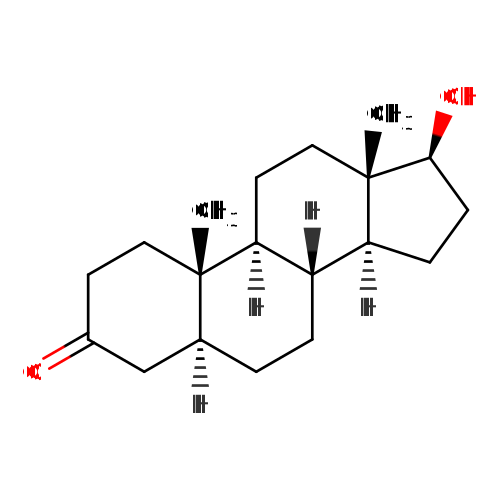
Chemical IUPAC Name (5S,8R,9S,10S,13S,14S,17S)-17-hydroxy-10,13-dimethyl-1,2,4,5,6,7,8,9,11,12,14,15,16,17-tetradecahydrocyclopenta[a]phenanthren-3-one
Chemical Formula C19H30O2
Chemical Structure Structure
Chemical Taxonomy
Kingdom
  • Organic
Super Class
  • Cholesterols and derivatives
Class
  • Steroids and Steroid Derivatives
Sub Class
  • Ketosteroids
Family
  • Mammalian Metabolite
Species
  • ketone
  • secondary alcohol
Biofunction
  • Hormones, Membrane component
Application
Source
  • Endogenous
Average Molecular Weight 290.440
Monoisotopic Molecular Weight 290.224579
Isomeric SMILES C[C@]12CC[C@H]3[C@@H](CC[C@H]4CC(=O)CC[C@]34C)[C@@H]1CC[C@@H]2O
Canonical SMILES CC12CCC3C(CCC4CC(=O)CCC34C)C1CCC2O
KEGG Compound ID C03917 Link Image
BioCyc ID 17-BETA-HYDROXY-5ALPHA-ANDROSTAN-3-O Link Image
BiGG ID 42776 Link Image
Wikipedia Link Dihydrotestosterone Link Image
NuGOwiki Link HMDB02961 Link Image
Metagene Link HMDB02961 Link Image
METLIN ID 2789 Link Image
PubChem Compound 10635 Link Image
PubChem Substance 6646 Link Image
ChEBI ID 16330 Link Image
CAS Registry Number 521-18-6
InChI Identifier InChI=1/C19H30O2/c1-18-9-7-13(20)11-12(18)3-4-14-15-5-6-17(21)19(15,2)10-8-16(14)18/h12,14-17,21H,3-11H2,1-2H3/t12-,14-,15-,16-,17-,18-,19-/m0/s1
Synthesis Reference Gardi, Rinaldo; Castelli, Pier Paolo; Gandolfi, Roberto; Ercoli, Alberto. Conversion of 5a-pregnane-3,2O-dione to dihydrotestosterone. (1961), 1250-7.
Melting Point (Experimental) 181 oC
Experimental Water Solubility 525 mg/mL at 25 oC [YALKOWSKY,SH & DANNENFELSER,RM (1992)] Source: PhysProp
Predicted Water Solubility 9.98e-03 mg/mL [Predicted by ALOGPS] Calculated using ALOGPS
Physiological Charge 0
State Solid
Experimental LogP/Hydrophobicity 3.55 [HANSCH,C ET AL. (1995)] Source: PhysProp
Predicted LogP/Hydrophobicity 3.37 [Predicted by ALOGPS]; 4.5 [Predicted by PubChem via XLOGP] Calculated using ALOGPS
Material Safety Data Sheet (MSDS)
MOL File Show
SDF File Show
PDB File Show
2D Structure
3D Structure
Experimental PDB ID Not Available
Experimental 1H NMR Spectrum Not Available
Experimental 13C NMR Spectrum Not Available
Experimental 13C HSQC Spectrum Not Available
Predicted 1H NMR Spectrum Show Image
Show Peaklist
Predicted 13C NMR Spectrum Show Image
Show Peaklist
Mass Spectrum Not Available
Simplified TOCSY Spectrum Not Available
BMRB Spectrum Not Available
Cellular Location
  • Membrane (Predicted from LogP)
  • Cytoplasm
  • endoplasmic reticulum
  • Extracellular
Biofluid Location
  • Blood
Tissue Location
Tissue References
Adipose Tissue
Adrenal Cortex
Adrenal Gland
Fibroblasts
Gonads
Hair
Muscle
Myelin
Neuron
Prostate
Skin
Testes
Thyroid Gland
Concentrations (Normal)
Biofluid Blood
Value 0.0054 +/- 0.0028 uM
Age Adult:>18 yrs old
Sex Both
Patient information Normal
Comments Not Available
References
  • Nieminen LR, Makino KK, Mehta N, Virkkunen M, Kim HY, Hibbeln JR: Relationship between omega-3 fatty acids and plasma neuroactive steroids in alcoholism, depression and controls. Prostaglandins Leukot Essent Fatty Acids. 2006 Oct-Nov;75(4-5):309-14. Epub 2006 Sep 7. [PubMed Link Image]
Biofluid Blood
Value 0.00041 +/- 0.00016 uM
Age Adult:>18 yrs old
Sex Male
Patient information Normal
Comments Not Available
References
  • Kim YS, Zhang H, Kim HY: Profiling neurosteroids in cerebrospinal fluids and plasma by gas chromatography/electron capture negative chemical ionization mass spectrometry. Anal Biochem. 2000 Jan 15;277(2):187-95. [PubMed Link Image]
Concentrations (Abnormal)
Biofluid Blood
Value 0.0054 +/- 0.0029 uM
Age Adult:>18 yrs old
Sex Both
Condition Major depressive disorder Alcoholism
Comments Not Available
References
  • Nieminen LR, Makino KK, Mehta N, Virkkunen M, Kim HY, Hibbeln JR: Relationship between omega-3 fatty acids and plasma neuroactive steroids in alcoholism, depression and controls. Prostaglandins Leukot Essent Fatty Acids. 2006 Oct-Nov;75(4-5):309-14. Epub 2006 Sep 7. [PubMed Link Image]
Associated Disorders
Condition References
Alcoholism
  • Nieminen LR, Makino KK, Mehta N, Virkkunen M, Kim HY, Hibbeln JR: Relationship between omega-3 fatty acids and plasma neuroactive steroids in alcoholism, depression and controls. Prostaglandins Leukot Essent Fatty Acids. 2006 Oct-Nov;75(4-5):309-14. Epub 2006 Sep 7. [PubMed Link Image]
Major depressive disorder
  • Nieminen LR, Makino KK, Mehta N, Virkkunen M, Kim HY, Hibbeln JR: Relationship between omega-3 fatty acids and plasma neuroactive steroids in alcoholism, depression and controls. Prostaglandins Leukot Essent Fatty Acids. 2006 Oct-Nov;75(4-5):309-14. Epub 2006 Sep 7. [PubMed Link Image]
OMIM ID
Pathways
Name SMPDB Link KEGG Link
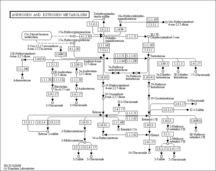
Androgen and Estrogen Metabolism SMP00068 Link Image map00150 Link Image
General References
  1. Choi MH, Kim JN, Chung BC: Rapid HPLC-electrospray tandem mass spectrometric assay for urinary testosterone and dihydrotestosterone glucuronides from patients with benign prostate hyperplasia. Clin Chem. 2003 Feb;49(2):322-5. [PubMed Link Image]
  2. Tincello DG, Saunders PT, Hodgins MB, Simpson NB, Edwards CR, Hargreaves TB, Wu FC: Correlation of clinical, endocrine and molecular abnormalities with in vivo responses to high-dose testosterone in patients with partial androgen insensitivity syndrome. Clin Endocrinol (Oxf). 1997 Apr;46(4):497-506. [PubMed Link Image]
  3. Farthing MJ, Rees LH, Edwards CR, Dawson AM: Male gonadal function in coeliac disease: 2. Sex hormones. Gut. 1983 Feb;24(2):127-35. [PubMed Link Image]
  4. Aganovic I, Alac M, Cabrijan T, Grizelj V, Korsic M, Misjak-Vitez M, Reiner Z, Suchanek E, Simunic V, Zjacic-Rotkvic V: [National consensus on hyperandrogenemia] Lijec Vjesn. 1996 Sep;118(9):189-90. [PubMed Link Image]
  5. Clark RV, Hermann DJ, Cunningham GR, Wilson TH, Morrill BB, Hobbs S: Marked suppression of dihydrotestosterone in men with benign prostatic hyperplasia by dutasteride, a dual 5alpha-reductase inhibitor. J Clin Endocrinol Metab. 2004 May;89(5):2179-84. [PubMed Link Image]
  6. Sato T, Sonoda T, Itami S, Takayasu S: Predominance of type I 5alpha-reductase in apocrine sweat glands of patients with excessive or abnormal odour derived from apocrine sweat (osmidrosis). Br J Dermatol. 1998 Nov;139(5):806-10. [PubMed Link Image]
  7. Christiansen K, Knussmann R: Androgen levels and components of aggressive behavior in men. Horm Behav. 1987 Jun;21(2):170-80. [PubMed Link Image]
  8. Hammond GL, Leinonen P, Bolton NJ, Vihko R: Measurement of sex hormone binding globulin in human amniotic fluid: its relationship to protein and testosterone concentrations, and fetal sex. Clin Endocrinol (Oxf). 1983 Apr;18(4):377-84. [PubMed Link Image]
  9. Gratterola R: Anovulation and increased androgenic activity as breast cancer risk in women with fibrocystic disease of the breast. Cancer Res. 1978 Sep;38(9):3051-4. [PubMed Link Image]
  10. Boccon-Gibod L, Laudat MH, Guiban D, Steg A: Hormonal consequences of orchidectomy for carcinoma of the prostate. With special reference to the measurement of free testosterone in saliva and prostatic dihydrotestosterone levels. Eur Urol. 1988;15(1-2):99-102. [PubMed Link Image]
  11. Misao R, Itoh N, Mori H, Fujimoto J, Tamaya T: Sex hormone-binding globulin mRNA levels in human uterine endometrium. Eur J Endocrinol. 1994 Dec;131(6):623-9. [PubMed Link Image]
  12. Toscano V, Horton R: Circulating dihydrotestosterone may not reflect peripheral formation. J Clin Invest. 1987 Jun;79(6):1653-8. [PubMed Link Image]
  13. Pineiro V, Casabiell X, Peino R, Lage M, Camina JP, Menendez C, Baltar J, Dieguez C, Casanueva F: Dihydrotestosterone, stanozolol, androstenedione and dehydroepiandrosterone sulphate inhibit leptin secretion in female but not in male samples of omental adipose tissue in vitro: lack of effect of testosterone. J Endocrinol. 1999 Mar;160(3):425-32. [PubMed Link Image]
  14. Dawood MY, Saxena BB: Testosterone and dihydrotestosterone in maternal and cord blood and in amniotic fluid. Am J Obstet Gynecol. 1977 Sep 1;129(1):37-42. [PubMed Link Image]
  15. Geller J, Candari CD: Comparison of dihydrotestosterone levels in prostatic cancer metastases and primary prostate cancer. Prostate. 1989;15(2):171-5. [PubMed Link Image]
  16. Cutolo M, Seriolo B, Villaggio B, Pizzorni C, Craviotto C, Sulli A: Androgens and estrogens modulate the immune and inflammatory responses in rheumatoid arthritis. Ann N Y Acad Sci. 2002 Jun;966:131-42. [PubMed Link Image]
  17. Wikipedia Link Image
Metabolic Enzymes
  1. 3-oxo-5-alpha-steroid 4-dehydrogenase 2
  2. 3-oxo-5-alpha-steroid 4-dehydrogenase 1
  3. Androgen receptor
  4. Putative uncharacterized protein
Enzyme 1 [top]
Enzyme 1 ID 5971
Enzyme 1 Name 3-oxo-5-alpha-steroid 4-dehydrogenase 2
Enzyme 1 Synonyms
  1. Steroid 5- alpha-reductase 2
  2. SR type 2
  3. 5 alpha-SR2
  4. Type II 5-alpha reductase
Enzyme 1 Gene Name SRD5A2
Enzyme 1 Protein Sequence >3-oxo-5-alpha-steroid 4-dehydrogenase 2
MQVQCQQSPVLAGSATLVALGALALYVAKPSGYGKHTESLKPAATRLPARAAWFLQELPS
FAVPAGILARQPLSLFGPPGTVLLGLFCVHYFHRTFVYSLLNRGRPYPAILILRGTAFCT
GNGVLQGYYLIYCAEYPDGWYTDIRFSLGVFLFILGMGINIHSDYILRQLRKPGEISYRI
PQGGLFTYVSGANFLGEIIEWIGYALATWSLPALAFAFFSLCFLGLRAFHHHRFYLKMFE
DYPKSRKALIPFIF
Enzyme 1 Number of Residues 254
Enzyme 1 Molecular Weight 28394
Enzyme 1 Theoretical pI 9.62
Enzyme 1 GO Classification
Function
Process
Component
  • cell
  • integral to membrane
  • intrinsic to membrane
  • membrane
Enzyme 1 General Function Not Available
Enzyme 1 Specific Function Converts testosterone (T) into 5-alpha- dihydrotestosterone (DHT) and progesterone or corticosterone into their corresponding 5-alpha-3-oxosteroids. It plays a central role in sexual differentiation and androgen physiology
Enzyme 1 Pathways
Enzyme 1 Reactions
  • a 3-oxo-5alpha-steroid + acceptor = a 3-oxo-delta4-steroid + reduced acceptor
Enzyme 1 Pfam Domain Function
Enzyme 1 Signals
  • 1-34
Enzyme 1 Transmembrane Regions Not Available
Enzyme 1 Essentiality Not Available
Enzyme 1 GenBank ID Protein 338469 Link Image
Enzyme 1 UniProtKB/Swiss-Prot ID P31213 Link Image
Enzyme 1 UniProtKB/Swiss-Prot Entry Name S5A2_HUMAN Link Image
Enzyme 1 PDB ID Not Available
Enzyme 1 Cellular Location Not Available
Enzyme 1 Gene Sequence >765 bp
ATGCAGGTTCAGTGCCAGCAGAGCCCAGTGCTGGCAGGCAGCGCCACTTTGGTCGCCCTT
GGGGCACTGGCCTTGTACGTCGCGAAGCCCTCCGGCTACGGGAAGCACACGGAGAGCCTG
AAGCCGGCGGCTACCCGCCTGCCAGCCCGCGCCGCCTGGTTCCTGCAGGAGCTGCCTTCC
TTCGCGGTGCCCGCGGGGATCCTCGCCCGGCAGCCCCTCTCCCTCTTCGGGCCACCTGGG
ACGGTACTTCTGGGCCTCTTCTGCGTACATTACTTCCACAGGACATTTGTGTACTCACTG
CTCAATCGAGGGAGGCCTTATCCAGCTATACTCATTCTCAGAGGCACTGCCTTCTGCACT
GGAAATGGAGTCCTTCAAGGCTACTATCTGATTTACTGTGCTGAATACCCTGATGGGTGG
TACACAGACATACGGTTTAGCTTGGGTGTCTTCTTATTTATTTTGGGAATGGGAATAAAC
ATTCATAGTGACTATATATTGCGCCAGCTCAGGAAGCCTGGAGAAATCAGCTACAGGATT
CCACAAGGTGGCTTGTTTACGTATGTTTCTGGAGCCAATTTCCTCGGTGAGATCATTGAA
TGGATCGGCTATGCCCTGGCCACTTGGTCCCTCCCAGCACTTGCATTTGCATTTTTCTCA
CTTTGTTTCCTTGGGCTGCGAGCTTTTCACCACCATAGGTTCTACCTCAAGATGTTTGAG
GACTACCCCAAATCTCGGAAAGCCCTTATTCCATTCATCTTTTAA
Enzyme 1 GenBank Gene ID M74047 Link Image
Enzyme 1 GeneCard ID SRD5A2 Link Image
Enzyme 1 GenAtlas ID SRD5A2 Link Image
Enzyme 1 HGNC ID HGNC:11285 Link Image
Enzyme 1 Chromosome Location 2
Enzyme 1 Locus 2p23
Enzyme 1 SNPs SNPJam Report Link Image
Enzyme 1 General References
  1. Andersson S, Berman DM, Jenkins EP, Russell DW: Deletion of steroid 5 alpha-reductase 2 gene in male pseudohermaphroditism. Nature. 1991 Nov 14;354(6349):159-61. [PubMed Link Image]
  2. Labrie F, Sugimoto Y, Luu-The V, Simard J, Lachance Y, Bachvarov D, Leblanc G, Durocher F, Paquet N: Structure of human type II 5 alpha-reductase gene. Endocrinology. 1992 Sep;131(3):1571-3. [PubMed Link Image]
  3. Thigpen AE, Davis DL, Milatovich A, Mendonca BB, Imperato-McGinley J, Griffin JE, Francke U, Wilson JD, Russell DW: Molecular genetics of steroid 5 alpha-reductase 2 deficiency. J Clin Invest. 1992 Sep;90(3):799-809. [PubMed Link Image]
  4. Boudon C, Lobaccaro JM, Lumbroso S, Ogur G, Ocal G, Belon C, Sultan C: A new deletion of the 5 alpha-reductase type 2 gene in a Turkish family with 5 alpha-reductase deficiency. Clin Endocrinol (Oxf). 1995 Aug;43(2):183-8. [PubMed Link Image]
  5. Cai LQ, Zhu YS, Katz MD, Herrera C, Baez J, DeFillo-Ricart M, Shackleton CH, Imperato-McGinley J: 5 alpha-reductase-2 gene mutations in the Dominican Republic. J Clin Endocrinol Metab. 1996 May;81(5):1730-5. [PubMed Link Image]
  6. Hochberg Z, Chayen R, Reiss N, Falik Z, Makler A, Munichor M, Farkas A, Goldfarb H, Ohana N, Hiort O: Clinical, biochemical, and genetic findings in a large pedigree of male and female patients with 5 alpha-reductase 2 deficiency. J Clin Endocrinol Metab. 1996 Aug;81(8):2821-7. [PubMed Link Image]
  7. Anwar R, Gilbey SG, New JP, Markham AF: Male pseudohermaphroditism resulting from a novel mutation in the human steroid 5 alpha-reductase type 2 gene (SRD5A2). Mol Pathol. 1997 Feb;50(1):51-2. [PubMed Link Image]
  8. Nordenskjold A, Magnus O, Aagenaes O, Knudtzon J: Homozygous mutation (A228T) in the 5alpha-reductase type 2 gene in a boy with 5alpha-reductase deficiency: genotype-phenotype correlations. Am J Med Genet. 1998 Nov 16;80(3):269-72. [PubMed Link Image]
  9. Nordenskjold A, Ivarsson SA: Molecular characterization of 5 alpha-reductase type 2 deficiency and fertility in a Swedish family. J Clin Endocrinol Metab. 1998 Sep;83(9):3236-8. [PubMed Link Image]
  10. Makridakis NM, Ross RK, Pike MC, Crocitto LE, Kolonel LN, Pearce CL, Henderson BE, Reichardt JK: Association of mis-sense substitution in SRD5A2 gene with prostate cancer in African-American and Hispanic men in Los Angeles, USA. Lancet. 1999 Sep 18;354(9183):975-8. [PubMed Link Image]
  11. Vilchis F, Mendez JP, Canto P, Lieberman E, Chavez B: Identification of missense mutations in the SRD5A2 gene from patients with steroid 5alpha-reductase 2 deficiency. Clin Endocrinol (Oxf). 2000 Mar;52(3):383-7. [PubMed Link Image]
  12. Chavez B, Valdez E, Vilchis F: Uniparental disomy in steroid 5alpha-reductase 2 deficiency. J Clin Endocrinol Metab. 2000 Sep;85(9):3147-50. [PubMed Link Image]
  13. Pearce CL, Makridakis NM, Ross RK, Pike MC, Kolonel LN, Henderson BE, Reichardt JK: Steroid 5-alpha reductase type II V89L substitution is not associated with risk of prostate cancer in a multiethnic population study. Cancer Epidemiol Biomarkers Prev. 2002 Apr;11(4):417-8. [PubMed Link Image]
Enzyme 1 Metabolite References Not Available
Enzyme 2 [top]
Enzyme 2 ID 5972
Enzyme 2 Name 3-oxo-5-alpha-steroid 4-dehydrogenase 1
Enzyme 2 Synonyms
  1. Steroid 5- alpha-reductase 1
  2. SR type 1
  3. S5AR
Enzyme 2 Gene Name SRD5A1
Enzyme 2 Protein Sequence >3-oxo-5-alpha-steroid 4-dehydrogenase 1
MATATGVAEERLLAALAYLQCAVGCAVFARNRQTNSVYGRHALPSHRLRVPARAAWVVQE
LPSLALPLYQYASESAPRLRSAPNCILLAMFLVHYGHRCLIYPFLMRGGKPMPLLACTMA
IMFCTCNGYLQSRYLSHCAVYADDWVTDPRFLIGFGLWLTGMLINIHSDHILRNLRKPGD
TGYKIPRGGLFEYVTAANYFGEIMEWCGYALASWSVQGAAFAFFTFCFLSGRAKEHHEWY
LRKFEEYPKFRKIIIPFLF
Enzyme 2 Number of Residues 259
Enzyme 2 Molecular Weight 29459
Enzyme 2 Theoretical pI 9.07
Enzyme 2 GO Classification
Function
Process
Component
  • cell
  • integral to membrane
  • intrinsic to membrane
  • membrane
Enzyme 2 General Function Not Available
Enzyme 2 Specific Function Converts testosterone into 5-alpha-dihydrotestosterone and progesterone or corticosterone into their corresponding 5- alpha-3-oxosteroids. It plays a central role in sexual differentiation and androgen physiology
Enzyme 2 Pathways
Enzyme 2 Reactions
  • a 3-oxo-5alpha-steroid + acceptor = a 3-oxo-delta4-steroid + reduced acceptor
Enzyme 2 Pfam Domain Function
Enzyme 2 Signals
  • 1-24
Enzyme 2 Transmembrane Regions
  • 111-131 151-171 209-229
Enzyme 2 Essentiality Not Available
Enzyme 2 GenBank ID Protein 177767 Link Image
Enzyme 2 UniProtKB/Swiss-Prot ID P18405 Link Image
Enzyme 2 UniProtKB/Swiss-Prot Entry Name S5A1_HUMAN Link Image
Enzyme 2 PDB ID Not Available
Enzyme 2 Cellular Location Not Available
Enzyme 2 Gene Sequence >780 bp
ATGGCAACGGCGACGGGGGTGGCGGAGGAGCGCCTGCTGGCCGCGCTCGCCTACCTGCAG
TGCGCCGTGGGCTGCGCGGTCTTCGCGCGGAATCGTCAGACGAACTCAGTGTACGGCCGC
CACGCGCTGCCCAGCCACAGGCTCCGAGTGCCGGCGCGGGCCGCCTGGGTGGTGCAGGAG
CTGCCCTCGCTGGCCCTGCCGCTCTACCAGTACGCCAGCGAGTCCGCCCCGCGTCTCCGC
AGCGCGCCCAACTGCATCCTCCTGGCCATGTTCCTCGTCCACTACGGGCATCGGTGCTTA
ATTTACCCGTTTCTGATGCGAGGAGGAAAGCCTATGCCACTGTTGGCATGTACAATGGCG
ATTATGTTCTGTACCTGTAACGGCTATTTGCAAAGCAGATACTTGAGCCATTGTGCAGTG
TATGCTGATGACTGGGTAACAGATCCCCGTTTTCTAATAGGTTTTGGCTTGTGGTTAACA
GGCATGTTGATAAACATCCATTCAGATCATATCCTAAGGAATCTCAGAAAACCAGGAGAT
ACTGGATACAAAATACCAAGGGGAGGCTTATTTGAATACGTAACTGCAGCCAACTATTTT
GGAGAAATCATGGAGTGGTGTGGCTATGCCCTGGCCAGCTGGTCTGTCCAAGGCGCGGCT
TTTGCTTTCTTCACGTTTTGTTTTTTATCTGGTAGAGCAAAAGAGCATCATGAGTGGTAC
CTCCGGAAATTTGAAGAGTATCCAAAGTTCAGAAAAATTATAATTCCATTTTTGTTTTAA
Enzyme 2 GenBank Gene ID M32313 Link Image
Enzyme 2 GeneCard ID SRD5A1 Link Image
Enzyme 2 GenAtlas ID SRD5A1 Link Image
Enzyme 2 HGNC ID HGNC:11284 Link Image
Enzyme 2 Chromosome Location 5
Enzyme 2 Locus 5p15
Enzyme 2 SNPs SNPJam Report Link Image
Enzyme 2 General References
  1. Andersson S, Russell DW: Structural and biochemical properties of cloned and expressed human and rat steroid 5 alpha-reductases. Proc Natl Acad Sci U S A. 1990 May;87(10):3640-4. [PubMed Link Image]
  2. Jenkins EP, Hsieh CL, Milatovich A, Normington K, Berman DM, Francke U, Russell DW: Characterization and chromosomal mapping of a human steroid 5 alpha-reductase gene and pseudogene and mapping of the mouse homologue. Genomics. 1991 Dec;11(4):1102-12. [PubMed Link Image]
  3. Hu RM, Han ZG, Song HD, Peng YD, Huang QH, Ren SX, Gu YJ, Huang CH, Li YB, Jiang CL, Fu G, Zhang QH, Gu BW, Dai M, Mao YF, Gao GF, Rong R, Ye M, Zhou J, Xu SH, Gu J, Shi JX, Jin WR, Zhang CK, Wu TM, Huang GY, Chen Z, Chen MD, Chen JL: Gene expression profiling in the human hypothalamus-pituitary-adrenal axis and full-length cDNA cloning. Proc Natl Acad Sci U S A. 2000 Aug 15;97(17):9543-8. [PubMed Link Image]
  4. Eminovic I, Liovic M, Prezelj J, Kocijancic A, Rozman D, Komel R: New steroid 5alpha-reductase type I (SRD5A1) homologous sequences on human chromosomes 6 and 8. Pflugers Arch. 2001;442(6 Suppl 1):R187-9. [PubMed Link Image]
Enzyme 2 Metabolite References Not Available
Enzyme 3 [top]
Enzyme 3 ID 6947
Enzyme 3 Name Androgen receptor
Enzyme 3 Synonyms
  1. Dihydrotestosterone receptor
Enzyme 3 Gene Name AR
Enzyme 3 Protein Sequence >Androgen receptor
MEVQLGLGRVYPRPPSKTYRGAFQNLFQSVREVIQNPGPRHPEAASAAPPGASLLLLQQQ
QQQQQQQQQQQQQQQQQQETSPRQQQQQQGEDGSPQAHRRGPTGYLVLDEEQQPSQPQSA
LECHPERGCVPEPGAAVAASKGLPQQLPAPPDEDDSAAPSTLSLLGPTFPGLSSCSADLK
DILSEASTMQLLQQQQQEAVSEGSSSGRAREASGAPTSSKDNYLGGTSTISDNAKELCKA
VSVSMGLGVEALEHLSPGEQLRGDCMYAPLLGVPPAVRPTPCAPLAECKGSLLDDSAGKS
TEDTAEYSPFKGGYTKGLEGESLGCSGSAAAGSSGTLELPSTLSLYKSGALDEAAAYQSR
DYYNFPLALAGPPPPPPPPHPHARIKLENPLDYGSAWAAAAAQCRYGDLASLHGAGAAGP
GSGSPSAAASSSWHTLFTAEEGQLYGPCGGGGGGGGGGGGGGGGGGGGGGGGEAGAVAPY
GYTRPPQGLAGQESDFTAPDVWYPGGMVSRVPYPSPTCVKSEMGPWMDSYSGPYGDMRLE
TARDHVLPIDYYFPPQKTCLICGDEASGCHYGALTCGSCKVFFKRAAEGKQKYLCASRND
CTIDKFRRKNCPSCRLRKCYEAGMTLGARKLKKLGNLKLQEEGEASSTTSPTEETTQKLT
VSHIEGYECQPIFLNVLEAIEPGVVCAGHDNNQPDSFAALLSSLNELGERQLVHVVKWAK
ALPGFRNLHVDDQMAVIQYSWMGLMVFAMGWRSFTNVNSRMLYFAPDLVFNEYRMHKSRM
YSQCVRMRHLSQEFGWLQITPQEFLCMKALLLFSIIPVDGLKNQKFFDELRMNYIKELDR
IIACKRKNPTSCSRRFYQLTKLLDSVQPIARELHQFTFDLLIKSHMVSVDFPEMMAEIIS
VQVPKILSGKVKPIYFHTQ
Enzyme 3 Number of Residues 919
Enzyme 3 Molecular Weight 98990
Enzyme 3 Theoretical pI 6.38
Enzyme 3 GO Classification
Function
  • DNA binding
  • androgen receptor activity
  • binding
  • ligand-dependent nuclear receptor activity
  • nucleic acid binding
  • receptor activity
  • signal transducer activity
  • steroid binding
  • steroid hormone receptor activity
  • transcription factor activity
Process
  • regulation of biological process
  • regulation of cellular metabolism
  • regulation of metabolism
  • regulation of nucleobase, nucleoside, nucleotide and nucleic acid metabolism
  • regulation of physiological process
  • regulation of transcription
  • regulation of transcription, DNA-dependent
Component
  • intracellular membrane-bound organelle
  • membrane-bound organelle
  • nucleus
  • organelle
Enzyme 3 General Function Not Available
Enzyme 3 Specific Function The steroid hormones and their receptors are involved in the regulation of eukaryotic gene expression and affect cellular proliferation and differentiation in target tissues. Activated, but not phosphorylated, by HIPK3
Enzyme 3 Pathways Not Available
Enzyme 3 Reactions Not Available
Enzyme 3 Pfam Domain Function
Enzyme 3 Signals
  • None
Enzyme 3 Transmembrane Regions
  • None
Enzyme 3 Essentiality Not Available
Enzyme 3 GenBank ID Protein 178628 Link Image
Enzyme 3 UniProtKB/Swiss-Prot ID P10275 Link Image
Enzyme 3 UniProtKB/Swiss-Prot Entry Name ANDR_HUMAN Link Image
Enzyme 3 PDB ID Not Available
Enzyme 3 Cellular Location Not Available
Enzyme 3 Gene Sequence >2760 bp
ATGGAAGTGCAGTTAGGGCTGGGAAGGGTCTACCCTCGGCCGCCGTCCAAGACCTACCGA
GGAGCTTTCCAGAATCTGTTCCAGAGCGTGCGCGAAGTGATCCAGAACCCGGGCCCCAGG
CACCCAGAGGCCGCGAGCGCAGCACCTCCCGGCGCCAGTTTGCTGCTGCTGCAGCAGCAG
CAGCAGCAGCAGCAGCAGCAGCAGCAGCAGCAGCAGCAGCAGCAGCAGCAGCAAGAGACT
AGCCCCAGGCAGCAGCAGCAGCAGCAGGGTGAGGATGGTTCTCCCCAAGCCCATCGTAGA
GGCCCCACAGGCTACCTGGTCCTGGATGAGGAACAGCAACCTTCACAGCCGCAGTCGGCC
CTGGAGTGCCACCCCGAGAGAGGTTGCGTCCCAGAGCCTGGAGCCGCCGTGGCCGCCAGC
AAGGGGCTGCCGCAGCAGCTGCCAGCACCTCCGGACGAGGATGACTCAGCTGCCCCATCC
ACGTTGTCCCTGCTGGGCCCCACTTTCCCCGGCTTAAGCAGCTGCTCCGCTGACCTTAAA
GACATCCTGAGCGAGGCCAGCACCATGCAACTCCTTCAGCAACAGCAGCAGGAAGCAGTA
TCCGAAGGCAGCAGCAGCGGGAGAGCGAGGGAGGCCTCGGGGGCTCCCACTTCCTCCAAG
GACAATTACTTAGGGGGCACTTCGACCATTTCTGACAACGCCAAGGAGTTGTGTAAGGCA
GTGTCGGTGTCCATGGGCCTGGGTGTGGAGGCGTTGGAGCATCTGAGTCCAGGGGAACAG
CTTCGGGGGGATTGCATGTACGCCCCACTTTTGGGAGTTCCACCCGCTGTGCGTCCCACT
CCTTGTGCCCCATTGGCCGAATGCAAAGGTTCTCTGCTAGACGACAGCGCAGGCAAGAGC
ACTGAAGATACTGCTGAGTATTCCCCTTTCAAGGGAGGTTACACCAAAGGGCTAGAAGGC
GAGAGCCTAGGCTGCTCTGGCAGCGCTGCAGCAGGGAGCTCCGGGACACTTGAACTGCCG
TCTACCCTGTCTCTCTACAAGTCCGGAGCACTGGACGAGGCAGCTGCGTACCAGAGTCGC
GACTACTACAACTTTCCACTGGCTCTGGCCGGACCGCCGCCCCCTCCGCCGCCTCCCCAT
CCCCACGCTCGCATCAAGCTGGAGAACCCGCTGGACTACGGCAGCGCCTGGGCGGCTGCG
GCGGCGCAGTGCCGCTATGGGGACCTGGCGAGCCTGCATGGCGCGGGTGCAGCGGGACCC
GGTTCTGGGTCACCCTCAGCCGCCGCTTCCTCATCCTGGCACACTCTCTTCACAGCCGAA
GAAGGCCAGTTGTATGGACCGTGTGGTGGTGGTGGGGGTGGTGGCGGCGGCGGCGGCGGC
GGCGGCGGCGGCGGCGGCGGCGGCGGCGGCGGCGGCGAGGCGGGAGCTGTAGCCCCCTAC
GGCTACACTCGGCCCCCTCAGGGGCTGGCGGGCCAGGAAAGCGACTTCACCGCACCTGAT
GTGTGGTACCCTGGCGGCATGGTGAGCAGAGTGCCCTATCCCAGTCCCACTTGTGTCAAA
AGCGAAATGGGCCCCTGGATGGATAGCTACTCCGGACCTTACGGGGACATGCGTTTGGAG
ACTGCCAGGGACCATGTTTTGCCCATTGACTATTACTTTCCACCCCAGAAGACCTGCCTG
ATCTGTGGAGATGAAGCTTCTGGGTGTCACTATGGAGCTCTCACATGTGGAAGCTGCAAG
GTCTTCTTCAAAAGAGCCGCTGAAGGGAAACAGAAGTACCTGTGCGCCAGCAGAAATGAT
TGCACTATTGATAAATTCCGAAGGAAAAATTGTCCATCTTGTCGTCTTCGGAAATGTTAT
GAAGCAGGGATGACTCTGGGAGCCCGGAAGCTGAAGAAACTTGGTAATCTGAAACTACAG
GAGGAAGGAGAGGCTTCCAGCACCACCAGCCCCACTGAGGAGACAACCCAGAAGCTGACA
GTGTCACACATTGAAGGCTATGAATGTCAGCCCATCTTTCTGAATGTCCTGGAAGCCATT
GAGCCAGGTGTAGTGTGTGCTGGACACGACAACAACCAGCCCGACTCCTTTGCAGCCTTG
CTCTCTAGCCTCAATGAACTGGGAGAGAGACAGCTTGTACACGTGGTCAAGTGGGCCAAG
GCCTTGCCTGGCTTCCGCAACTTACACGTGGACGACCAGATGGCTGTCATTCAGTACTCC
TGGATGGGGCTCATGGTGTTTGCCATGGGCTGGCGATCCTTCACCAATGTCAACTCCAGG
ATGCTCTACTTCGCCCCTGATCTGGTTTTCAATGAGTACCGCATGCACAAGTCCCGGATG
TACAGCCAGTGTGTCCGAATGAGGCACCTCTCTCAAGAGTTTGGATGGCTCCAAATCACC
CCCCAGGAATTCCTGTGCATGAAAGCACTGCTACTCTTCAGCATTATTCCAGTGGATGGG
CTGAAAAATCAAAAATTCTTTGATGAACTTCGAATGAACTACATCAAGGAACTCGATCGT
ATCATTGCATGCAAAAGAAAAAATCCCACATCCTGCTCAAGACGCTTCTACCAGCTCACC
AAGCTCCTGGACTCCGTGCAGCCTATTGCGAGAGAGCTGCATCAGTTCACTTTTGACCTG
CTAATCAAGTCACACATGGTGAGCGTGGACTTTCCGGAAATGATGGCAGAGATCATCTCT
GTGCAAGTGCCCAAGATCCTTTCTGGGAAAGTCAAGCCCATCTATTTCCACACCCAGTGA
Enzyme 3 GenBank Gene ID M20132 Link Image
Enzyme 3 GeneCard ID AR Link Image
Enzyme 3 GenAtlas ID AR Link Image
Enzyme 3 HGNC ID HGNC:644 Link Image
Enzyme 3 Chromosome Location X
Enzyme 3 Locus Xq11.2-q12
Enzyme 3 SNPs SNPJam Report Link Image
Enzyme 3 General References
  1. Lubahn DB, Joseph DR, Sar M, Tan J, Higgs HN, Larson RE, French FS, Wilson EM: The human androgen receptor: complementary deoxyribonucleic acid cloning, sequence analysis and gene expression in prostate. Mol Endocrinol. 1988 Dec;2(12):1265-75. [PubMed Link Image]
  2. Lubahn DB, Brown TR, Simental JA, Higgs HN, Migeon CJ, Wilson EM, French FS: Sequence of the intron/exon junctions of the coding region of the human androgen receptor gene and identification of a point mutation in a family with complete androgen insensitivity. Proc Natl Acad Sci U S A. 1989 Dec;86(23):9534-8. [PubMed Link Image]
  3. Govindan MV: Specific region in hormone binding domain is essential for hormone binding and trans-activation by human androgen receptor. Mol Endocrinol. 1990 Mar;4(3):417-27. [PubMed Link Image]
  4. Chang CS, Kokontis J, Liao ST: Structural analysis of complementary DNA and amino acid sequences of human and rat androgen receptors. Proc Natl Acad Sci U S A. 1988 Oct;85(19):7211-5. [PubMed Link Image]
  5. Rao MA, Cheng H, Quayle AN, Nishitani H, Nelson CC, Rennie PS: RanBPM, a nuclear protein that interacts with and regulates transcriptional activity of androgen receptor and glucocorticoid receptor. J Biol Chem. 2002 Dec 13;277(50):48020-7. Epub 2002 Oct 1. [PubMed Link Image]
  6. Tilley WD, Marcelli M, Wilson JD, McPhaul MJ: Characterization and expression of a cDNA encoding the human androgen receptor. Proc Natl Acad Sci U S A. 1989 Jan;86(1):327-31. [PubMed Link Image]
  7. Marcelli M, Tilley WD, Wilson CM, Griffin JE, Wilson JD, McPhaul MJ: Definition of the human androgen receptor gene structure permits the identification of mutations that cause androgen resistance: premature termination of the receptor protein at amino acid residue 588 causes complete androgen resistance. Mol Endocrinol. 1990 Aug;4(8):1105-16. [PubMed Link Image]
  8. Faber PW, Kuiper GG, van Rooij HC, van der Korput JA, Brinkmann AO, Trapman J: The N-terminal domain of the human androgen receptor is encoded by one, large exon. Mol Cell Endocrinol. 1989 Feb;61(2):257-62. [PubMed Link Image]
  9. Chang CS, Kokontis J, Liao ST: Molecular cloning of human and rat complementary DNA encoding androgen receptors. Science. 1988 Apr 15;240(4850):324-6. [PubMed Link Image]
  10. Trapman J, Klaassen P, Kuiper GG, van der Korput JA, Faber PW, van Rooij HC, Geurts van Kessel A, Voorhorst MM, Mulder E, Brinkmann AO: Cloning, structure and expression of a cDNA encoding the human androgen receptor. Biochem Biophys Res Commun. 1988 May 31;153(1):241-8. [PubMed Link Image]
  11. Kuiper GG, Faber PW, van Rooij HC, van der Korput JA, Ris-Stalpers C, Klaassen P, Trapman J, Brinkmann AO: Structural organization of the human androgen receptor gene. J Mol Endocrinol. 1989 May;2(3):R1-4. [PubMed Link Image]
  12. Lubahn DB, Joseph DR, Sullivan PM, Willard HF, French FS, Wilson EM: Cloning of human androgen receptor complementary DNA and localization to the X chromosome. Science. 1988 Apr 15;240(4850):327-30. [PubMed Link Image]
  13. Ris-Stalpers C, Trifiro MA, Kuiper GG, Jenster G, Romalo G, Sai T, van Rooij HC, Kaufman M, Rosenfield RL, Liao S, et al.: Substitution of aspartic acid-686 by histidine or asparagine in the human androgen receptor leads to a functionally inactive protein with altered hormone-binding characteristics. Mol Endocrinol. 1991 Oct;5(10):1562-9. [PubMed Link Image]
  14. Sleddens HF, Oostra BA, Brinkmann AO, Trapman J: Trinucleotide repeat polymorphism in the androgen receptor gene (AR). Nucleic Acids Res. 1992 Mar 25;20(6):1427. [PubMed Link Image]
  15. Giovannucci E, Stampfer MJ, Krithivas K, Brown M, Dahl D, Brufsky A, Talcott J, Hennekens CH, Kantoff PW: The CAG repeat within the androgen receptor gene and its relationship to prostate cancer. Proc Natl Acad Sci U S A. 1997 Apr 1;94(7):3320-3. [PubMed Link Image]
  16. Waragai M, Lammers CH, Takeuchi S, Imafuku I, Udagawa Y, Kanazawa I, Kawabata M, Mouradian MM, Okazawa H: PQBP-1, a novel polyglutamine tract-binding protein, inhibits transcription activation by Brn-2 and affects cell survival. Hum Mol Genet. 1999 Jun;8(6):977-87. [PubMed Link Image]
  17. Hsiao PW, Lin DL, Nakao R, Chang C: The linkage of Kennedy's neuron disease to ARA24, the first identified androgen receptor polyglutamine region-associated coactivator. J Biol Chem. 1999 Jul 16;274(29):20229-34. [PubMed Link Image]
  18. Oettgen P, Finger E, Sun Z, Akbarali Y, Thamrongsak U, Boltax J, Grall F, Dube A, Weiss A, Brown L, Quinn G, Kas K, Endress G, Kunsch C, Libermann TA: PDEF, a novel prostate epithelium-specific ets transcription factor, interacts with the androgen receptor and activates prostate-specific antigen gene expression. J Biol Chem. 2000 Jan 14;275(2):1216-25. [PubMed Link Image]
  19. Sharma M, Zarnegar M, Li X, Lim B, Sun Z: Androgen receptor interacts with a novel MYST protein, HBO1. J Biol Chem. 2000 Nov 10;275(45):35200-8. [PubMed Link Image]
  20. Wong CW, McNally C, Nickbarg E, Komm BS, Cheskis BJ: Estrogen receptor-interacting protein that modulates its nongenomic activity-crosstalk with Src/Erk phosphorylation cascade. Proc Natl Acad Sci U S A. 2002 Nov 12;99(23):14783-8. Epub 2002 Nov 1. [PubMed Link Image]
  21. Niki T, Takahashi-Niki K, Taira T, Iguchi-Ariga SM, Ariga H: DJBP: a novel DJ-1-binding protein, negatively regulates the androgen receptor by recruiting histone deacetylase complex, and DJ-1 antagonizes this inhibition by abrogation of this complex. Mol Cancer Res. 2003 Feb;1(4):247-61. [PubMed Link Image]
  22. Matias PM, Donner P, Coelho R, Thomaz M, Peixoto C, Macedo S, Otto N, Joschko S, Scholz P, Wegg A, Basler S, Schafer M, Egner U, Carrondo MA: Structural evidence for ligand specificity in the binding domain of the human androgen receptor. Implications for pathogenic gene mutations. J Biol Chem. 2000 Aug 25;275(34):26164-71. [PubMed Link Image]
  23. Matias PM, Carrondo MA, Coelho R, Thomaz M, Zhao XY, Wegg A, Crusius K, Egner U, Donner P: Structural basis for the glucocorticoid response in a mutant human androgen receptor (AR(ccr)) derived from an androgen-independent prostate cancer. J Med Chem. 2002 Mar 28;45(7):1439-46. [PubMed Link Image]
  24. Pinsky L, Trifiro M, Kaufman M, Beitel LK, Mhatre A, Kazemi-Esfarjani P, Sabbaghian N, Lumbroso R, Alvarado C, Vasiliou M, et al.: Androgen resistance due to mutation of the androgen receptor. Clin Invest Med. 1992 Oct;15(5):456-72. [PubMed Link Image]
  25. Brown TR, Scherer PA, Chang YT, Migeon CJ, Ghirri P, Murono K, Zhou Z: Molecular genetics of human androgen insensitivity. Eur J Pediatr. 1993;152 Suppl 2:S62-9. [PubMed Link Image]
  26. Sultan C, Lumbroso S, Poujol N, Belon C, Boudon C, Lobaccaro JM: Mutations of androgen receptor gene in androgen insensitivity syndromes. J Steroid Biochem Mol Biol. 1993 Nov;46(5):519-30. [PubMed Link Image]
  27. Patterson MN, Hughes IA, Gottlieb B, Pinsky L: The androgen receptor gene mutations database. Nucleic Acids Res. 1994 Sep;22(17):3560-2. [PubMed Link Image]
  28. Brinkmann AO, Jenster G, Ris-Stalpers C, van der Korput JA, Bruggenwirth HT, Boehmer AL, Trapman J: Androgen receptor mutations. J Steroid Biochem Mol Biol. 1995 Jun;53(1-6):443-8. [PubMed Link Image]
  29. Gottlieb B, Trifiro M, Lumbroso R, Pinsky L: The androgen receptor gene mutations database. Nucleic Acids Res. 1997 Jan 1;25(1):158-62. [PubMed Link Image]
  30. Veldscholte J, Ris-Stalpers C, Kuiper GG, Jenster G, Berrevoets C, Claassen E, van Rooij HC, Trapman J, Brinkmann AO, Mulder E: A mutation in the ligand binding domain of the androgen receptor of human LNCaP cells affects steroid binding characteristics and response to anti-androgens. Biochem Biophys Res Commun. 1990 Dec 14;173(2):534-40. [PubMed Link Image]
  31. Brown TR, Lubahn DB, Wilson EM, French FS, Migeon CJ, Corden JL: Functional characterization of naturally occurring mutant androgen receptors from subjects with complete androgen insensitivity. Mol Endocrinol. 1990 Dec;4(12):1759-72. [PubMed Link Image]
  32. Marcelli M, Tilley WD, Zoppi S, Griffin JE, Wilson JD, McPhaul MJ: Androgen resistance associated with a mutation of the androgen receptor at amino acid 772 (Arg----Cys) results from a combination of decreased messenger ribonucleic acid levels and impairment of receptor function. J Clin Endocrinol Metab. 1991 Aug;73(2):318-25. [PubMed Link Image]
  33. Marcelli M, Zoppi S, Grino PB, Griffin JE, Wilson JD, McPhaul MJ: A mutation in the DNA-binding domain of the androgen receptor gene causes complete testicular feminization in a patient with receptor-positive androgen resistance. J Clin Invest. 1991 Mar;87(3):1123-6. [PubMed Link Image]
  34. McPhaul MJ, Marcelli M, Tilley WD, Griffin JE, Isidro-Gutierrez RF, Wilson JD: Molecular basis of androgen resistance in a family with a qualitative abnormality of the androgen receptor and responsive to high-dose androgen therapy. J Clin Invest. 1991 Apr;87(4):1413-21. [PubMed Link Image]
  35. La Spada AR, Wilson EM, Lubahn DB, Harding AE, Fischbeck KH: Androgen receptor gene mutations in X-linked spinal and bulbar muscular atrophy. Nature. 1991 Jul 4;352(6330):77-9. [PubMed Link Image]
  36. Prior L, Bordet S, Trifiro MA, Mhatre A, Kaufman M, Pinsky L, Wrogeman K, Belsham DD, Pereira F, Greenberg C, et al.: Replacement of arginine 773 by cysteine or histidine in the human androgen receptor causes complete androgen insensitivity with different receptor phenotypes. Am J Hum Genet. 1992 Jul;51(1):143-55. [PubMed Link Image]
  37. Saunders PT, Padayachi T, Tincello DG, Shalet SM, Wu FC: Point mutations detected in the androgen receptor gene of three men with partial androgen insensitivity syndrome. Clin Endocrinol (Oxf). 1992 Sep;37(3):214-20. [PubMed Link Image]
  38. Sweet CR, Behzadian MA, McDonough PG: A unique point mutation in the androgen receptor gene in a family with complete androgen insensitivity syndrome. Fertil Steril. 1992 Oct;58(4):703-7. [PubMed Link Image]
  39. Jakubiczka S, Werder EA, Wieacker P: Point mutation in the steroid-binding domain of the androgen receptor gene in a family with complete androgen insensitivity syndrome (CAIS). Hum Genet. 1992 Nov;90(3):311-2. [PubMed Link Image]
  40. Batch JA, Williams DM, Davies HR, Brown BD, Evans BA, Hughes IA, Patterson MN: Androgen receptor gene mutations identified by SSCP in fourteen subjects with androgen insensitivity syndrome. Hum Mol Genet. 1992 Oct;1(7):497-503. [PubMed Link Image]
  41. Nakao R, Haji M, Yanase T, Ogo A, Takayanagi R, Katsube T, Fukumaki Y, Nawata H: A single amino acid substitution (Met786----Val) in the steroid-binding domain of human androgen receptor leads to complete androgen insensitivity syndrome. J Clin Endocrinol Metab. 1992 May;74(5):1152-7. [PubMed Link Image]
  42. Wilson CM, Griffin JE, Wilson JD, Marcelli M, Zoppi S, McPhaul MJ: Immunoreactive androgen receptor expression in subjects with androgen resistance. J Clin Endocrinol Metab. 1992 Dec;75(6):1474-8. [PubMed Link Image]
  43. McPhaul MJ, Marcelli M, Zoppi S, Wilson CM, Griffin JE, Wilson JD: Mutations in the ligand-binding domain of the androgen receptor gene cluster in two regions of the gene. J Clin Invest. 1992 Nov;90(5):2097-101. [PubMed Link Image]
  44. Veldscholte J, Berrevoets CA, Ris-Stalpers C, Kuiper GG, Jenster G, Trapman J, Brinkmann AO, Mulder E: The androgen receptor in LNCaP cells contains a mutation in the ligand binding domain which affects steroid binding characteristics and response to antiandrogens. J Steroid Biochem Mol Biol. 1992 Mar;41(3-8):665-9. [PubMed Link Image]
  45. Zoppi S, Marcelli M, Deslypere JP, Griffin JE, Wilson JD, McPhaul MJ: Amino acid substitutions in the DNA-binding domain of the human androgen receptor are a frequent cause of receptor-binding positive androgen resistance. Mol Endocrinol. 1992 Mar;6(3):409-15. [PubMed Link Image]
  46. De Bellis A, Quigley CA, Cariello NF, el-Awady MK, Sar M, Lane MV, Wilson EM, French FS: Single base mutations in the human androgen receptor gene causing complete androgen insensitivity: rapid detection by a modified denaturing gradient gel electrophoresis technique. Mol Endocrinol. 1992 Nov;6(11):1909-20. [PubMed Link Image]
  47. Wooster R, Mangion J, Eeles R, Smith S, Dowsett M, Averill D, Barrett-Lee P, Easton DF, Ponder BA, Stratton MR: A germline mutation in the androgen receptor gene in two brothers with breast cancer and Reifenstein syndrome. Nat Genet. 1992 Oct;2(2):132-4. [PubMed Link Image]
  48. Newmark JR, Hardy DO, Tonb DC, Carter BS, Epstein JI, Isaacs WB, Brown TR, Barrack ER: Androgen receptor gene mutations in human prostate cancer. Proc Natl Acad Sci U S A. 1992 Jul 15;89(14):6319-23. [PubMed Link Image]
  49. Macke JP, Hu N, Hu S, Bailey M, King VL, Brown T, Hamer D, Nathans J: Sequence variation in the androgen receptor gene is not a common determinant of male sexual orientation. Am J Hum Genet. 1993 Oct;53(4):844-52. [PubMed Link Image]
  50. Lumbroso S, Lobaccaro JM, Belon C, Martin D, Chaussain JL, Sultan C: A new mutation within the deoxyribonucleic acid-binding domain of the androgen receptor gene in a family with complete androgen insensitivity syndrome. Fertil Steril. 1993 Nov;60(5):814-9. [PubMed Link Image]
  51. Lobaccaro JM, Lumbroso S, Ktari R, Dumas R, Sultan C: An exonic point mutation creates a MaeIII site in the androgen receptor gene of a family with complete androgen insensitivity syndrome. Hum Mol Genet. 1993 Jul;2(7):1041-3. [PubMed Link Image]
  52. Lobaccaro JM, Lumbroso S, Belon C, Galtier-Dereure F, Bringer J, Lesimple T, Namer M, Cutuli BF, Pujol H, Sultan C: Androgen receptor gene mutation in male breast cancer. Hum Mol Genet. 1993 Nov;2(11):1799-802. [PubMed Link Image]
  53. Adeyemo O, Kallio PJ, Palvimo JJ, Kontula K, Janne OA: A single-base substitution in exon 6 of the androgen receptor gene causing complete androgen insensitivity: the mutated receptor fails to transactivate but binds to DNA in vitro. Hum Mol Genet. 1993 Nov;2(11):1809-12. [PubMed Link Image]
  54. Nakao R, Yanase T, Sakai Y, Haji M, Nawata H: A single amino acid substitution (gly743 --> val) in the steroid-binding domain of the human androgen receptor leads to Reifenstein syndrome. J Clin Endocrinol Metab. 1993 Jul;77(1):103-7. [PubMed Link Image]
  55. Hiort O, Huang Q, Sinnecker GH, Sadeghi-Nejad A, Kruse K, Wolfe HJ, Yandell DW: Single strand conformation polymorphism analysis of androgen receptor gene mutations in patients with androgen insensitivity syndromes: application for diagnosis, genetic counseling, and therapy. J Clin Endocrinol Metab. 1993 Jul;77(1):262-6. [PubMed Link Image]
  56. Batch JA, Evans BA, Hughes IA, Patterson MN: Mutations of the androgen receptor gene identified in perineal hypospadias. J Med Genet. 1993 Mar;30(3):198-201. [PubMed Link Image]
  57. Lobaccaro JM, Lumbroso S, Berta P, Chaussain JL, Sultan C: Complete androgen insensitivity syndrome associated with a de novo mutation of the androgen receptor gene detected by single strand conformation polymorphism. J Steroid Biochem Mol Biol. 1993 Mar;44(3):211-6. [PubMed Link Image]
  58. Suzuki H, Sato N, Watabe Y, Masai M, Seino S, Shimazaki J: Androgen receptor gene mutations in human prostate cancer. J Steroid Biochem Mol Biol. 1993 Dec;46(6):759-65. [PubMed Link Image]
  59. Kazemi-Esfarjani P, Beitel LK, Trifiro M, Kaufman M, Rennie P, Sheppard P, Matusik R, Pinsky L: Substitution of valine-865 by methionine or leucine in the human androgen receptor causes complete or partial androgen insensitivity, respectively with distinct androgen receptor phenotypes. Mol Endocrinol. 1993 Jan;7(1):37-46. [PubMed Link Image]
  60. Mowszowicz I, Lee HJ, Chen HT, Mestayer C, Portois MC, Cabrol S, Mauvais-Jarvis P, Chang C: A point mutation in the second zinc finger of the DNA-binding domain of the androgen receptor gene causes complete androgen insensitivity in two siblings with receptor-positive androgen resistance. Mol Endocrinol. 1993 Jul;7(7):861-9. [PubMed Link Image]
  61. Culig Z, Hobisch A, Cronauer MV, Cato AC, Hittmair A, Radmayr C, Eberle J, Bartsch G, Klocker H: Mutant androgen receptor detected in an advanced-stage prostatic carcinoma is activated by adrenal androgens and progesterone. Mol Endocrinol. 1993 Dec;7(12):1541-50. [PubMed Link Image]
  62. Castagnaro M, Yandell DW, Dockhorn-Dworniczak B, Wolfe HJ, Poremba C: [Androgen receptor gene mutations and p53 gene analysis in advanced prostate cancer] Verh Dtsch Ges Pathol. 1993;77:119-23. [PubMed Link Image]
  63. Schoenberg MP, Hakimi JM, Wang S, Bova GS, Epstein JI, Fischbeck KH, Isaacs WB, Walsh PC, Barrack ER: Microsatellite mutation (CAG24-->18) in the androgen receptor gene in human prostate cancer. Biochem Biophys Res Commun. 1994 Jan 14;198(1):74-80. [PubMed Link Image]
  64. Gaddipati JP, McLeod DG, Heidenberg HB, Sesterhenn IA, Finger MJ, Moul JW, Srivastava S: Frequent detection of codon 877 mutation in the androgen receptor gene in advanced prostate cancers. Cancer Res. 1994 Jun 1;54(11):2861-4. [PubMed Link Image]
  65. Lobaccaro JM, Belon C, Lumbroso S, Olewniczack G, Carre-Pigeon F, Job JC, Chaussain JL, Toublanc JE, Sultan C: Molecular prenatal diagnosis of partial androgen insensitivity syndrome based on the Hind III polymorphism of the androgen receptor gene. Clin Endocrinol (Oxf). 1994 Mar;40(3):297-302. [PubMed Link Image]
  66. Lumbroso S, Lobaccaro JM, Belon C, Amram S, Bachelard B, Garandeau P, Sultan C: Molecular prenatal exclusion of familial partial androgen insensitivity (Reifenstein syndrome) Eur J Endocrinol. 1994 Apr;130(4):327-32. [PubMed Link Image]
  67. Imasaki K, Hasegawa T, Okabe T, Sakai Y, Haji M, Takayanagi R, Nawata H: Single amino acid substitution (840Arg-->His) in the hormone-binding domain of the androgen receptor leads to incomplete androgen insensitivity syndrome associated with a thermolabile androgen receptor. Eur J Endocrinol. 1994 Jun;130(6):569-74. [PubMed Link Image]
  68. Hiort O, Klauber G, Cendron M, Sinnecker GH, Keim L, Schwinger E, Wolfe HJ, Yandell DW: Molecular characterization of the androgen receptor gene in boys with hypospadias. Eur J Pediatr. 1994 May;153(5):317-21. [PubMed Link Image]
  69. Beitel LK, Prior L, Vasiliou DM, Gottlieb B, Kaufman M, Lumbroso R, Alvarado C, McGillivray B, Trifiro M, Pinsky L: Complete androgen insensitivity due to mutations in the probable alpha-helical segments of the DNA-binding domain in the human androgen receptor. Hum Mol Genet. 1994 Jan;3(1):21-7. [PubMed Link Image]
  70. Hiort O, Wodtke A, Struve D, Zollner A, Sinnecker GH: Detection of point mutations in the androgen receptor gene using non-isotopic single strand conformation polymorphism analysis. German Collaborative Intersex Study Group. Hum Mol Genet. 1994 Jul;3(7):1163-6. [PubMed Link Image]
  71. Baldazzi L, Baroncini C, Pirazzoli P, Balsamo A, Capelli M, Marchetti G, Bernardi F, Cacciari E: Two mutations causing complete androgen insensitivity: a frame-shift in the steroid binding domain and a Cys-->Phe substitution in the second zinc finger of the androgen receptor. Hum Mol Genet. 1994 Jul;3(7):1169-70. [PubMed Link Image]
  72. De Bellis A, Quigley CA, Marschke KB, el-Awady MK, Lane MV, Smith EP, Sar M, Wilson EM, French FS: Characterization of mutant androgen receptors causing partial androgen insensitivity syndrome. J Clin Endocrinol Metab. 1994 Mar;78(3):513-22. [PubMed Link Image]
  73. Tsukada T, Inoue M, Tachibana S, Nakai Y, Takebe H: An androgen receptor mutation causing androgen resistance in undervirilized male syndrome. J Clin Endocrinol Metab. 1994 Oct;79(4):1202-7. [PubMed Link Image]
  74. Beitel LK, Kazemi-Esfarjani P, Kaufman M, Lumbroso R, DiGeorge AM, Killinger DW, Trifiro MA, Pinsky L: Substitution of arginine-839 by cysteine or histidine in the androgen receptor causes different receptor phenotypes in cultured cells and coordinate degrees of clinical androgen resistance. J Clin Invest. 1994 Aug;94(2):546-54. [PubMed Link Image]
  75. Marcelli M, Zoppi S, Wilson CM, Griffin JE, McPhaul MJ: Amino acid substitutions in the hormone-binding domain of the human androgen receptor alter the stability of the hormone receptor complex. J Clin Invest. 1994 Oct;94(4):1642-50. [PubMed Link Image]
  76. Yong EL, Ng SC, Roy AC, Yun G, Ratnam SS: Pregnancy after hormonal correction of severe spermatogenic defect due to mutation in androgen receptor gene. Lancet. 1994 Sep 17;344(8925):826-7. [PubMed Link Image]
  77. Ris-Stalpers C, Hoogenboezem T, Sleddens HF, Verleun-Mooijman MC, Degenhart HJ, Drop SL, Halley DJ, Oosterwijk JC, Hodgins MB, Trapman J, et al.: A practical approach to the detection of androgen receptor gene mutations and pedigree analysis in families with x-linked androgen insensitivity. Pediatr Res. 1994 Aug;36(2):227-34. [PubMed Link Image]
  78. Imai A, Ohno T, Iida K, Ohsuye K, Okano Y, Tamaya T: A frame-shift mutation of the androgen receptor gene in a patient with receptor-negative complete testicular feminization: comparison with a single base substitution in a receptor-reduced incomplete form. Ann Clin Biochem. 1995 Sep;32 ( Pt 5):482-6. [PubMed Link Image]
  79. Takahashi H, Furusato M, Allsbrook WC Jr, Nishii H, Wakui S, Barrett JC, Boyd J: Prevalence of androgen receptor gene mutations in latent prostatic carcinomas from Japanese men. Cancer Res. 1995 Apr 15;55(8):1621-4. [PubMed Link Image]
  80. Davies HR, Hughes IA, Patterson MN: Genetic counselling in complete androgen insensitivity syndrome: trinucleotide repeat polymorphisms, single-strand conformation polymorphism and direct detection of two novel mutations in the androgen receptor gene. Clin Endocrinol (Oxf). 1995 Jul;43(1):69-77. [PubMed Link Image]
  81. Quigley CA, De Bellis A, Marschke KB, el-Awady MK, Wilson EM, French FS: Androgen receptor defects: historical, clinical, and molecular perspectives. Endocr Rev. 1995 Jun;16(3):271-321. [PubMed Link Image]
  82. Shkolny DL, Brown TR, Punnett HH, Kaufman M, Trifiro MA, Pinsky L: Characterization of alternative amino acid substitutions at arginine 830 of the androgen receptor that cause complete androgen insensitivity in three families. Hum Mol Genet. 1995 Apr;4(4):515-21. [PubMed Link Image]
  83. Belsham DD, Pereira F, Greenberg CR, Liao S, Wrogemann K: Leu-676-Pro mutation of the androgen receptor causes complete androgen insensitivity syndrome in a large Hutterite kindred. Hum Mutat. 1995;5(1):28-33. [PubMed Link Image]
  84. Murono K, Mendonca BB, Arnhold IJ, Rigon AC, Migeon CJ, Brown TR: Human androgen insensitivity due to point mutations encoding amino acid substitutions in the androgen receptor steroid-binding domain. Hum Mutat. 1995;6(2):152-62. [PubMed Link Image]
  85. Peterziel H, Culig Z, Stober J, Hobisch A, Radmayr C, Bartsch G, Klocker H, Cato AC: Mutant androgen receptors in prostatic tumors distinguish between amino-acid-sequence requirements for transactivation and ligand binding. Int J Cancer. 1995 Nov 15;63(4):544-50. [PubMed Link Image]
  86. Allera A, Herbst MA, Griffin JE, Wilson JD, Schweikert HU, McPhaul MJ: Mutations of the androgen receptor coding sequence are infrequent in patients with isolated hypospadias. J Clin Endocrinol Metab. 1995 Sep;80(9):2697-9. [PubMed Link Image]
  87. Elo JP, Kvist L, Leinonen K, Isomaa V, Henttu P, Lukkarinen O, Vihko P: Mutated human androgen receptor gene detected in a prostatic cancer patient is also activated by estradiol. J Clin Endocrinol Metab. 1995 Dec;80(12):3494-500. [PubMed Link Image]
  88. Gast A, Neuschmid-Kaspar F, Klocker H, Cato AC: A single amino acid exchange abolishes dimerization of the androgen receptor and causes Reifenstein syndrome. Mol Cell Endocrinol. 1995 Apr 28;111(1):93-8. [PubMed Link Image]
  89. Taplin ME, Bubley GJ, Shuster TD, Frantz ME, Spooner AE, Ogata GK, Keer HN, Balk SP: Mutation of the androgen-receptor gene in metastatic androgen-independent prostate cancer. N Engl J Med. 1995 May 25;332(21):1393-8. [PubMed Link Image]
  90. Hiort O, Sinnecker GH, Holterhus PM, Nitsche EM, Kruse K: The clinical and molecular spectrum of androgen insensitivity syndromes. Am J Med Genet. 1996 May 3;63(1):218-22. [PubMed Link Image]
  91. Tilley WD, Buchanan G, Hickey TE, Bentel JM: Mutations in the androgen receptor gene are associated with progression of human prostate cancer to androgen independence. Clin Cancer Res. 1996 Feb;2(2):277-85. [PubMed Link Image]
  92. Weidemann W, Linck B, Haupt H, Mentrup B, Romalo G, Stockklauser K, Brinkmann AO, Schweikert HU, Spindler KD: Clinical and biochemical investigations and molecular analysis of subjects with mutations in the androgen receptor gene. Clin Endocrinol (Oxf). 1996 Dec;45(6):733-9. [PubMed Link Image]
  93. Malmgren H, Gustavsson J, Tuvemo T, Dahl N: Rapid detection of a mutation hot-spot in the human androgen receptor. Clin Genet. 1996 Oct;50(4):202-5. [PubMed Link Image]
  94. Bevan CL, Brown BB, Davies HR, Evans BA, Hughes IA, Patterson MN: Functional analysis of six androgen receptor mutations identified in patients with partial androgen insensitivity syndrome. Hum Mol Genet. 1996 Feb;5(2):265-73. [PubMed Link Image]
  95. Choong CS, Sturm MJ, Strophair JA, McCulloch RK, Tilley WD, Leedman PJ, Hurley DM: Partial androgen insensitivity caused by an androgen receptor mutation at amino acid 907 (Gly-->Arg) that results in decreased ligand binding affinity and reduced androgen receptor messenger ribonucleic acid levels. J Clin Endocrinol Metab. 1996 Jan;81(1):236-43. [PubMed Link Image]
  96. Lumbroso S, Lobaccaro JM, Georget V, Leger J, Poujol N, Terouanne B, Evain-Brion D, Czernichow P, Sultan C: A novel substitution (Leu707Arg) in exon 4 of the androgen receptor gene causes complete androgen resistance. J Clin Endocrinol Metab. 1996 May;81(5):1984-8. [PubMed Link Image]
  97. Rodien P, Mebarki F, Mowszowicz I, Chaussain JL, Young J, Morel Y, Schaison G: Different phenotypes in a family with androgen insensitivity caused by the same M780I point mutation in the androgen receptor gene. J Clin Endocrinol Metab. 1996 Aug;81(8):2994-8. [PubMed Link Image]
  98. Choong CS, Quigley CA, French FS, Wilson EM: A novel missense mutation in the amino-terminal domain of the human androgen receptor gene in a family with partial androgen insensitivity syndrome causes reduced efficiency of protein translation. J Clin Invest. 1996 Sep 15;98(6):1423-31. [PubMed Link Image]
  99. Bruggenwirth HT, Boehmer AL, Verleun-Mooijman MC, Hoogenboezem T, Kleijer WJ, Otten BJ, Trapman J, Brinkmann AO: Molecular basis of androgen insensitivity. J Steroid Biochem Mol Biol. 1996 Aug;58(5-6):569-75. [PubMed Link Image]
  100. Sutherland RW, Wiener JS, Hicks JP, Marcelli M, Gonzales ET Jr, Roth DR, Lamb DJ: Androgen receptor gene mutations are rarely associated with isolated penile hypospadias. J Urol. 1996 Aug;156(2 Pt 2):828-31. [PubMed Link Image]
  101. Lobaccaro JM, Poujol N, Chiche L, Lumbroso S, Brown TR, Sultan C: Molecular modeling and in vitro investigations of the human androgen receptor DNA-binding domain: application for the study of two mutations. Mol Cell Endocrinol. 1996 Feb 5;116(2):137-47. [PubMed Link Image]
  102. Imasaki K, Okabe T, Murakami H, Tanaka Y, Haji M, Takayanagi R, Nawata H: Androgen insensitivity syndrome due to new mutations in the DNA-binding domain of the androgen receptor. Mol Cell Endocrinol. 1996 Jun 18;120(1):15-24. [PubMed Link Image]
  103. Evans BA, Harper ME, Daniells CE, Watts CE, Matenhelia S, Green J, Griffiths K: Low incidence of androgen receptor gene mutations in human prostatic tumors using single strand conformation polymorphism analysis. Prostate. 1996 Mar;28(3):162-71. [PubMed Link Image]
  104. Suzuki H, Akakura K, Komiya A, Aida S, Akimoto S, Shimazaki J: Codon 877 mutation in the androgen receptor gene in advanced prostate cancer: relation to antiandrogen withdrawal syndrome. Prostate. 1996 Sep;29(3):153-8. [PubMed Link Image]
  105. Boehmer AL, Brinkmann AO, Niermeijer MF, Bakker L, Halley DJ, Drop SL: Germ-line and somatic mosaicism in the androgen insensitivity syndrome: implications for genetic counseling. Am J Hum Genet. 1997 Apr;60(4):1003-6. [PubMed Link Image]
  106. Koivisto P, Kononen J, Palmberg C, Tammela T, Hyytinen E, Isola J, Trapman J, Cleutjens K, Noordzij A, Visakorpi T, Kallioniemi OP: Androgen receptor gene amplification: a possible molecular mechanism for androgen deprivation therapy failure in prostate cancer. Cancer Res. 1997 Jan 15;57(2):314-9. [PubMed Link Image]
  107. Tincello DG, Saunders PT, Hodgins MB, Simpson NB, Edwards CR, Hargreaves TB, Wu FC: Correlation of clinical, endocrine and molecular abnormalities with in vivo responses to high-dose testosterone in patients with partial androgen insensitivity syndrome. Clin Endocrinol (Oxf). 1997 Apr;46(4):497-506. [PubMed Link Image]
  108. Essawi M, Gad YZ, el-Rouby O, Temtamy SA, Sabour YA, el-Awady MK: Molecular analysis of androgen resistance syndromes in Egyptian patients. Dis Markers. 1997 Apr;13(2):99-105. [PubMed Link Image]
  109. Sinnecker GH, Hiort O, Nitsche EM, Holterhus PM, Kruse K: Functional assessment and clinical classification of androgen sensitivity in patients with mutations of the androgen receptor gene. German Collaborative Intersex Study Group. Eur J Pediatr. 1997 Jan;156(1):7-14. [PubMed Link Image]
  110. Jakubiczka S, Nedel S, Werder EA, Schleiermacher E, Theile U, Wolff G, Wieacker P: Mutations of the androgen receptor gene in patients with complete androgen insensitivity. Hum Mutat. 1997;9(1):57-61. [PubMed Link Image]
  111. Watanabe M, Ushijima T, Shiraishi T, Yatani R, Shimazaki J, Kotake T, Sugimura T, Nagao M: Genetic alterations of androgen receptor gene in Japanese human prostate cancer. Jpn J Clin Oncol. 1997 Dec;27(6):389-93. [PubMed Link Image]
  112. Wang C, Uchida T: [Androgen receptor gene mutations in prostate cancer] Nippon Hinyokika Gakkai Zasshi. 1997 May;88(5):550-6. [PubMed Link Image]
  113. Komori S, Sakata K, Tanaka H, Shima H, Koyama K: DNA analysis of the androgen receptor gene in two cases with complete androgen insensitivity syndrome. J Obstet Gynaecol Res. 1997 Jun;23(3):277-81. [PubMed Link Image]
  114. Albers N, Ulrichs C, Gluer S, Hiort O, Sinnecker GH, Mildenberger H, Brodehl J: Etiologic classification of severe hypospadias: implications for prognosis and management. J Pediatr. 1997 Sep;131(3):386-92. [PubMed Link Image]
  115. Ko TM, Yang YS, Wu MY, Kao CH, Hsu PM, Chuang SM, Lee TY: Complete androgen insensitivity syndrome. Molecular characterization in two Chinese women. J Reprod Med. 1997 Jul;42(7):424-8. [PubMed Link Image]
  116. Bevan CL, Hughes IA, Patterson MN: Wide variation in androgen receptor dysfunction in complete androgen insensitivity syndrome. J Steroid Biochem Mol Biol. 1997 Apr;61(1-2):19-26. [PubMed Link Image]
  117. Radmayr C, Culig Z, Glatzl J, Neuschmid-Kaspar F, Bartsch G, Klocker H: Androgen receptor point mutations as the underlying molecular defect in 2 patients with androgen insensitivity syndrome. J Urol. 1997 Oct;158(4):1553-6. [PubMed Link Image]
  118. Komori S, Kasumi H, Sakata K, Tanaka H, Hamada K, Koyama K: Molecular analysis of the androgen receptor gene in 4 patients with complete androgen insensitivity. Arch Gynecol Obstet. 1998;261(2):95-100. [PubMed Link Image]
  119. Cabral DF, Maciel-Guerra AT, Hackel C: Mutations of androgen receptor gene in Brazilian patients with male pseudohermaphroditism. Braz J Med Biol Res. 1998 Jun;31(6):775-8. [PubMed Link Image]
  120. Wang Q, Ghadessy FJ, Yong EL: Analysis of the transactivation domain of the androgen receptor in patients with male infertility. Clin Genet. 1998 Sep;54(3):185-92. [PubMed Link Image]
  121. Tanaka H, Komori S, Sakata K, Shima H, Koyama K: One additional mutation at exon A amplifies thermolability of androgen receptor in a case with complete androgen insensitivity syndrome. Gynecol Endocrinol. 1998 Apr;12(2):75-82. [PubMed Link Image]
  122. Lundberg Giwercman Y, Nikoshkov A, Lindsten K, Bystrom B, Pousette A, Chibalin AV, Arvidsson S, Tiulpakov A, Semitcheva TV, Peterkova V, Hagenfeldt K, Ritzen EM, Wedell A: Functional characterisation of mutations in the ligand-binding domain of the androgen receptor gene in patients with androgen insensitivity syndrome. Hum Genet. 1998 Oct;103(4):529-31. [PubMed Link Image]
  123. Dork T, Schnieders F, Jakubiczka S, Wieacker P, Schroeder-Kurth T, Schmidtke J: A new missense substitution at a mutational hot spot of the androgen receptor in siblings with complete androgen insensitivity syndrome. Hum Mutat. 1998;11(4):337-9. [PubMed Link Image]
  124. Nordenskjold A, Soderhall S: An androgen receptor gene mutation (A645D) in a boy with a normal phenotype. Hum Mutat. 1998;11(4):339. [PubMed Link Image]
  125. Weidemann W, Peters B, Romalo G, Spindler KD, Schweikert HU: Response to androgen treatment in a patient with partial androgen insensitivity and a mutation in the deoxyribonucleic acid-binding domain of the androgen receptor. J Clin Endocrinol Metab. 1998 Apr;83(4):1173-6. [PubMed Link Image]
  126. Georget V, Terouanne B, Lumbroso S, Nicolas JC, Sultan C: Trafficking of androgen receptor mutants fused to green fluorescent protein: a new investigation of partial androgen insensitivity syndrome. J Clin Endocrinol Metab. 1998 Oct;83(10):3597-603. [PubMed Link Image]
  127. Wang Q, Ghadessy FJ, Trounson A, de Kretser D, McLachlan R, Ng SC, Yong EL: Azoospermia associated with a mutation in the ligand-binding domain of an androgen receptor displaying normal ligand binding, but defective trans-activation. J Clin Endocrinol Metab. 1998 Dec;83(12):4303-9. [PubMed Link Image]
  128. Hiort O, Sinnecker GH, Holterhus PM, Nitsche EM, Kruse K: Inherited and de novo androgen receptor gene mutations: investigation of single-case families. J Pediatr. 1998 Jun;132(6):939-43. [PubMed Link Image]
  129. Yong EL, Tut TG, Ghadessy FJ, Prins G, Ratnam SS: Partial androgen insensitivity and correlations with the predicted three dimensional structure of the androgen receptor ligand-binding domain. Mol Cell Endocrinol. 1998 Feb;137(1):41-50. [PubMed Link Image]
  130. Knoke I, Jakubiczka S, Lehnert H, Wieacker P: A new point mutation of the androgen receptor gene in a patient with partial androgen resistance and severe oligozoospermia. Andrologia. 1999 Jul;31(4):199-201. [PubMed Link Image]
  131. Taplin ME, Bubley GJ, Ko YJ, Small EJ, Upton M, Rajeshkumar B, Balk SP: Selection for androgen receptor mutations in prostate cancers treated with androgen antagonist. Cancer Res. 1999 Jun 1;59(11):2511-5. [PubMed Link Image]
  132. Melo KF, Latronico AC, Costa EM, Billerbeck AE, Mendonca BB, Arnhold IJ: A novel point mutation (R840S) in the androgen receptor in a Brazilian family with partial androgen insensitivity syndrome. Hum Mutat. 1999 Oct;14(4):353. [PubMed Link Image]
  133. Gottlieb B, Vasiliou DM, Lumbroso R, Beitel LK, Pinsky L, Trifiro MA: Analysis of exon 1 mutations in the androgen receptor gene. Hum Mutat. 1999;14(6):527-39. [PubMed Link Image]
  134. Chen CP, Chern SR, Wang TY, Wang W, Wang KL, Jeng CJ: Androgen receptor gene mutations in 46,XY females with germ cell tumours. Hum Reprod. 1999 Mar;14(3):664-70. [PubMed Link Image]
  135. Kanayama H, Naroda T, Inoue Y, Kurokawa Y, Kagawa S: A case of complete testicular feminization: laparoscopic orchiectomy and analysis of androgen receptor gene mutation. Int J Urol. 1999 Jun;6(6):327-30. [PubMed Link Image]
  136. Shkolny DL, Beitel LK, Ginsberg J, Pekeles G, Arbour L, Pinsky L, Trifiro MA: Discordant measures of androgen-binding kinetics in two mutant androgen receptors causing mild or partial androgen insensitivity, respectively. J Clin Endocrinol Metab. 1999 Feb;84(2):805-10. [PubMed Link Image]
  137. Wallen MJ, Linja M, Kaartinen K, Schleutker J, Visakorpi T: Androgen receptor gene mutations in hormone-refractory prostate cancer. J Pathol. 1999 Dec;189(4):559-63. [PubMed Link Image]
  138. Zhao XY, Boyle B, Krishnan AV, Navone NM, Peehl DM, Feldman D: Two mutations identified in the androgen receptor of the new human prostate cancer cell line MDA PCa 2a. J Urol. 1999 Dec;162(6):2192-9. [PubMed Link Image]
  139. Ong YC, Wong HB, Adaikan G, Yong EL: Directed pharmacological therapy of ambiguous genitalia due to an androgen receptor gene mutation. Lancet. 1999 Oct 23;354(9188):1444-5. [PubMed Link Image]
  140. Peters I, Weidemann W, Romalo G, Knorr D, Schweikert HU, Spindler KD: An androgen receptor mutation in the direct vicinity of the proposed C-terminal alpha-helix of the ligand binding domain containing the AF-2 transcriptional activating function core is associated with complete androgen insensitivity. Mol Cell Endocrinol. 1999 Feb 25;148(1-2):47-53. [PubMed Link Image]
  141. Nazareth LV, Stenoien DL, Bingman WE 3rd, James AJ, Wu C, Zhang Y, Edwards DP, Mancini M, Marcelli M, Lamb DJ, Weigel NL: A C619Y mutation in the human androgen receptor causes inactivation and mislocalization of the receptor with concomitant sequestration of SRC-1 (steroid receptor coactivator 1) Mol Endocrinol. 1999 Dec;13(12):2065-75. [PubMed Link Image]
  142. Holterhus PM, Wiebel J, Sinnecker GH, Bruggenwirth HT, Sippell WG, Brinkmann AO, Kruse K, Hiort O: Clinical and molecular spectrum of somatic mosaicism in androgen insensitivity syndrome. Pediatr Res. 1999 Dec;46(6):684-90. [PubMed Link Image]
  143. Yaegashi N, Uehara S, Senoo M, Sato J, Fujiwara J, Funato T, Sasaki T, Yajima A: Point mutations in the steroid-binding domain of the androgen receptor gene of five Japanese patients with androgen insensitivity syndrome. Tohoku J Exp Med. 1999 Mar;187(3):263-72. [PubMed Link Image]
  144. Nordenskjold A, Friedman E, Tapper-Persson M, Soderhall C, Leviav A, Svensson J, Anvret M: Screening for mutations in candidate genes for hypospadias. Urol Res. 1999;27(1):49-55. [PubMed Link Image]
  145. Marcelli M, Ittmann M, Mariani S, Sutherland R, Nigam R, Murthy L, Zhao Y, DiConcini D, Puxeddu E, Esen A, Eastham J, Weigel NL, Lamb DJ: Androgen receptor mutations in prostate cancer. Cancer Res. 2000 Feb 15;60(4):944-9. [PubMed Link Image]
  146. Ahmed SF, Cheng A, Dovey L, Hawkins JR, Martin H, Rowland J, Shimura N, Tait AD, Hughes IA: Phenotypic features, androgen receptor binding, and mutational analysis in 278 clinical cases reported as androgen insensitivity syndrome. J Clin Endocrinol Metab. 2000 Feb;85(2):658-65. [PubMed Link Image]
  147. Chavez B, Mendez JP, Ulloa-Aguirre A, Larrea F, Vilchis F: Eight novel mutations of the androgen receptor gene in patients with androgen insensitivity syndrome. J Hum Genet. 2001;46(10):560-5. [PubMed Link Image]
  148. Sills ES, Sholes TE, Perloe M, Kaplan CR, Davis JG, Tucker MJ: Characterization of a novel receptor mutation A-->T at exon 4 in complete androgen insensitivity syndrome and a carrier sibling via bidirectional polymorphism sequence analysis. Int J Mol Med. 2002 Jan;9(1):45-8. [PubMed Link Image]
Enzyme 3 Metabolite References Not Available
Enzyme 4 [top]
Enzyme 4 ID 16464
Enzyme 4 Name Putative uncharacterized protein
Enzyme 4 Synonyms Not Available
Enzyme 4 Gene Name SRD5A1
Enzyme 4 Protein Sequence >Putative uncharacterized protein
MATATGVAEERLLAALAYLQCAVGCAVFARNRQTNSVYGRHALPSHRLRVPARAAWVVQE
LPSLALPLYQYASESAPRLRSAPNCILLAMFLVHYGHRCLIYPFLMRGGKPMPLLACTMA
IMFCTCNGYLQSRYLSHCAVYADDWVTDPRFLIGFGLWLTGMLINIHSDHILRNLRKPGD
TGYKIPRGGLFEYVTAANYFGEIMEWCGYALASWSVQGAAFAFFTFCFLSGRAKEHHEWY
LRKFEEYPKFRKIIIPFLF
Enzyme 4 Number of Residues 259
Enzyme 4 Molecular Weight 29459
Enzyme 4 Theoretical pI 9.07
Enzyme 4 GO Classification
Function
Process
Component
  • cell
  • integral to membrane
  • intrinsic to membrane
  • membrane
Enzyme 4 General Function Not Available
Enzyme 4 Specific Function Not Available
Enzyme 4 Pathways Not Available
Enzyme 4 Reactions Not Available
Enzyme 4 Pfam Domain Function
Enzyme 4 Signals
  • None
Enzyme 4 Transmembrane Regions
  • None
Enzyme 4 Essentiality Not Available
Enzyme 4 GenBank ID Protein Not Available
Enzyme 4 UniProtKB/Swiss-Prot ID B2R7Q1 Link Image
Enzyme 4 UniProtKB/Swiss-Prot Entry Name B2R7Q1_HUMAN Link Image
Enzyme 4 PDB ID Not Available
Enzyme 4 Cellular Location Not Available
Enzyme 4 Gene Sequence Not Available
Enzyme 4 GenBank Gene ID AK313070 Link Image
Enzyme 4 GeneCard ID B2R7Q1 Link Image
Enzyme 4 GenAtlas ID Not Available
Enzyme 4 HGNC ID Not Available
Enzyme 4 Chromosome Location Not Available
Enzyme 4 Locus Not Available
Enzyme 4 SNPs SNPJam Report Link Image
Enzyme 4 General References Not Available
Enzyme 4 Metabolite References Not Available