| Record Information |
|---|
| Version | 5.0 |
|---|
| Status | Detected and Quantified |
|---|
| Creation Date | 2005-11-16 15:48:42 UTC |
|---|
| Update Date | 2022-03-07 02:49:06 UTC |
|---|
| HMDB ID | HMDB0000779 |
|---|
| Secondary Accession Numbers | |
|---|
| Metabolite Identification |
|---|
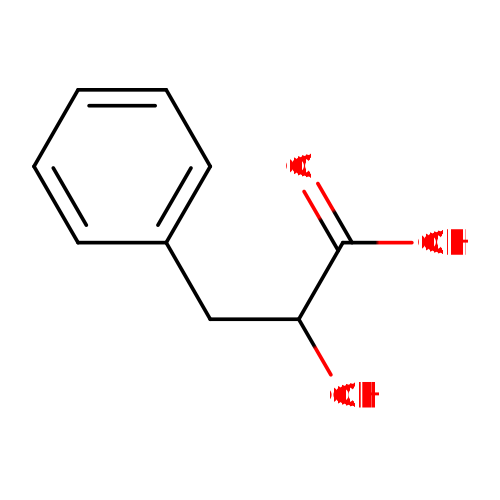
| Common Name | Phenyllactic acid |
|---|
| Description | Phenyllactic acid a product of phenylalanine catabolism, appearing prominently in the urine in individuals with phenylketonuria. Levels of several phenylalanine metabolites, including phenylacetate (PAA), phenyllactate (PLA), and phenylpyruvate (PPA)) are elevated in Phenylketonuria (PKU) (OMIM 261600 ). Phenyllactic acid is likely produced from phenylpyruvate via the action of lactate dehydrogenase. The D-form of this organic acid is typically derived from bacterial sources while the L-form is almost certainly endogenous. Levels of phenyllactate are normally very low in blood or urine. High levels of PLA in the urine or blood are often indicative of phenylketonuria (PKU) and hyperphenylalaninemia (HPA). PKU is due to lack of the enzyme phenylalanine hydroxylase (PAH), so that phenylalanine is converted not to tyrosine but to phenylpyruvic acid (a precursor of phenylactate). In particular, excessive phenylalanine is typically metabolized into phenylketones through, a transaminase pathway route involving glutamate. Metabolites of this transamination reaction include phenylacetate, phenylpyruvate and phenethylamine. In persons with PKU, dietary phenylalanine either accumulates in the body or some of it is converted to phenylpyruvic acid and then to phenyllactate through the action of lactate dehydrogenase. Individuals with PKU tend to excrete large quantities of phenylpyruvate, phenylacetate and phenyllactate, along with phenylalanine, in their urine. If untreated, mental retardation effects and microcephaly are evident by the first year along with other symptoms which include: unusual irritability, epileptic seizures and skin lesions. Hyperactivity, EEG abnormalities and seizures, and severe learning disabilities are major clinical problems later in life. A "musty or mousy" odor of skin, hair, sweat and urine (due to phenylacetate accumulation); and a tendency to hypopigmentation and eczema are also observed. The neural-development effects of PKU are primarily due to the disruption of neurotransmitter synthesis. In particular, phenylalanine is a large, neutral amino acid which moves across the blood-brain barrier (BBB) via the large neutral amino acid transporter (LNAAT). Excessive phenylalanine in the blood saturates the transporter. Thus, excessive levels of phenylalanine significantly decrease the levels of other LNAAs in the brain. But since these amino acids are required for protein and neurotransmitter synthesis, phenylalanine accumulation disrupts brain development, leading to mental retardation. (PMID: 10790306 ; OMIM: 261600 ). Phenyllactic acid can be found in Acinetobacter, Bacteroides, Bifidobacterium, Clostridium, Enterococcus, Escherichia, Eubacterium, Klebsiella, Lactobacillus, Pseudomonas and Staphylococcus (PMID: 19961416 ). |
|---|
| Structure | InChI=1S/C9H10O3/c10-8(9(11)12)6-7-4-2-1-3-5-7/h1-5,8,10H,6H2,(H,11,12) |
|---|
| Synonyms | | Value | Source |
|---|
| 2-Hydroxy-2-phenylpropionic acid | ChEBI | | 2-Phenyllactic acid | ChEBI | | alpha-Hydroxy-alpha-methylbenzeneacetic acid | ChEBI | | alpha-Hydroxy-alpha-phenylpropionic acid | ChEBI | | alpha-Methylmandelic acid | ChEBI | | 2-Hydroxy-2-phenylpropionate | Generator | | 2-Phenyllactate | Generator | | a-Hydroxy-a-methylbenzeneacetate | Generator | | a-Hydroxy-a-methylbenzeneacetic acid | Generator | | alpha-Hydroxy-alpha-methylbenzeneacetate | Generator | | Α-hydroxy-α-methylbenzeneacetate | Generator | | Α-hydroxy-α-methylbenzeneacetic acid | Generator | | a-Hydroxy-a-phenylpropionate | Generator | | a-Hydroxy-a-phenylpropionic acid | Generator | | alpha-Hydroxy-alpha-phenylpropionate | Generator | | Α-hydroxy-α-phenylpropionate | Generator | | Α-hydroxy-α-phenylpropionic acid | Generator | | a-Methylmandelate | Generator | | a-Methylmandelic acid | Generator | | alpha-Methylmandelate | Generator | | Α-methylmandelate | Generator | | Α-methylmandelic acid | Generator | | Phenyllactate | Generator | | Atrolactic acid, (+-)-isomer | MeSH | | Hydroxyphenylpropionic acid | MeSH | | Atrolactic acid | MeSH | | Atrolactic acid monosodium salt, (S)-isomer | MeSH | | HMMA | MeSH | | Hydroxymethylmandelic acid | MeSH | | 2-Hydroxy-3-phenylpropionic acid | ChEBI | | beta-Phenyllactic acid | ChEBI | | DL-3-Phenyllactic acid | ChEBI | | DL-beta-Phenyllactic acid | ChEBI | | 2-Hydroxy-3-phenylpropionate | Generator | | b-Phenyllactate | Generator | | b-Phenyllactic acid | Generator | | beta-Phenyllactate | Generator | | β-phenyllactate | Generator | | β-phenyllactic acid | Generator | | DL-3-Phenyllactate | Generator | | DL-b-Phenyllactate | Generator | | DL-b-Phenyllactic acid | Generator | | DL-beta-Phenyllactate | Generator | | DL-β-phenyllactate | Generator | | DL-β-phenyllactic acid | Generator | | 3-Phenyllactic acid | MeSH, HMDB | | 3-Phenyllactic acid, monosodium salt | MeSH, HMDB | | 3-Phenyllactate | MeSH, Generator, HMDB | | 3-Phenyllactic acid, calcium salt | MeSH, HMDB | | 3-Phenyllactic acid, (D)-isomer | MeSH, HMDB | | 3-Phenyllactic acid, (DL)-isomer | MeSH, HMDB | | 3-Phenyllactic acid, (L)-isomer | MeSH, HMDB | | 2-Hydroxy-3-(phenyl)propanoic acid | HMDB | | 3-(Phenyl)-2-hydroxypropanoic acid | HMDB |
|
|---|
| Chemical Formula | C9H10O3 |
|---|
| Average Molecular Weight | 166.1739 |
|---|
| Monoisotopic Molecular Weight | 166.062994186 |
|---|
| IUPAC Name | 2-hydroxy-3-phenylpropanoic acid |
|---|
| Traditional Name | β-phenyllactic acid |
|---|
| CAS Registry Number | 828-01-3 |
|---|
| SMILES | OC(CC1=CC=CC=C1)C(O)=O |
|---|
| InChI Identifier | InChI=1S/C9H10O3/c10-8(9(11)12)6-7-4-2-1-3-5-7/h1-5,8,10H,6H2,(H,11,12) |
|---|
| InChI Key | VOXXWSYKYCBWHO-UHFFFAOYSA-N |
|---|
| Chemical Taxonomy |
|---|
| Description | Belongs to the class of organic compounds known as benzene and substituted derivatives. These are aromatic compounds containing one monocyclic ring system consisting of benzene. |
|---|
| Kingdom | Organic compounds |
|---|
| Super Class | Benzenoids |
|---|
| Class | Benzene and substituted derivatives |
|---|
| Sub Class | Not Available |
|---|
| Direct Parent | Benzene and substituted derivatives |
|---|
| Alternative Parents | |
|---|
| Substituents | - Hydroxy acid
- Monocyclic benzene moiety
- Alpha-hydroxy acid
- Tertiary alcohol
- Monocarboxylic acid or derivatives
- Carboxylic acid
- Carboxylic acid derivative
- Organic oxygen compound
- Organic oxide
- Hydrocarbon derivative
- Aromatic alcohol
- Organooxygen compound
- Carbonyl group
- Alcohol
- Aromatic homomonocyclic compound
|
|---|
| Molecular Framework | Aromatic homomonocyclic compounds |
|---|
| External Descriptors | |
|---|
| Ontology |
|---|
| Not Available | Not Available |
|---|
| Physical Properties |
|---|
| State | Solid |
|---|
| Experimental Molecular Properties | |
|---|
| Experimental Chromatographic Properties | Experimental Collision Cross Sections |
|---|
| Predicted Molecular Properties | |
|---|
| Predicted Chromatographic Properties | Predicted Collision Cross SectionsPredicted Retention Times Underivatized| Chromatographic Method | Retention Time | Reference |
|---|
| Measured using a Waters Acquity ultraperformance liquid chromatography (UPLC) ethylene-bridged hybrid (BEH) C18 column (100 mm × 2.1 mm; 1.7 μmparticle diameter). Predicted by Afia on May 17, 2022. Predicted by Afia on May 17, 2022. | 3.67 minutes | 32390414 | | Predicted by Siyang on May 30, 2022 | 10.8859 minutes | 33406817 | | Predicted by Siyang using ReTip algorithm on June 8, 2022 | 3.53 minutes | 32390414 | | AjsUoB = Accucore 150 Amide HILIC with 10mM Ammonium Formate, 0.1% Formic Acid | 69.4 seconds | 40023050 | | Fem_Long = Waters ACQUITY UPLC HSS T3 C18 with Water:MeOH and 0.1% Formic Acid | 1454.4 seconds | 40023050 | | Fem_Lipids = Ascentis Express C18 with (60:40 water:ACN):(90:10 IPA:ACN) and 10mM NH4COOH + 0.1% Formic Acid | 344.6 seconds | 40023050 | | Life_Old = Waters ACQUITY UPLC BEH C18 with Water:(20:80 acetone:ACN) and 0.1% Formic Acid | 113.3 seconds | 40023050 | | Life_New = RP Waters ACQUITY UPLC HSS T3 C18 with Water:(30:70 MeOH:ACN) and 0.1% Formic Acid | 199.4 seconds | 40023050 | | RIKEN = Waters ACQUITY UPLC BEH C18 with Water:ACN and 0.1% Formic Acid | 103.6 seconds | 40023050 | | Eawag_XBridgeC18 = XBridge C18 3.5u 2.1x50 mm with Water:MeOH and 0.1% Formic Acid | 368.4 seconds | 40023050 | | BfG_NTS_RP1 =Agilent Zorbax Eclipse Plus C18 (2.1 mm x 150 mm, 3.5 um) with Water:ACN and 0.1% Formic Acid | 379.0 seconds | 40023050 | | HILIC_BDD_2 = Merck SeQuant ZIC-HILIC with ACN(0.1% formic acid):water(16 mM ammonium formate) | 117.0 seconds | 40023050 | | UniToyama_Atlantis = RP Waters Atlantis T3 (2.1 x 150 mm, 5 um) with ACN:Water and 0.1% Formic Acid | 846.1 seconds | 40023050 | | BDD_C18 = Hypersil Gold 1.9µm C18 with Water:ACN and 0.1% Formic Acid | 361.0 seconds | 40023050 | | UFZ_Phenomenex = Kinetex Core-Shell C18 2.6 um, 3.0 x 100 mm, Phenomenex with Water:MeOH and 0.1% Formic Acid | 1034.5 seconds | 40023050 | | SNU_RIKEN_POS = Waters ACQUITY UPLC BEH C18 with Water:ACN and 0.1% Formic Acid | 239.7 seconds | 40023050 | | RPMMFDA = Waters ACQUITY UPLC BEH C18 with Water:ACN and 0.1% Formic Acid | 316.2 seconds | 40023050 | | MTBLS87 = Merck SeQuant ZIC-pHILIC column with ACN:Water and :ammonium carbonate | 399.0 seconds | 40023050 | | KI_GIAR_zic_HILIC_pH2_7 = Merck SeQuant ZIC-HILIC with ACN:Water and 0.1% FA | 242.8 seconds | 40023050 | | Meister zic-pHILIC pH9.3 = Merck SeQuant ZIC-pHILIC column with ACN:Water 5mM NH4Ac pH9.3 and 5mM ammonium acetate in water | 120.6 seconds | 40023050 |
Predicted Kovats Retention IndicesUnderivatizedDerivatized| Derivative Name / Structure | SMILES | Kovats RI Value | Column Type | Reference |
|---|
| Phenyllactic acid,1TMS,isomer #1 | C[Si](C)(C)OC(CC1=CC=CC=C1)C(=O)O | 1545.2 | Semi standard non polar | 33892256 | | Phenyllactic acid,1TMS,isomer #2 | C[Si](C)(C)OC(=O)C(O)CC1=CC=CC=C1 | 1517.4 | Semi standard non polar | 33892256 | | Phenyllactic acid,2TMS,isomer #1 | C[Si](C)(C)OC(=O)C(CC1=CC=CC=C1)O[Si](C)(C)C | 1557.6 | Semi standard non polar | 33892256 | | Phenyllactic acid,1TBDMS,isomer #1 | CC(C)(C)[Si](C)(C)OC(CC1=CC=CC=C1)C(=O)O | 1768.7 | Semi standard non polar | 33892256 | | Phenyllactic acid,1TBDMS,isomer #2 | CC(C)(C)[Si](C)(C)OC(=O)C(O)CC1=CC=CC=C1 | 1748.2 | Semi standard non polar | 33892256 | | Phenyllactic acid,2TBDMS,isomer #1 | CC(C)(C)[Si](C)(C)OC(=O)C(CC1=CC=CC=C1)O[Si](C)(C)C(C)(C)C | 2026.6 | Semi standard non polar | 33892256 |
|
|---|
| Spectra |
|---|
| |
|---|
| Biological Properties |
|---|
| Cellular Locations | Not Available |
|---|
| Biospecimen Locations | |
|---|
| Tissue Locations | |
|---|
| Pathways | |
|---|
| Normal Concentrations |
|---|
| |
| Feces | Detected but not Quantified | Not Quantified | Adult (>18 years old) | Both | Normal | | details | | Saliva | Detected but not Quantified | Not Quantified | Adult (>18 years old) | Male | Normal | | details | | Saliva | Detected but not Quantified | Not Quantified | Adult (>18 years old) | Male | Normal | | details | | Saliva | Detected and Quantified | 3.77 +/- 1.71 uM | Adult (>18 years old) | Both | Normal | | details | | Saliva | Detected but not Quantified | Not Quantified | Adult (>18 years old) | Male | Normal | | details | | Saliva | Detected but not Quantified | Not Quantified | Adult (>18 years old) | Male | Normal | | details | | Saliva | Detected but not Quantified | Not Quantified | Adult (>18 years old) | Male | Normal | | details | | Saliva | Detected but not Quantified | Not Quantified | Adult (>18 years old) | Male | Normal | | details | | Saliva | Detected but not Quantified | Not Quantified | Adult (>18 years old) | Male | Normal | | details | | Saliva | Detected but not Quantified | Not Quantified | Adult (>18 years old) | Male | Normal | | details | | Saliva | Detected but not Quantified | Not Quantified | Adult (>18 years old) | Male | Normal | | details | | Saliva | Detected but not Quantified | Not Quantified | Adult (>18 years old) | Male | Normal | | details | | Saliva | Detected but not Quantified | Not Quantified | Adult (>18 years old) | Male | Normal | | details | | Urine | Detected and Quantified | 0.23-0.49 umol/mmol creatinine | Adult (>18 years old) | Female | Normal | | details | | Urine | Detected and Quantified | 0.23-0.39 umol/mmol creatinine | Adult (>18 years old) | Male | Normal | | details | | Urine | Detected and Quantified | 0.0680 +/- 0.204 umol/mmol creatinine | Infant (0-1 year old) | Both | Normal | | details | | Urine | Detected and Quantified | 0.136 +/- 0.476 umol/mmol creatinine | Infant (0-1 year old) | Both | Normal | | details | | Urine | Detected and Quantified | 0.204 +/- 0.612 umol/mmol creatinine | Infant (0-1 year old) | Both | Normal | | details | | Urine | Detected and Quantified | 1.0886 +/- 0.680 umol/mmol creatinine | Infant (0-1 year old) | Both | Normal | | details | | Urine | Detected and Quantified | 1.225 +/- 0.816 umol/mmol creatinine | Infant (0-1 year old) | Both | Normal | | details | | Urine | Detected and Quantified | 1.225 +/- 0.884 umol/mmol creatinine | Infant (0-1 year old) | Both | Normal | | details |
|
|---|
| Abnormal Concentrations |
|---|
| |
| Blood | Detected and Quantified | 0-82.9 uM | Children (1-13 years old) | Both | Phenylketonuria | | details | | Feces | Detected but not Quantified | Not Quantified | Adult (>18 years old) | Both | Colorectal Cancer | | details | | Saliva | Detected but not Quantified | Not Quantified | Adult (>18 years old) | Male | Attachment loss | | details | | Saliva | Detected but not Quantified | Not Quantified | Adult (>18 years old) | Male | Periodontal Probing Depth | | details | | Saliva | Detected but not Quantified | Not Quantified | Adult (>18 years old) | Male | Supragingival Plaque | | details | | Urine | Detected and Quantified | 149.7 +/- 208.5 umol/mmol creatinine | Newborn (0-30 days old) | Both | Phenylketonuria | | details | | Urine | Detected and Quantified | 31.297 +/- 11.566 umol/mmol creatinine | Children (1-13 years old) | Both | Phenylketonuria | | details | | Urine | Detected and Quantified | 361.277 +/- 500.0731 umol/mmol creatinine | Children (1-13 years old) | Both | Phenylketonuria | | details | | Urine | Detected and Quantified | 48.306 +/- 24.493 umol/mmol creatinine | Children (1-13 years old) | Both | Phenylketonuria | | details | | Urine | Detected and Quantified | 59.873 +/- 34.699 umol/mmol creatinine | Children (1-13 years old) | Both | Phenylketonuria | | details | | Urine | Detected and Quantified | 786.510 +/- 1020.557 umol/mmol creatinine | Children (1-13 years old) | Both | Phenylketonuria | | details | | Urine | Detected and Quantified | 796.0348 +/- 753.852 umol/mmol creatinine | Children (1-13 years old) | Both | Phenylketonuria | | details |
|
|---|
| Associated Disorders and Diseases |
|---|
| Disease References | | Colorectal cancer |
|---|
- Brown DG, Rao S, Weir TL, O'Malia J, Bazan M, Brown RJ, Ryan EP: Metabolomics and metabolic pathway networks from human colorectal cancers, adjacent mucosa, and stool. Cancer Metab. 2016 Jun 6;4:11. doi: 10.1186/s40170-016-0151-y. eCollection 2016. [PubMed:27275383 ]
| | Attachment loss |
|---|
- Liebsch C, Pitchika V, Pink C, Samietz S, Kastenmuller G, Artati A, Suhre K, Adamski J, Nauck M, Volzke H, Friedrich N, Kocher T, Holtfreter B, Pietzner M: The Saliva Metabolome in Association to Oral Health Status. J Dent Res. 2019 Jun;98(6):642-651. doi: 10.1177/0022034519842853. Epub 2019 Apr 26. [PubMed:31026179 ]
| | Periodontal Probing Depth |
|---|
- Liebsch C, Pitchika V, Pink C, Samietz S, Kastenmuller G, Artati A, Suhre K, Adamski J, Nauck M, Volzke H, Friedrich N, Kocher T, Holtfreter B, Pietzner M: The Saliva Metabolome in Association to Oral Health Status. J Dent Res. 2019 Jun;98(6):642-651. doi: 10.1177/0022034519842853. Epub 2019 Apr 26. [PubMed:31026179 ]
| | Supragingival Plaque |
|---|
- Liebsch C, Pitchika V, Pink C, Samietz S, Kastenmuller G, Artati A, Suhre K, Adamski J, Nauck M, Volzke H, Friedrich N, Kocher T, Holtfreter B, Pietzner M: The Saliva Metabolome in Association to Oral Health Status. J Dent Res. 2019 Jun;98(6):642-651. doi: 10.1177/0022034519842853. Epub 2019 Apr 26. [PubMed:31026179 ]
| | Phenylketonuria |
|---|
- Monch E, Kneer J, Jakobs C, Arnold M, Diehl H, Batzler U: Examination of urine metabolites in the newborn period and during protein loading tests at 6 months of age--Part 1. Eur J Pediatr. 1990;149 Suppl 1:S17-24. [PubMed:2091926 ]
- Clemens PC, Schunemann MH, Hoffmann GF, Kohlschutter A: Plasma concentrations of phenyllactic acid in phenylketonuria. J Inherit Metab Dis. 1990;13(2):227-8. [PubMed:2116554 ]
- Rampini S, Vollmin JA, Bosshard HR, Muller M, Curtius HC: Aromatic acids in urine of healthy infants, persistent hyperphenylalaninemia, and phenylketonuria, before and after phenylalanine load. Pediatr Res. 1974 Jul;8(7):704-9. [PubMed:4837567 ]
|
|
|---|
| Associated OMIM IDs | |
|---|
| External Links |
|---|
| DrugBank ID | Not Available |
|---|
| Phenol Explorer Compound ID | Not Available |
|---|
| FooDB ID | FDB093343 |
|---|
| KNApSAcK ID | C00000150 |
|---|
| Chemspider ID | 1263 |
|---|
| KEGG Compound ID | Not Available |
|---|
| BioCyc ID | Not Available |
|---|
| BiGG ID | Not Available |
|---|
| Wikipedia Link | Not Available |
|---|
| METLIN ID | Not Available |
|---|
| PubChem Compound | 1303 |
|---|
| PDB ID | Not Available |
|---|
| ChEBI ID | 50392 |
|---|
| Food Biomarker Ontology | Not Available |
|---|
| VMH ID | Not Available |
|---|
| MarkerDB ID | MDB00000250 |
|---|
| Good Scents ID | Not Available |
|---|
| References |
|---|
| Synthesis Reference | Yu, Jian Ming; Xue, Fen. A method of synthesis of phenyllactic acid and substituted phenyllactic acids. Chinese Chemical Letters (1993), 4(8), 673-4. |
|---|
| Material Safety Data Sheet (MSDS) | Download (PDF) |
|---|
| General References | - Iijima S, Ishii A, Miyakoshi T, Odaira T, Musha M: Studies on the experimental phenylketonuria in rats. Tohoku J Exp Med. 1975 Oct;117(2):167-78. [PubMed:1209606 ]
- Sarkissian CN, Scriver CR, Mamer OA: Measurement of phenyllactate, phenylacetate, and phenylpyruvate by negative ion chemical ionization-gas chromatography/mass spectrometry in brain of mouse genetic models of phenylketonuria and non-phenylketonuria hyperphenylalaninemia. Anal Biochem. 2000 May 1;280(2):242-9. [PubMed:10790306 ]
- Beloborodova NV, Khodakova AS, Bairamov IT, Olenin AY: Microbial origin of phenylcarboxylic acids in the human body. Biochemistry (Mosc). 2009 Dec;74(12):1350-5. [PubMed:19961416 ]
- Elshenawy S, Pinney SE, Stuart T, Doulias PT, Zura G, Parry S, Elovitz MA, Bennett MJ, Bansal A, Strauss JF 3rd, Ischiropoulos H, Simmons RA: The Metabolomic Signature of the Placenta in Spontaneous Preterm Birth. Int J Mol Sci. 2020 Feb 4;21(3). pii: ijms21031043. doi: 10.3390/ijms21031043. [PubMed:32033212 ]
|
|---|