| Record Information |
|---|
| Version | 5.0 |
|---|
| Status | Expected but not Quantified |
|---|
| Creation Date | 2012-09-06 15:16:49 UTC |
|---|
| Update Date | 2022-03-07 02:51:38 UTC |
|---|
| HMDB ID | HMDB0014468 |
|---|
| Secondary Accession Numbers | |
|---|
| Metabolite Identification |
|---|
| Common Name | Tolcapone |
|---|
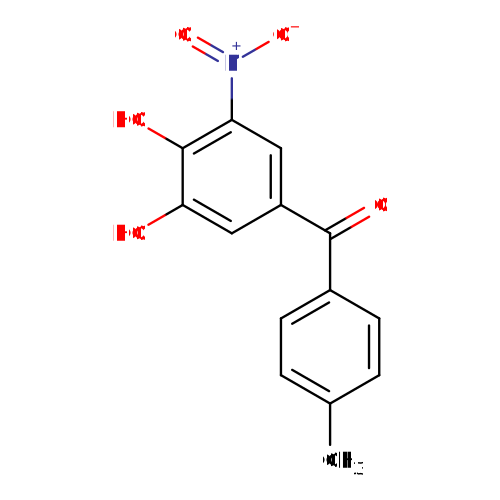
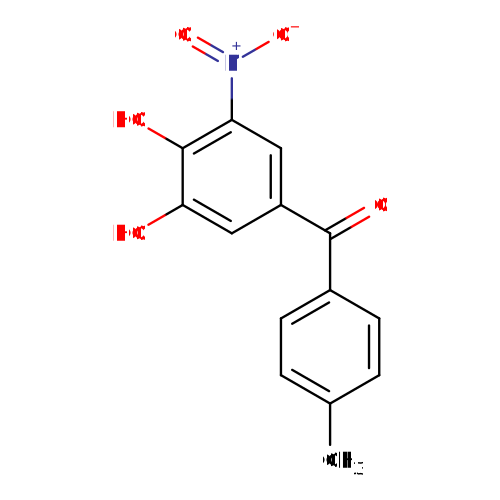
| Description | Tolcapone, also known as tasmar, belongs to the class of organic compounds known as benzophenones. These are organic compounds containing a ketone attached to two phenyl groups. Tolcapone is a drug which is used as an adjunct to levodopa/carbidopa therapy for the symptomatic treatment of parkinson's disease. this drug is generally reserved for patients with parkinsonian syndrome receiving levodopa/carbidopa who are experiencing symptom fluctuations and are not responding adequately to or are not candidates for other adjunctive therapies. Tolcapone is an extremely weak basic (essentially neutral) compound (based on its pKa). Tolcapone is a potentially toxic compound. Benzophenone substituted on one of the phenyl rings at C-3 and C-4 by hydroxy groups and at C-5 by a nitro group, and on the other phenyl ring by a methyl group at C-4. |
|---|
| Structure | CC1=CC=C(C=C1)C(=O)C1=CC(=C(O)C(O)=C1)[N+]([O-])=O InChI=1S/C14H11NO5/c1-8-2-4-9(5-3-8)13(17)10-6-11(15(19)20)14(18)12(16)7-10/h2-7,16,18H,1H3 |
|---|
| Synonyms | | Value | Source |
|---|
| 3,4-Dihydroxy-4'-methyl-5-nitrobenzophenone | ChEBI | | 3,4-Dihydroxy-5-nitro-4'-methylbenzophenone | ChEBI | | 4'-Methyl-3,4-dihydroxy-5-nitrobenzophenone | ChEBI | | Tasmar | Kegg | | Roche brand OF tolcapone | HMDB | | 3,4-Dihydroxy-5'-methyl-5-nitrobenzophenone | HMDB | | 3,4 Dihydroxy 5' methyl 5 nitrobenzophenone | HMDB |
|
|---|
| Chemical Formula | C14H11NO5 |
|---|
| Average Molecular Weight | 273.2408 |
|---|
| Monoisotopic Molecular Weight | 273.063722467 |
|---|
| IUPAC Name | 5-(4-methylbenzoyl)-3-nitrobenzene-1,2-diol |
|---|
| Traditional Name | tolcapone |
|---|
| CAS Registry Number | 134308-13-7 |
|---|
| SMILES | CC1=CC=C(C=C1)C(=O)C1=CC(=C(O)C(O)=C1)[N+]([O-])=O |
|---|
| InChI Identifier | InChI=1S/C14H11NO5/c1-8-2-4-9(5-3-8)13(17)10-6-11(15(19)20)14(18)12(16)7-10/h2-7,16,18H,1H3 |
|---|
| InChI Key | MIQPIUSUKVNLNT-UHFFFAOYSA-N |
|---|
| Chemical Taxonomy |
|---|
| Description | Belongs to the class of organic compounds known as benzophenones. These are organic compounds containing a ketone attached to two phenyl groups. |
|---|
| Kingdom | Organic compounds |
|---|
| Super Class | Benzenoids |
|---|
| Class | Benzene and substituted derivatives |
|---|
| Sub Class | Benzophenones |
|---|
| Direct Parent | Benzophenones |
|---|
| Alternative Parents | |
|---|
| Substituents | - Benzophenone
- Diphenylmethane
- Aryl-phenylketone
- Nitrophenol
- Nitrobenzene
- Nitroaromatic compound
- Benzoyl
- Catechol
- Aryl ketone
- 1-hydroxy-4-unsubstituted benzenoid
- 1-hydroxy-2-unsubstituted benzenoid
- Toluene
- Phenol
- Ketone
- Organic nitro compound
- C-nitro compound
- Organic 1,3-dipolar compound
- Propargyl-type 1,3-dipolar organic compound
- Allyl-type 1,3-dipolar organic compound
- Organic oxoazanium
- Organic nitrogen compound
- Hydrocarbon derivative
- Organic oxide
- Organic oxygen compound
- Organopnictogen compound
- Organonitrogen compound
- Organooxygen compound
- Aromatic homomonocyclic compound
|
|---|
| Molecular Framework | Aromatic homomonocyclic compounds |
|---|
| External Descriptors | |
|---|
| Ontology |
|---|
| Physiological effect | Not Available |
|---|
| Disposition | |
|---|
| Process | Not Available |
|---|
| Role | |
|---|
| Physical Properties |
|---|
| State | Solid |
|---|
| Experimental Molecular Properties | | Property | Value | Reference |
|---|
| Melting Point | Not Available | Not Available | | Boiling Point | Not Available | Not Available | | Water Solubility | 0.057 g/L | Not Available | | LogP | 4 | Not Available |
|
|---|
| Experimental Chromatographic Properties | Not Available |
|---|
| Predicted Molecular Properties | |
|---|
| Predicted Chromatographic Properties | Predicted Collision Cross SectionsPredicted Retention Times Underivatized| Chromatographic Method | Retention Time | Reference |
|---|
| Measured using a Waters Acquity ultraperformance liquid chromatography (UPLC) ethylene-bridged hybrid (BEH) C18 column (100 mm × 2.1 mm; 1.7 μmparticle diameter). Predicted by Afia on May 17, 2022. Predicted by Afia on May 17, 2022. | 6.53 minutes | 32390414 | | Predicted by Siyang on May 30, 2022 | 15.1844 minutes | 33406817 | | Predicted by Siyang using ReTip algorithm on June 8, 2022 | 1.13 minutes | 32390414 | | Fem_Long = Waters ACQUITY UPLC HSS T3 C18 with Water:MeOH and 0.1% Formic Acid | 2367.2 seconds | 40023050 | | Fem_Lipids = Ascentis Express C18 with (60:40 water:ACN):(90:10 IPA:ACN) and 10mM NH4COOH + 0.1% Formic Acid | 435.5 seconds | 40023050 | | Life_Old = Waters ACQUITY UPLC BEH C18 with Water:(20:80 acetone:ACN) and 0.1% Formic Acid | 180.5 seconds | 40023050 | | Life_New = RP Waters ACQUITY UPLC HSS T3 C18 with Water:(30:70 MeOH:ACN) and 0.1% Formic Acid | 249.8 seconds | 40023050 | | RIKEN = Waters ACQUITY UPLC BEH C18 with Water:ACN and 0.1% Formic Acid | 366.3 seconds | 40023050 | | Eawag_XBridgeC18 = XBridge C18 3.5u 2.1x50 mm with Water:MeOH and 0.1% Formic Acid | 777.1 seconds | 40023050 | | BfG_NTS_RP1 =Agilent Zorbax Eclipse Plus C18 (2.1 mm x 150 mm, 3.5 um) with Water:ACN and 0.1% Formic Acid | 833.6 seconds | 40023050 | | HILIC_BDD_2 = Merck SeQuant ZIC-HILIC with ACN(0.1% formic acid):water(16 mM ammonium formate) | 133.6 seconds | 40023050 | | UniToyama_Atlantis = RP Waters Atlantis T3 (2.1 x 150 mm, 5 um) with ACN:Water and 0.1% Formic Acid | 1358.7 seconds | 40023050 | | BDD_C18 = Hypersil Gold 1.9µm C18 with Water:ACN and 0.1% Formic Acid | 556.3 seconds | 40023050 | | UFZ_Phenomenex = Kinetex Core-Shell C18 2.6 um, 3.0 x 100 mm, Phenomenex with Water:MeOH and 0.1% Formic Acid | 1551.9 seconds | 40023050 | | SNU_RIKEN_POS = Waters ACQUITY UPLC BEH C18 with Water:ACN and 0.1% Formic Acid | 476.2 seconds | 40023050 | | RPMMFDA = Waters ACQUITY UPLC BEH C18 with Water:ACN and 0.1% Formic Acid | 508.0 seconds | 40023050 | | MTBLS87 = Merck SeQuant ZIC-pHILIC column with ACN:Water and :ammonium carbonate | 478.9 seconds | 40023050 | | KI_GIAR_zic_HILIC_pH2_7 = Merck SeQuant ZIC-HILIC with ACN:Water and 0.1% FA | 274.6 seconds | 40023050 | | Meister zic-pHILIC pH9.3 = Merck SeQuant ZIC-pHILIC column with ACN:Water 5mM NH4Ac pH9.3 and 5mM ammonium acetate in water | 119.8 seconds | 40023050 |
Predicted Kovats Retention IndicesUnderivatizedDerivatized| Derivative Name / Structure | SMILES | Kovats RI Value | Column Type | Reference |
|---|
| Tolcapone,1TMS,isomer #1 | CC1=CC=C(C(=O)C2=CC(O)=C(O[Si](C)(C)C)C([N+](=O)[O-])=C2)C=C1 | 2527.6 | Semi standard non polar | 33892256 | | Tolcapone,1TMS,isomer #2 | CC1=CC=C(C(=O)C2=CC(O[Si](C)(C)C)=C(O)C([N+](=O)[O-])=C2)C=C1 | 2551.1 | Semi standard non polar | 33892256 | | Tolcapone,2TMS,isomer #1 | CC1=CC=C(C(=O)C2=CC(O[Si](C)(C)C)=C(O[Si](C)(C)C)C([N+](=O)[O-])=C2)C=C1 | 2571.0 | Semi standard non polar | 33892256 | | Tolcapone,1TBDMS,isomer #1 | CC1=CC=C(C(=O)C2=CC(O)=C(O[Si](C)(C)C(C)(C)C)C([N+](=O)[O-])=C2)C=C1 | 2809.6 | Semi standard non polar | 33892256 | | Tolcapone,1TBDMS,isomer #2 | CC1=CC=C(C(=O)C2=CC(O[Si](C)(C)C(C)(C)C)=C(O)C([N+](=O)[O-])=C2)C=C1 | 2829.5 | Semi standard non polar | 33892256 | | Tolcapone,2TBDMS,isomer #1 | CC1=CC=C(C(=O)C2=CC(O[Si](C)(C)C(C)(C)C)=C(O[Si](C)(C)C(C)(C)C)C([N+](=O)[O-])=C2)C=C1 | 3072.6 | Semi standard non polar | 33892256 |
|
|---|
| General References | - Guay DR: Tolcapone, a selective catechol-O-methyltransferase inhibitor for treatment of Parkinson's disease. Pharmacotherapy. 1999 Jan;19(1):6-20. [PubMed:9917075 ]
- Keating GM, Lyseng-Williamson KA: Tolcapone: a review of its use in the management of Parkinson's disease. CNS Drugs. 2005;19(2):165-84. [PubMed:15697329 ]
- Truong DD: Tolcapone: review of its pharmacology and use as adjunctive therapy in patients with Parkinson's disease. Clin Interv Aging. 2009;4:109-13. Epub 2009 May 14. [PubMed:19503773 ]
- Forsberg M, Lehtonen M, Heikkinen M, Savolainen J, Jarvinen T, Mannisto PT: Pharmacokinetics and pharmacodynamics of entacapone and tolcapone after acute and repeated administration: a comparative study in the rat. J Pharmacol Exp Ther. 2003 Feb;304(2):498-506. [PubMed:12538800 ]
- Kaakkola S: Clinical pharmacology, therapeutic use and potential of COMT inhibitors in Parkinson's disease. Drugs. 2000 Jun;59(6):1233-50. [PubMed:10882160 ]
|
|---|