Hmdb loader
Record Information
Version5.0
StatusExpected but not Quantified
Creation Date2012-09-12 00:35:55 UTC
Update Date2023-02-21 17:26:53 UTC
HMDB IDHMDB0039215
Secondary Accession Numbers
  • HMDB39215
Metabolite Identification
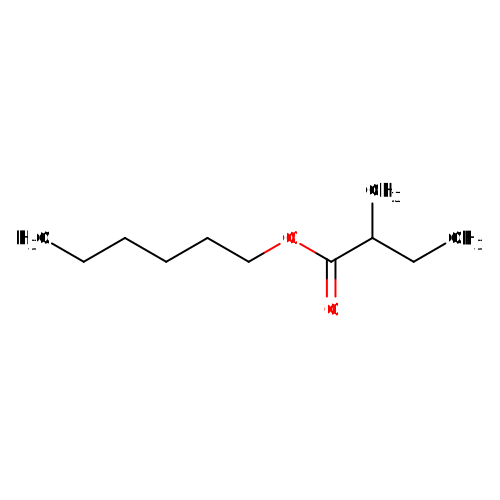
Common NameHexyl 2-methylbutanoate
DescriptionHexyl 2-methylbutanoate belongs to the class of organic compounds known as fatty acid esters. These are carboxylic ester derivatives of a fatty acid. Based on a literature review a small amount of articles have been published on Hexyl 2-methylbutanoate.
Structure
Data?1677000413
Synonyms
ValueSource
Hexyl 2-methylbutanoic acidGenerator
2-Methylbutanoic acid, N-hexyl esterHMDB
BromoacetylcarnitineHMDB
Butanoic acid, 2-methyl-, hexyl esterHMDB
Butyric acid, 2-methyl-, hexyl esterHMDB
FEMA 3499HMDB
Hexyl 2-methylbutyrateHMDB
N-Hexyl 2-methyl butyrateHMDB
N-Hexyl 2-methylbutanoateHMDB
Chemical FormulaC11H22O2
Average Molecular Weight186.2912
Monoisotopic Molecular Weight186.161979948
IUPAC Namehexyl 2-methylbutanoate
Traditional Namehexyl 2-methylbutanoate
CAS Registry Number10032-15-2
SMILES
CCCCCCOC(=O)C(C)CC
InChI Identifier
InChI=1S/C11H22O2/c1-4-6-7-8-9-13-11(12)10(3)5-2/h10H,4-9H2,1-3H3
InChI KeyYUECNVSODFDKOQ-UHFFFAOYSA-N
Chemical Taxonomy
Description Belongs to the class of organic compounds known as fatty acid esters. These are carboxylic ester derivatives of a fatty acid.
KingdomOrganic compounds
Super ClassLipids and lipid-like molecules
ClassFatty Acyls
Sub ClassFatty acid esters
Direct ParentFatty acid esters
Alternative Parents
Substituents
  • Fatty acid ester
  • Carboxylic acid ester
  • Monocarboxylic acid or derivatives
  • Carboxylic acid derivative
  • Organic oxygen compound
  • Organic oxide
  • Hydrocarbon derivative
  • Organooxygen compound
  • Carbonyl group
  • Aliphatic acyclic compound
Molecular FrameworkAliphatic acyclic compounds
External DescriptorsNot Available
Ontology
Not AvailableNot Available
Physical Properties
StateNot Available
Experimental Molecular Properties
PropertyValueReference
Melting PointNot AvailableNot Available
Boiling Point105.00 °C. @ 30.00 mm HgThe Good Scents Company Information System
Water Solubility0 slightlyThe Good Scents Company Information System
LogP4.196 (est)The Good Scents Company Information System
Experimental Chromatographic PropertiesNot Available
Predicted Molecular Properties
PropertyValueSource
Water Solubility0.053 g/LALOGPS
logP4.1ALOGPS
logP3.82ChemAxon
logS-3.6ALOGPS
pKa (Strongest Basic)-7.1ChemAxon
Physiological Charge0ChemAxon
Hydrogen Acceptor Count1ChemAxon
Hydrogen Donor Count0ChemAxon
Polar Surface Area26.3 ŲChemAxon
Rotatable Bond Count8ChemAxon
Refractivity54.29 m³·mol⁻¹ChemAxon
Polarizability23.41 ųChemAxon
Number of Rings0ChemAxon
BioavailabilityYesChemAxon
Rule of FiveYesChemAxon
Ghose FilterYesChemAxon
Veber's RuleYesChemAxon
MDDR-like RuleNoChemAxon
Predicted Chromatographic Properties

Predicted Collision Cross Sections

PredictorAdduct TypeCCS Value (Å2)Reference
DarkChem[M+H]+145.18331661259
DarkChem[M-H]-142.11931661259
DeepCCS[M+H]+151.76930932474
DeepCCS[M-H]-148.48230932474
DeepCCS[M-2H]-185.8130932474
DeepCCS[M+Na]+161.35530932474
AllCCS[M+H]+148.632859911
AllCCS[M+H-H2O]+145.032859911
AllCCS[M+NH4]+152.032859911
AllCCS[M+Na]+153.032859911
AllCCS[M-H]-149.432859911
AllCCS[M+Na-2H]-151.132859911
AllCCS[M+HCOO]-153.132859911

Predicted Retention Times

Underivatized

Chromatographic MethodRetention TimeReference
Measured using a Waters Acquity ultraperformance liquid chromatography (UPLC) ethylene-bridged hybrid (BEH) C18 column (100 mm × 2.1 mm; 1.7 μmparticle diameter). Predicted by Afia on May 17, 2022. Predicted by Afia on May 17, 2022.7.94 minutes32390414
Predicted by Siyang on May 30, 202219.0745 minutes33406817
Predicted by Siyang using ReTip algorithm on June 8, 20221.98 minutes32390414
AjsUoB = Accucore 150 Amide HILIC with 10mM Ammonium Formate, 0.1% Formic Acid26.7 seconds40023050
Fem_Long = Waters ACQUITY UPLC HSS T3 C18 with Water:MeOH and 0.1% Formic Acid2633.5 seconds40023050
Fem_Lipids = Ascentis Express C18 with (60:40 water:ACN):(90:10 IPA:ACN) and 10mM NH4COOH + 0.1% Formic Acid656.4 seconds40023050
Life_Old = Waters ACQUITY UPLC BEH C18 with Water:(20:80 acetone:ACN) and 0.1% Formic Acid236.1 seconds40023050
Life_New = RP Waters ACQUITY UPLC HSS T3 C18 with Water:(30:70 MeOH:ACN) and 0.1% Formic Acid398.3 seconds40023050
RIKEN = Waters ACQUITY UPLC BEH C18 with Water:ACN and 0.1% Formic Acid428.8 seconds40023050
Eawag_XBridgeC18 = XBridge C18 3.5u 2.1x50 mm with Water:MeOH and 0.1% Formic Acid856.7 seconds40023050
BfG_NTS_RP1 =Agilent Zorbax Eclipse Plus C18 (2.1 mm x 150 mm, 3.5 um) with Water:ACN and 0.1% Formic Acid860.6 seconds40023050
HILIC_BDD_2 = Merck SeQuant ZIC-HILIC with ACN(0.1% formic acid):water(16 mM ammonium formate)123.6 seconds40023050
UniToyama_Atlantis = RP Waters Atlantis T3 (2.1 x 150 mm, 5 um) with ACN:Water and 0.1% Formic Acid1603.0 seconds40023050
BDD_C18 = Hypersil Gold 1.9µm C18 with Water:ACN and 0.1% Formic Acid562.5 seconds40023050
UFZ_Phenomenex = Kinetex Core-Shell C18 2.6 um, 3.0 x 100 mm, Phenomenex with Water:MeOH and 0.1% Formic Acid1711.4 seconds40023050
SNU_RIKEN_POS = Waters ACQUITY UPLC BEH C18 with Water:ACN and 0.1% Formic Acid548.3 seconds40023050
RPMMFDA = Waters ACQUITY UPLC BEH C18 with Water:ACN and 0.1% Formic Acid450.6 seconds40023050
MTBLS87 = Merck SeQuant ZIC-pHILIC column with ACN:Water and :ammonium carbonate522.6 seconds40023050
KI_GIAR_zic_HILIC_pH2_7 = Merck SeQuant ZIC-HILIC with ACN:Water and 0.1% FA578.9 seconds40023050
Meister zic-pHILIC pH9.3 = Merck SeQuant ZIC-pHILIC column with ACN:Water 5mM NH4Ac pH9.3 and 5mM ammonium acetate in water9.1 seconds40023050

Predicted Kovats Retention Indices

Underivatized

MetaboliteSMILESKovats RI ValueColumn TypeReference
Hexyl 2-methylbutanoateCCCCCCOC(=O)C(C)CC1446.7Standard polar33892256
Hexyl 2-methylbutanoateCCCCCCOC(=O)C(C)CC1225.9Standard non polar33892256
Hexyl 2-methylbutanoateCCCCCCOC(=O)C(C)CC1261.3Semi standard non polar33892256
Spectra
Biological Properties
Cellular Locations
  • Extracellular
  • Membrane
Biospecimen LocationsNot Available
Tissue LocationsNot Available
Pathways
Normal Concentrations
Not Available
Abnormal Concentrations
Not Available
Associated Disorders and Diseases
Disease ReferencesNone
Associated OMIM IDsNone
DrugBank IDNot Available
Phenol Explorer Compound IDNot Available
FooDB IDFDB018747
KNApSAcK IDC00035642
Chemspider ID23221
KEGG Compound IDNot Available
BioCyc IDNot Available
BiGG IDNot Available
Wikipedia LinkNot Available
METLIN IDNot Available
PubChem Compound24838
PDB IDNot Available
ChEBI IDNot Available
Food Biomarker OntologyNot Available
VMH IDNot Available
MarkerDB IDNot Available
Good Scents IDrw1024372
References
Synthesis ReferenceNot Available
Material Safety Data Sheet (MSDS)Not Available
General References
  1. Simons K, Toomre D: Lipid rafts and signal transduction. Nat Rev Mol Cell Biol. 2000 Oct;1(1):31-9. [PubMed:11413487 ]
  2. Watson AD: Thematic review series: systems biology approaches to metabolic and cardiovascular disorders. Lipidomics: a global approach to lipid analysis in biological systems. J Lipid Res. 2006 Oct;47(10):2101-11. Epub 2006 Aug 10. [PubMed:16902246 ]
  3. Sethi JK, Vidal-Puig AJ: Thematic review series: adipocyte biology. Adipose tissue function and plasticity orchestrate nutritional adaptation. J Lipid Res. 2007 Jun;48(6):1253-62. Epub 2007 Mar 20. [PubMed:17374880 ]
  4. Lingwood D, Simons K: Lipid rafts as a membrane-organizing principle. Science. 2010 Jan 1;327(5961):46-50. doi: 10.1126/science.1174621. [PubMed:20044567 ]
  5. (). Yannai, Shmuel. (2004) Dictionary of food compounds with CD-ROM: Additives, flavors, and ingredients. Boca Raton: Chapman & Hall/CRC.. .
  6. Gunstone, Frank D., John L. Harwood, and Albert J. Dijkstra (2007). The lipid handbook with CD-ROM. CRC Press.