| Record Information |
|---|
| Version | 5.0 |
|---|
| Status | Detected and Quantified |
|---|
| Creation Date | 2005-11-16 15:48:42 UTC |
|---|
| Update Date | 2022-03-07 02:49:05 UTC |
|---|
| HMDB ID | HMDB0000694 |
|---|
| Secondary Accession Numbers | |
|---|
| Metabolite Identification |
|---|
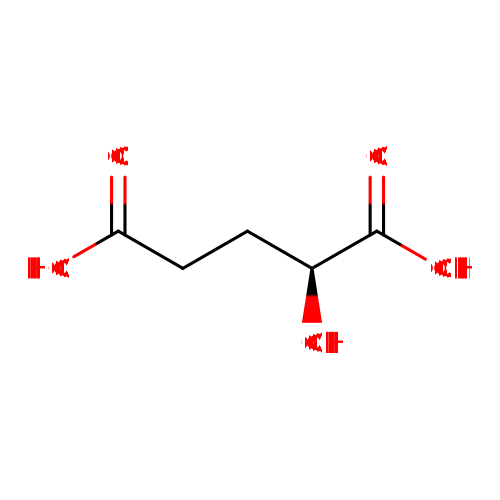
| Common Name | L-2-Hydroxyglutaric acid |
|---|
| Description | L-2-Hydroxyglutaric acid is a metabolite that accumulates in L-2-hydroxyglutaric aciduria, which is a neurometabolic disorder (OMIM: 236792 ), and has been reported in multiple patients who have a clinical phenotype of progressive neurodegeneration with extrapyramidal and cerebellar signs, seizures, and spongiform changes in the white matter (OMIM: 600721 ). In humans, 2-hydroxyglutarate is formed by a hydroxyacid-oxoacid transhydrogenase whereas in bacteria it is formed by a 2-hydroxyglutarate synthase. L-2-Hydroxyglutaric acid can be converted to alpha-ketoglutaric acid through the action of 2-hydroxyglutarate dehydrogenase (EC 1.1.99.2). In humans, there are two such enzymes (D2HGDH and L2HGDH). Both the D and L stereoisomers of hydroxyglutaric acid are found in body fluids. L-2-Hydroxyglutaric acid can also be produced via gain-of-function mutations in the cytosolic and mitochondrial isoforms of isocitrate dehydrogenase (IDH). IDH is part of the TCA cycle and this compound is generated in high abundance when IDH is mutated. Since L-2-hydroxyglutaric acid is sufficiently similar in structure to 2-oxoglutarate (2OG), it is able to inhibit a range of 2OG-dependent dioxygenases, including histone lysine demethylases (KDMs) and members of the ten-eleven translocation (TET) family of 5-methylcytosine (5mC) hydroxylases. This inhibitory effect leads to alterations in the hypoxia-inducible factor (HIF)-mediated hypoxic response and alterations in gene expression through global epigenetic remodeling. The net effect is that L-2-hydroxyglutaric acid causes a cascading effect that leads genetic perturbations and malignant transformation. Depending on the circumstances, L-2-hydroxyglutaric acid can function as an oncometabolite, a neurotoxin, an acidogen, and a metabotoxin. An oncometabolite is a compound that promotes tumour growth and survival. A neurotoxin is compound that is toxic to neurons or neural tissue. An acidogen is an acidic compound that induces acidosis, which has multiple adverse effects on many organ systems. A metabotoxin is an endogenously produced metabolite that causes adverse health effects at chronically high levels. As an oncometabolite, L-2-hydroxyglutaric acid is a competitive inhibitor of multiple alpha-ketoglutarate-dependent dioxygenases, including histone demethylases and the TET family of 5mC hydroxylases. As a result, high levels of 2-hydroxyglutarate lead to genome-wide histone and DNA methylation alterations, which in turn lead to mutations that ultimately cause cancer (PMID: 29038145 ). As a neurotoxin, L-2-hydroxyglutaric acid mediates its neurotoxicity through activation of N-methyl-D-aspartate receptors. L-2-Hydroxyglutaric acid is structurally similar to the excitatory amino acid glutamate and stimulates neurodegeneration by mechanisms similar to glutamate, NMDA, or mitochondrial toxins (PMID: 12153528 ). As an acidogen, L-2-hydroxyglutaric acid is classified as an alpha hydroxy acid belonging to the general class of compounds known as organic acids. Chronically high levels of L-2-hydroxyglutaric acid are characteristic of the inborn error of metabolism called L-2-hydroxyglutaric aciduria. Abnormally high levels of organic acids in the blood (organic acidemia), urine (organic aciduria), the brain, and other tissues lead to general metabolic acidosis. Acidosis typically occurs when arterial pH falls below 7.35. In infants with acidosis, the initial symptoms include poor feeding, vomiting, loss of appetite, weak muscle tone (hypotonia), and lack of energy (lethargy). These can progress to heart abnormalities, kidney abnormalities, liver damage, seizures, coma, and possibly death. These are the symptoms typical of untreated L-2-hydroxyglutaric aciduria. Many affected children with organic acidemias experience intellectual disability or delayed development. In adults, acidosis or acidemia is characterized by headaches, confusion, feeling tired, tremors, sleepiness, and seizures. |
|---|
| Structure | InChI=1S/C5H8O5/c6-3(5(9)10)1-2-4(7)8/h3,6H,1-2H2,(H,7,8)(H,9,10)/t3-/m0/s1 |
|---|
| Synonyms | | Value | Source |
|---|
| (S)-2-Hydroxyglutarate | ChEBI | | (S)-2-Hydroxyglutaric acid | Generator | | L-2-Hydroxyglutarate | Generator | | (S)-Α-hydroxyglutarate | HMDB | | (S)-Α-hydroxyglutaric acid | HMDB | | (S)-alpha-Hydroxyglutarate | HMDB | | (S)-alpha-Hydroxyglutaric acid | HMDB | | 2-Hydroxy-(S)-pentanedioate | HMDB | | 2-Hydroxy-(S)-pentanedioic acid | HMDB | | 2-Hydroxy-L-glutarate | HMDB | | 2-Hydroxy-L-glutaric acid | HMDB | | L-Α-hydroxyglutarate | HMDB | | L-Α-hydroxyglutaric acid | HMDB | | L-alpha-Hydroxyglutarate | HMDB | | L-alpha-Hydroxyglutaric acid | HMDB | | L-2-Hydroxyglutaric acid | HMDB |
|
|---|
| Chemical Formula | C5H8O5 |
|---|
| Average Molecular Weight | 148.114 |
|---|
| Monoisotopic Molecular Weight | 148.037173366 |
|---|
| IUPAC Name | (2S)-2-hydroxypentanedioic acid |
|---|
| Traditional Name | L-2-hydroxyglutaric acid |
|---|
| CAS Registry Number | 13095-48-2 |
|---|
| SMILES | O[C@@H](CCC(O)=O)C(O)=O |
|---|
| InChI Identifier | InChI=1S/C5H8O5/c6-3(5(9)10)1-2-4(7)8/h3,6H,1-2H2,(H,7,8)(H,9,10)/t3-/m0/s1 |
|---|
| InChI Key | HWXBTNAVRSUOJR-VKHMYHEASA-N |
|---|
| Chemical Taxonomy |
|---|
| Description | Belongs to the class of organic compounds known as short-chain hydroxy acids and derivatives. These are hydroxy acids with an alkyl chain the contains less than 6 carbon atoms. |
|---|
| Kingdom | Organic compounds |
|---|
| Super Class | Organic acids and derivatives |
|---|
| Class | Hydroxy acids and derivatives |
|---|
| Sub Class | Short-chain hydroxy acids and derivatives |
|---|
| Direct Parent | Short-chain hydroxy acids and derivatives |
|---|
| Alternative Parents | |
|---|
| Substituents | - Short-chain hydroxy acid
- Fatty acid
- Monosaccharide
- Dicarboxylic acid or derivatives
- Alpha-hydroxy acid
- Secondary alcohol
- Carboxylic acid
- Carboxylic acid derivative
- Organic oxygen compound
- Organic oxide
- Hydrocarbon derivative
- Organooxygen compound
- Carbonyl group
- Alcohol
- Aliphatic acyclic compound
|
|---|
| Molecular Framework | Aliphatic acyclic compounds |
|---|
| External Descriptors | |
|---|
| Ontology |
|---|
| Physiological effect | |
|---|
| Disposition | |
|---|
| Process | |
|---|
| Role | |
|---|
| Physical Properties |
|---|
| State | Solid |
|---|
| Experimental Molecular Properties | | Property | Value | Reference |
|---|
| Melting Point | Not Available | Not Available | | Boiling Point | Not Available | Not Available | | Water Solubility | Not Available | Not Available | | LogP | Not Available | Not Available |
|
|---|
| Experimental Chromatographic Properties | Experimental Collision Cross Sections |
|---|
| Predicted Molecular Properties | |
|---|
| Predicted Chromatographic Properties | Predicted Collision Cross SectionsPredicted Retention Times Underivatized| Chromatographic Method | Retention Time | Reference |
|---|
| Measured using a Waters Acquity ultraperformance liquid chromatography (UPLC) ethylene-bridged hybrid (BEH) C18 column (100 mm × 2.1 mm; 1.7 μmparticle diameter). Predicted by Afia on May 17, 2022. Predicted by Afia on May 17, 2022. | 5.74 minutes | 32390414 | | Measured using a Waters Acquity ultraperformance liquid chromatography (UPLC) ethylene-bridged hybrid (BEH) C18 column (100 mm × 2.1 mm; 1.7 μmparticle diameter). Predicted by Afia on May 17, 2022. Predicted by Afia on May 17, 2022. | 1.53 minutes | 32390414 | | Predicted by Siyang on May 30, 2022 | 9.4449 minutes | 33406817 | | Predicted by Siyang using ReTip algorithm on June 8, 2022 | 3.03 minutes | 32390414 | | AjsUoB = Accucore 150 Amide HILIC with 10mM Ammonium Formate, 0.1% Formic Acid | 265.5 seconds | 40023050 | | Fem_Long = Waters ACQUITY UPLC HSS T3 C18 with Water:MeOH and 0.1% Formic Acid | 773.8 seconds | 40023050 | | Fem_Lipids = Ascentis Express C18 with (60:40 water:ACN):(90:10 IPA:ACN) and 10mM NH4COOH + 0.1% Formic Acid | 329.8 seconds | 40023050 | | Life_Old = Waters ACQUITY UPLC BEH C18 with Water:(20:80 acetone:ACN) and 0.1% Formic Acid | 55.1 seconds | 40023050 | | Life_New = RP Waters ACQUITY UPLC HSS T3 C18 with Water:(30:70 MeOH:ACN) and 0.1% Formic Acid | 191.3 seconds | 40023050 | | RIKEN = Waters ACQUITY UPLC BEH C18 with Water:ACN and 0.1% Formic Acid | 66.7 seconds | 40023050 | | Eawag_XBridgeC18 = XBridge C18 3.5u 2.1x50 mm with Water:MeOH and 0.1% Formic Acid | 262.2 seconds | 40023050 | | BfG_NTS_RP1 =Agilent Zorbax Eclipse Plus C18 (2.1 mm x 150 mm, 3.5 um) with Water:ACN and 0.1% Formic Acid | 251.6 seconds | 40023050 | | HILIC_BDD_2 = Merck SeQuant ZIC-HILIC with ACN(0.1% formic acid):water(16 mM ammonium formate) | 453.3 seconds | 40023050 | | UniToyama_Atlantis = RP Waters Atlantis T3 (2.1 x 150 mm, 5 um) with ACN:Water and 0.1% Formic Acid | 603.0 seconds | 40023050 | | BDD_C18 = Hypersil Gold 1.9µm C18 with Water:ACN and 0.1% Formic Acid | 76.9 seconds | 40023050 | | UFZ_Phenomenex = Kinetex Core-Shell C18 2.6 um, 3.0 x 100 mm, Phenomenex with Water:MeOH and 0.1% Formic Acid | 825.9 seconds | 40023050 | | SNU_RIKEN_POS = Waters ACQUITY UPLC BEH C18 with Water:ACN and 0.1% Formic Acid | 207.7 seconds | 40023050 | | RPMMFDA = Waters ACQUITY UPLC BEH C18 with Water:ACN and 0.1% Formic Acid | 217.5 seconds | 40023050 | | MTBLS87 = Merck SeQuant ZIC-pHILIC column with ACN:Water and :ammonium carbonate | 720.0 seconds | 40023050 | | KI_GIAR_zic_HILIC_pH2_7 = Merck SeQuant ZIC-HILIC with ACN:Water and 0.1% FA | 286.7 seconds | 40023050 | | Meister zic-pHILIC pH9.3 = Merck SeQuant ZIC-pHILIC column with ACN:Water 5mM NH4Ac pH9.3 and 5mM ammonium acetate in water | 462.6 seconds | 40023050 |
Predicted Kovats Retention IndicesUnderivatizedDerivatized| Derivative Name / Structure | SMILES | Kovats RI Value | Column Type | Reference |
|---|
| L-2-Hydroxyglutaric acid,1TMS,isomer #1 | C[Si](C)(C)O[C@@H](CCC(=O)O)C(=O)O | 1441.3 | Semi standard non polar | 33892256 | | L-2-Hydroxyglutaric acid,1TMS,isomer #2 | C[Si](C)(C)OC(=O)CC[C@H](O)C(=O)O | 1442.3 | Semi standard non polar | 33892256 | | L-2-Hydroxyglutaric acid,1TMS,isomer #3 | C[Si](C)(C)OC(=O)[C@@H](O)CCC(=O)O | 1400.3 | Semi standard non polar | 33892256 | | L-2-Hydroxyglutaric acid,2TMS,isomer #1 | C[Si](C)(C)OC(=O)CC[C@H](O[Si](C)(C)C)C(=O)O | 1536.2 | Semi standard non polar | 33892256 | | L-2-Hydroxyglutaric acid,2TMS,isomer #2 | C[Si](C)(C)OC(=O)[C@H](CCC(=O)O)O[Si](C)(C)C | 1504.0 | Semi standard non polar | 33892256 | | L-2-Hydroxyglutaric acid,2TMS,isomer #3 | C[Si](C)(C)OC(=O)CC[C@H](O)C(=O)O[Si](C)(C)C | 1476.7 | Semi standard non polar | 33892256 | | L-2-Hydroxyglutaric acid,3TMS,isomer #1 | C[Si](C)(C)OC(=O)CC[C@H](O[Si](C)(C)C)C(=O)O[Si](C)(C)C | 1584.8 | Semi standard non polar | 33892256 | | L-2-Hydroxyglutaric acid,1TBDMS,isomer #1 | CC(C)(C)[Si](C)(C)O[C@@H](CCC(=O)O)C(=O)O | 1698.7 | Semi standard non polar | 33892256 | | L-2-Hydroxyglutaric acid,1TBDMS,isomer #2 | CC(C)(C)[Si](C)(C)OC(=O)CC[C@H](O)C(=O)O | 1702.2 | Semi standard non polar | 33892256 | | L-2-Hydroxyglutaric acid,1TBDMS,isomer #3 | CC(C)(C)[Si](C)(C)OC(=O)[C@@H](O)CCC(=O)O | 1672.0 | Semi standard non polar | 33892256 | | L-2-Hydroxyglutaric acid,2TBDMS,isomer #1 | CC(C)(C)[Si](C)(C)OC(=O)CC[C@H](O[Si](C)(C)C(C)(C)C)C(=O)O | 1992.1 | Semi standard non polar | 33892256 | | L-2-Hydroxyglutaric acid,2TBDMS,isomer #2 | CC(C)(C)[Si](C)(C)OC(=O)[C@H](CCC(=O)O)O[Si](C)(C)C(C)(C)C | 1979.7 | Semi standard non polar | 33892256 | | L-2-Hydroxyglutaric acid,2TBDMS,isomer #3 | CC(C)(C)[Si](C)(C)OC(=O)CC[C@H](O)C(=O)O[Si](C)(C)C(C)(C)C | 1935.0 | Semi standard non polar | 33892256 | | L-2-Hydroxyglutaric acid,3TBDMS,isomer #1 | CC(C)(C)[Si](C)(C)OC(=O)CC[C@H](O[Si](C)(C)C(C)(C)C)C(=O)O[Si](C)(C)C(C)(C)C | 2222.5 | Semi standard non polar | 33892256 |
|
|---|
| Spectra |
|---|
| |
|---|
| Biological Properties |
|---|
| Cellular Locations | - Cytoplasm (predicted from logP)
- Mitochondria
|
|---|
| Biospecimen Locations | - Blood
- Cerebrospinal Fluid (CSF)
- Feces
- Saliva
- Urine
|
|---|
| Tissue Locations | Not Available |
|---|
| Pathways | |
|---|
| Normal Concentrations |
|---|
| |
| Blood | Detected but not Quantified | Not Quantified | Adult (>18 years old) | Both | Normal | | details | | Blood | Detected and Quantified | 0.6(0.5-1.0) uM | Infant (0-1 year old) | Female | Normal | | details | | Blood | Detected and Quantified | 0.5-1.0 uM | Infant (0-1 year old) | Both | Normal | | details | | Blood | Detected and Quantified | 0 uM | Children (1 - 13 years old) | Both | Normal | | details | | Blood | Detected and Quantified | 1.5 (0.0-1.5) uM | Adult (>18 years old) | Both | Normal | | details | | Cerebrospinal Fluid (CSF) | Detected and Quantified | 0.3-2.3 uM | Infant (0-1 year old) | Both | Normal | | details | | Cerebrospinal Fluid (CSF) | Detected and Quantified | 0.7(0.3-2.3) uM | Infant (0-1 year old) | Female | Normal | | details | | Cerebrospinal Fluid (CSF) | Detected and Quantified | 1.0 +/- 1.0 uM | Adult (>18 years old) | Not Specified | Normal | | details | | Cerebrospinal Fluid (CSF) | Detected and Quantified | 1 uM | Children (1-13 years old) | Both | Normal | | details | | Feces | Detected but not Quantified | Not Quantified | Not Specified | Not Specified | Normal | | details | | Feces | Detected but not Quantified | Not Quantified | Adult (>18 years old) | Both | Normal | | details | | Saliva | Detected but not Quantified | Not Quantified | Adult (>18 years old) | Both | Normal | | details | | Urine | Detected and Quantified | 1.3-19 umol/mmol creatinine | Infant (0-1 year old) | Both | Normal | | details | | Urine | Detected and Quantified | <2.5 umol/mmol creatinine | Adolescent (13-18 years old) | Male | Normal | | details | | Urine | Detected and Quantified | 6(1.3-19) umol/mmol creatinine | Infant (0-1 year old) | Female | Normal | | details | | Urine | Detected but not Quantified | Not Quantified | Adult (>18 years old) | Both | Normal | | details | | Urine | Detected but not Quantified | Not Quantified | Adult (>18 years old) | Both | Normal | | details | | Urine | Detected and Quantified | 24.379 +/- 9.126 umol/mmol creatinine | Children (1 - 13 years old) | Not Specified | Normal | | details | | Urine | Detected and Quantified | <26.15 umol/mmol creatinine | Children (1 - 18 years old) | Both | Normal | | details | | Urine | Detected but not Quantified | Not Quantified | Adult (>18 years old) | Both | Normal | | details | | Urine | Detected and Quantified | 33.0 (13.3-77.9) umol/mmol creatinine | Adult (>18 years old) | Both | Normal | | details | | Urine | Detected and Quantified | 2.2 (0.8-52) umol/mmol creatinine | Adult (>18 years old) | Both | Normal | | details | | Urine | Detected and Quantified | 11.2 (4.6-33.6) umol/mmol creatinine | Adolescent (13-18 years old) | Both | Normal | | details | | Urine | Detected and Quantified | 12.4 (5.1-24.9) umol/mmol creatinine | Children (1-13 years old) | Both | Normal | | details | | Urine | Detected and Quantified | 41.5 (14.6-150.3) umol/mmol creatinine | Infant (0-1 year old) | Both | Normal | | details | | Urine | Detected and Quantified | 51.9 (13.7-97.3) umol/mmol creatinine | Newborn (0-30 days old) | Both | Normal | | details |
|
|---|
| Abnormal Concentrations |
|---|
| |
| Blood | Detected and Quantified | 47.0 +/- 13.0 uM | Adult (>18 years old) | Both | L-2-hydroxyglutaric aciduria | | details | | Blood | Detected and Quantified | 23 uM | Adolescent (13-18 years old) | Male | L-2-hydroxyglutaric aciduria | | details | | Blood | Detected and Quantified | 2.0(1.1-3.0) uM | Infant (0-1 year old) | Both | Combined D,L-2-hydroxyglutaric aciduria | | details | | Blood | Detected and Quantified | 47(27-62) uM | Infant (0-1 year old) | Female | L-2-Hydroxyglutaric aciduria | | details | | Cerebrospinal Fluid (CSF) | Detected and Quantified | 30 uM | Adolescent (13-18 years old) | Male | L-2-hydroxyglutaric aciduria | | details | | Cerebrospinal Fluid (CSF) | Detected and Quantified | 62 (34-100) uM | Infant (0-1 year old) | Female | L-2-Hydroxyglutaric aciduria | | details | | Urine | Detected and Quantified | 61.074 +/- 36.982 umol/mmol creatinine | Children (1 - 13 years old) | Not Specified | Eosinophilic esophagitis | | details | | Urine | Detected and Quantified | 32 umol/mmol creatinine | Infant (0-1 year old) | Female | D,L-2-Hydroxyglutaric aciduria | | details | | Urine | Detected and Quantified | 60 umol/mmol creatinine | Infant (0-1 year old) | Female | D2-/L2-hydroxyglutaric aciduria | | details | | Urine | Detected and Quantified | 122 umol/mmol creatinine | Infant (0-1 year old) | Female | D2-/L2-hydroxyglutaric aciduria | | details | | Urine | Detected and Quantified | 942 umol/mmol creatinine | Adolescent (13-18 years old) | Male | L-2-hydroxyglutaric aciduria | | details | | Urine | Detected and Quantified | 161(64-247) umol/mmol creatinine | Infant (0-1 year old) | Both | Combined D,L-2-hydroxyglutaric aciduria | | details | | Urine | Detected and Quantified | 76-83 umol/mmol creatinine | Infant (0-1 year old) | Male | D-2-hydroxyglutaric aciduria | | details | | Urine | Detected and Quantified | 145 umol/mmol creatinine | Children (1-13 years old) | Male | D, L-2-hydroxyglutaric aciduria | | details | | Urine | Detected but not Quantified | Not Quantified | Adult (>18 years old) | Both | Bladder cancer | | details |
|
|---|
| Associated Disorders and Diseases |
|---|
| Disease References | | L-2-Hydroxyglutaric aciduria |
|---|
- Gibson KM, ten Brink HJ, Schor DS, Kok RM, Bootsma AH, Hoffmann GF, Jakobs C: Stable-isotope dilution analysis of D- and L-2-hydroxyglutaric acid: application to the detection and prenatal diagnosis of D- and L-2-hydroxyglutaric acidemias. Pediatr Res. 1993 Sep;34(3):277-80. [PubMed:8134166 ]
- Seijo-Martinez M, Navarro C, Castro del Rio M, Vila O, Puig M, Ribes A, Butron M: L-2-hydroxyglutaric aciduria: clinical, neuroimaging, and neuropathological findings. Arch Neurol. 2005 Apr;62(4):666-70. [PubMed:15824270 ]
- Gibson KM, Craigen W, Herman GE, Jakobs C: D-2-hydroxyglutaric aciduria in a newborn with neurological abnormalities: a new neurometabolic disorder? J Inherit Metab Dis. 1993;16(3):497-500. [PubMed:7609436 ]
- G.Frauendienst-Egger, Friedrich K. Trefz (2017). MetaGene: Metabolic & Genetic Information Center (MIC: http://www.metagene.de). METAGENE consortium.
| | D, L-2-hydroxyglutaric aciduria |
|---|
- Kranendijk M, Struys EA, Salomons GS, Van der Knaap MS, Jakobs C: Progress in understanding 2-hydroxyglutaric acidurias. J Inherit Metab Dis. 2012 Jul;35(4):571-87. doi: 10.1007/s10545-012-9462-5. Epub 2012 Mar 6. [PubMed:22391998 ]
- Gibson KM, Craigen W, Herman GE, Jakobs C: D-2-hydroxyglutaric aciduria in a newborn with neurological abnormalities: a new neurometabolic disorder? J Inherit Metab Dis. 1993;16(3):497-500. [PubMed:7609436 ]
- Muntau AC, Roschinger W, Merkenschlager A, van der Knaap MS, Jakobs C, Duran M, Hoffmann GF, Roscher AA: Combined D-2- and L-2-hydroxyglutaric aciduria with neonatal onset encephalopathy: a third biochemical variant of 2-hydroxyglutaric aciduria? Neuropediatrics. 2000 Jun;31(3):137-40. doi: 10.1055/s-2000-7497. [PubMed:10963100 ]
- G.Frauendienst-Egger, Friedrich K. Trefz (2017). MetaGene: Metabolic & Genetic Information Center (MIC: http://www.metagene.de). METAGENE consortium.
| | Eosinophilic esophagitis |
|---|
- Slae, M., Huynh, H., Wishart, D.S. (2014). Analysis of 30 normal pediatric urine samples via NMR spectroscopy (unpublished work). NA.
| | D-2-hydroxyglutaric aciduria |
|---|
- Wajne M, Vargas CR, Funayama C, Fernandez A, Elias ML, Goodman SI, Jakobs C, van der Knaap MS: D-2-Hydroxyglutaric aciduria in a patient with a severe clinical phenotype and unusual MRI findings. J Inherit Metab Dis. 2002 Feb;25(1):28-34. [PubMed:11999977 ]
|
|
|---|
| Associated OMIM IDs | - 236792 (L-2-Hydroxyglutaric aciduria)
- 615182 (D, L-2-hydroxyglutaric aciduria)
- 610247 (Eosinophilic esophagitis)
- 600721 (D-2-hydroxyglutaric aciduria)
|
|---|
| External Links |
|---|
| DrugBank ID | Not Available |
|---|
| Phenol Explorer Compound ID | Not Available |
|---|
| FooDB ID | FDB022185 |
|---|
| KNApSAcK ID | Not Available |
|---|
| Chemspider ID | 388969 |
|---|
| KEGG Compound ID | C03196 |
|---|
| BioCyc ID | CPD-381 |
|---|
| BiGG ID | Not Available |
|---|
| Wikipedia Link | Alpha-Hydroxyglutaric acid |
|---|
| METLIN ID | Not Available |
|---|
| PubChem Compound | 439939 |
|---|
| PDB ID | Not Available |
|---|
| ChEBI ID | 32797 |
|---|
| Food Biomarker Ontology | Not Available |
|---|
| VMH ID | Not Available |
|---|
| MarkerDB ID | MDB00000222 |
|---|
| Good Scents ID | Not Available |
|---|
| References |
|---|
| Synthesis Reference | Kobayashi, Hidehiko; Yamaguchi, Koretaka; Yamashita, Takeshi. a-Hydroxyglutaric acid from glutamic acid. Jpn. Tokkyo Koho (1968), 3 pp. |
|---|
| Material Safety Data Sheet (MSDS) | Download (PDF) |
|---|
| General References | - Guneral F, Bachmann C: Age-related reference values for urinary organic acids in a healthy Turkish pediatric population. Clin Chem. 1994 Jun;40(6):862-6. [PubMed:8087979 ]
- Gibson KM, ten Brink HJ, Schor DS, Kok RM, Bootsma AH, Hoffmann GF, Jakobs C: Stable-isotope dilution analysis of D- and L-2-hydroxyglutaric acid: application to the detection and prenatal diagnosis of D- and L-2-hydroxyglutaric acidemias. Pediatr Res. 1993 Sep;34(3):277-80. [PubMed:8134166 ]
- Rashed MS, AlAmoudi M, Aboul-Enein HY: Chiral liquid chromatography tandem mass spectrometry in the determination of the configuration of 2-hydroxyglutaric acid in urine. Biomed Chromatogr. 2000 Aug;14(5):317-20. [PubMed:10960831 ]
- Fujitake J, Ishikawa Y, Fujii H, Nishimura K, Hayakawa K, Inoue F, Terada N, Okochi M, Tatsuoka Y: L-2-hydroxyglutaric aciduria: two Japanese adult cases in one family. J Neurol. 1999 May;246(5):378-82. [PubMed:10399870 ]
- Barth PG, Hoffmann GF, Jaeken J, Lehnert W, Hanefeld F, van Gennip AH, Duran M, Valk J, Schutgens RB, Trefz FK, et al.: L-2-hydroxyglutaric acidemia: a novel inherited neurometabolic disease. Ann Neurol. 1992 Jul;32(1):66-71. [PubMed:1642474 ]
- de Klerk JB, Huijmans JG, Stroink H, Robben SG, Jakobs C, Duran M: L-2-hydroxyglutaric aciduria: clinical heterogeneity versus biochemical homogeneity in a sibship. Neuropediatrics. 1997 Dec;28(6):314-7. [PubMed:9453028 ]
- Collins RRJ, Patel K, Putnam WC, Kapur P, Rakheja D: Oncometabolites: A New Paradigm for Oncology, Metabolism, and the Clinical Laboratory. Clin Chem. 2017 Dec;63(12):1812-1820. doi: 10.1373/clinchem.2016.267666. Epub 2017 Oct 16. [PubMed:29038145 ]
- Kolker S, Pawlak V, Ahlemeyer B, Okun JG, Horster F, Mayatepek E, Krieglstein J, Hoffmann GF, Kohr G: NMDA receptor activation and respiratory chain complex V inhibition contribute to neurodegeneration in d-2-hydroxyglutaric aciduria. Eur J Neurosci. 2002 Jul;16(1):21-8. [PubMed:12153528 ]
|
|---|