| Record Information |
|---|
| Version | 5.0 |
|---|
| Status | Detected but not Quantified |
|---|
| Creation Date | 2006-05-22 15:12:49 UTC |
|---|
| Update Date | 2023-02-21 17:16:35 UTC |
|---|
| HMDB ID | HMDB0003315 |
|---|
| Secondary Accession Numbers | |
|---|
| Metabolite Identification |
|---|
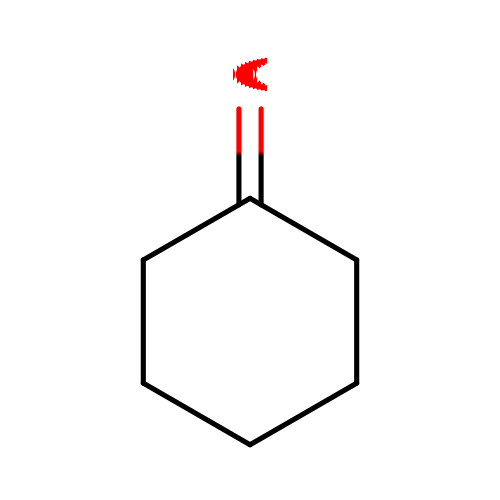
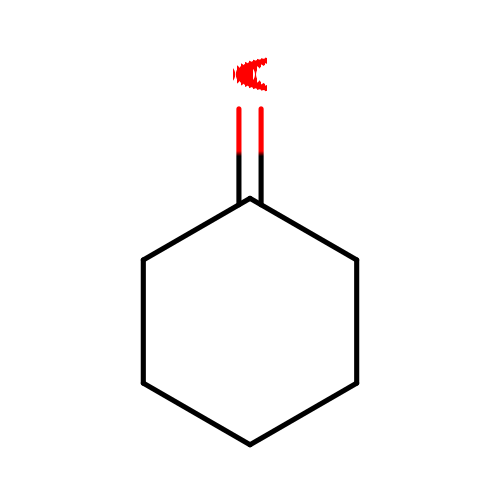
| Common Name | Cyclohexanone |
|---|
| Description | Cyclohexanone is a colorless oily liquid with an odor resembling acetone and peppermint. Cyclohexanone is occasionally found as a volatile component of human urine. Biological fluids such as blood and urine have been shown to contain a large number of components, some of them volatiles (low boiling point) apparently present in all individuals, while others such are much more variable. In some cases differences up to an order of magnitude are observed. Although some of these changes may have dietary origins, others seem to be characteristic of the individual. Cyclohexanone is obtained through oxidation of cyclohexane or dehydrogenation of phenol. Approx. 95% of its manufacturing is used for the production of nylon. Information on toxicity to human beings is fragmentary. Acute exposure is characterized by irritation of the eyes, nose, and throat. In two persons, drowsiness and renal impairment were found; however, these workers were also exposed to other compounds. Hepatic disorders were found in a group of workers exposed for over five years. In animals, cyclohexanone is characterized by relatively low acute toxicity (DL50 by intragastric administration is approximately 2 g/kg body wt.). Effects on the central nervous system (CNS) were found (narcosis), as well as irritation of the eyes and skin. Following multiple administration, effects were found in the CNS, liver, and kidneys as well as irritation of the conjunctiva. Mutagenic and genotoxic effects were found, but no teratogenic effects were detected; however, there were embryotoxic effects and influence on reproduction Cyclohexanone is well absorbed through the skin, respiratory tract, and alimentary tract. The main metabolic pathway leads to cyclohexanol, which is excreted in urine coupled with glucuronic acid. A high correlation was found between the concentration of cyclohexanone in the working environment and its concentration in urine. Cyclohexanone is formed from the hydrocarbons cyclohexane and 1-, 2-, and 3-hexanol. A patient's case report documents the development of anosmia (an olfactory disorder) and rhinitis caused by occupational exposure to organic solvents, including cyclohexanone (PMID:10476412 , 16925936 , 16477465 ). |
|---|
| Structure | InChI=1S/C6H10O/c7-6-4-2-1-3-5-6/h1-5H2 |
|---|
| Synonyms | | Value | Source |
|---|
| Cyclohexyl ketone | ChEBI | | Ketocyclohexane | ChEBI | | Ketohexamethylene | ChEBI | | Oxocyclohexane | ChEBI | | ANON | HMDB | | Anone | HMDB | | Cicloesanone | HMDB | | Cyclic ketone | HMDB | | Cyclohexanon | HMDB | | Cyclohexanone homopolymer | HMDB | | Cykloheksanon | HMDB | | Hexanon | HMDB | | Hytrol O | HMDB | | Hytrolo | HMDB | | Nadone | HMDB | | Pimelic ketone | HMDB | | Pimelin ketone | HMDB | | Rcra waste number u057 | HMDB | | Sextone | HMDB |
|
|---|
| Chemical Formula | C6H10O |
|---|
| Average Molecular Weight | 98.143 |
|---|
| Monoisotopic Molecular Weight | 98.073164942 |
|---|
| IUPAC Name | cyclohexanone |
|---|
| Traditional Name | cyclohexanone |
|---|
| CAS Registry Number | 108-94-1 |
|---|
| SMILES | O=C1CCCCC1 |
|---|
| InChI Identifier | InChI=1S/C6H10O/c7-6-4-2-1-3-5-6/h1-5H2 |
|---|
| InChI Key | JHIVVAPYMSGYDF-UHFFFAOYSA-N |
|---|
| Chemical Taxonomy |
|---|
| Description | Belongs to the class of organic compounds known as cyclic ketones. These are organic compounds containing a ketone that is conjugated to a cyclic moiety. |
|---|
| Kingdom | Organic compounds |
|---|
| Super Class | Organic oxygen compounds |
|---|
| Class | Organooxygen compounds |
|---|
| Sub Class | Carbonyl compounds |
|---|
| Direct Parent | Cyclic ketones |
|---|
| Alternative Parents | |
|---|
| Substituents | - Cyclic ketone
- Organic oxide
- Hydrocarbon derivative
- Aliphatic homomonocyclic compound
|
|---|
| Molecular Framework | Aliphatic homomonocyclic compounds |
|---|
| External Descriptors | |
|---|
| Ontology |
|---|
| Physiological effect | |
|---|
| Disposition | |
|---|
| Process | Not Available |
|---|
| Role | |
|---|
| Physical Properties |
|---|
| State | Liquid |
|---|
| Experimental Molecular Properties | | Property | Value | Reference |
|---|
| Melting Point | -31 °C | Not Available | | Boiling Point | 154.00 to 156.00 °C. @ 760.00 mm Hg | The Good Scents Company Information System | | Water Solubility | 25 mg/mL at 25 °C | Not Available | | LogP | 0.81 | HANSCH,C ET AL. (1995) |
|
|---|
| Experimental Chromatographic Properties | Not Available |
|---|
| Predicted Molecular Properties | |
|---|
| Predicted Chromatographic Properties | Predicted Collision Cross SectionsPredicted Retention Times Underivatized| Chromatographic Method | Retention Time | Reference |
|---|
| Measured using a Waters Acquity ultraperformance liquid chromatography (UPLC) ethylene-bridged hybrid (BEH) C18 column (100 mm × 2.1 mm; 1.7 μmparticle diameter). Predicted by Afia on May 17, 2022. Predicted by Afia on May 17, 2022. | 3.13 minutes | 32390414 | | Predicted by Siyang on May 30, 2022 | 12.6475 minutes | 33406817 | | Predicted by Siyang using ReTip algorithm on June 8, 2022 | 5.28 minutes | 32390414 | | Fem_Long = Waters ACQUITY UPLC HSS T3 C18 with Water:MeOH and 0.1% Formic Acid | 1595.5 seconds | 40023050 | | Fem_Lipids = Ascentis Express C18 with (60:40 water:ACN):(90:10 IPA:ACN) and 10mM NH4COOH + 0.1% Formic Acid | 462.6 seconds | 40023050 | | Life_Old = Waters ACQUITY UPLC BEH C18 with Water:(20:80 acetone:ACN) and 0.1% Formic Acid | 164.0 seconds | 40023050 | | Life_New = RP Waters ACQUITY UPLC HSS T3 C18 with Water:(30:70 MeOH:ACN) and 0.1% Formic Acid | 306.3 seconds | 40023050 | | RIKEN = Waters ACQUITY UPLC BEH C18 with Water:ACN and 0.1% Formic Acid | 294.7 seconds | 40023050 | | Eawag_XBridgeC18 = XBridge C18 3.5u 2.1x50 mm with Water:MeOH and 0.1% Formic Acid | 429.1 seconds | 40023050 | | BfG_NTS_RP1 =Agilent Zorbax Eclipse Plus C18 (2.1 mm x 150 mm, 3.5 um) with Water:ACN and 0.1% Formic Acid | 513.8 seconds | 40023050 | | HILIC_BDD_2 = Merck SeQuant ZIC-HILIC with ACN(0.1% formic acid):water(16 mM ammonium formate) | 123.6 seconds | 40023050 | | UniToyama_Atlantis = RP Waters Atlantis T3 (2.1 x 150 mm, 5 um) with ACN:Water and 0.1% Formic Acid | 1097.2 seconds | 40023050 | | BDD_C18 = Hypersil Gold 1.9µm C18 with Water:ACN and 0.1% Formic Acid | 319.7 seconds | 40023050 | | UFZ_Phenomenex = Kinetex Core-Shell C18 2.6 um, 3.0 x 100 mm, Phenomenex with Water:MeOH and 0.1% Formic Acid | 1019.9 seconds | 40023050 | | SNU_RIKEN_POS = Waters ACQUITY UPLC BEH C18 with Water:ACN and 0.1% Formic Acid | 298.7 seconds | 40023050 | | RPMMFDA = Waters ACQUITY UPLC BEH C18 with Water:ACN and 0.1% Formic Acid | 345.2 seconds | 40023050 | | MTBLS87 = Merck SeQuant ZIC-pHILIC column with ACN:Water and :ammonium carbonate | 547.0 seconds | 40023050 | | KI_GIAR_zic_HILIC_pH2_7 = Merck SeQuant ZIC-HILIC with ACN:Water and 0.1% FA | 431.6 seconds | 40023050 | | Meister zic-pHILIC pH9.3 = Merck SeQuant ZIC-pHILIC column with ACN:Water 5mM NH4Ac pH9.3 and 5mM ammonium acetate in water | 117.9 seconds | 40023050 |
Predicted Kovats Retention IndicesUnderivatizedDerivatized| Derivative Name / Structure | SMILES | Kovats RI Value | Column Type | Reference |
|---|
| Cyclohexanone,1TMS,isomer #1 | C[Si](C)(C)OC1=CCCCC1 | 1116.1 | Semi standard non polar | 33892256 | | Cyclohexanone,1TMS,isomer #1 | C[Si](C)(C)OC1=CCCCC1 | 1114.0 | Standard non polar | 33892256 | | Cyclohexanone,1TMS,isomer #1 | C[Si](C)(C)OC1=CCCCC1 | 1295.8 | Standard polar | 33892256 | | Cyclohexanone,1TBDMS,isomer #1 | CC(C)(C)[Si](C)(C)OC1=CCCCC1 | 1308.5 | Semi standard non polar | 33892256 | | Cyclohexanone,1TBDMS,isomer #1 | CC(C)(C)[Si](C)(C)OC1=CCCCC1 | 1289.3 | Standard non polar | 33892256 | | Cyclohexanone,1TBDMS,isomer #1 | CC(C)(C)[Si](C)(C)OC1=CCCCC1 | 1503.6 | Standard polar | 33892256 |
|
|---|
| Disease References | | Ulcerative colitis |
|---|
- De Preter V, Machiels K, Joossens M, Arijs I, Matthys C, Vermeire S, Rutgeerts P, Verbeke K: Faecal metabolite profiling identifies medium-chain fatty acids as discriminating compounds in IBD. Gut. 2015 Mar;64(3):447-58. doi: 10.1136/gutjnl-2013-306423. Epub 2014 May 8. [PubMed:24811995 ]
| | Crohn's disease |
|---|
- De Preter V, Machiels K, Joossens M, Arijs I, Matthys C, Vermeire S, Rutgeerts P, Verbeke K: Faecal metabolite profiling identifies medium-chain fatty acids as discriminating compounds in IBD. Gut. 2015 Mar;64(3):447-58. doi: 10.1136/gutjnl-2013-306423. Epub 2014 May 8. [PubMed:24811995 ]
|
|
|---|
| General References | - Zheng M, McErlane KM, Ong MC: Hydromorphone metabolites: isolation and identification from pooled urine samples of a cancer patient. Xenobiotica. 2002 May;32(5):427-39. [PubMed:12065064 ]
- Authors unspecified: Cyclohexanone. IARC Monogr Eval Carcinog Risks Hum. 1999;71 Pt 3:1359-64. [PubMed:10476412 ]
- Muttray A, Haxel B, Mann W, Letzel S: [Toxic anosmia and rhinitis due to occupational solvent exposure]. HNO. 2006 Nov;54(11):883-7. [PubMed:16477465 ]
- Walker R, Flanagan RJ, Lennard MS, Mills GA, Walker V: Solid-phase microextraction: investigation of the metabolism of substances that may be abused by inhalation. J Chromatogr Sci. 2006 Aug;44(7):387-93. [PubMed:16925936 ]
|
|---|