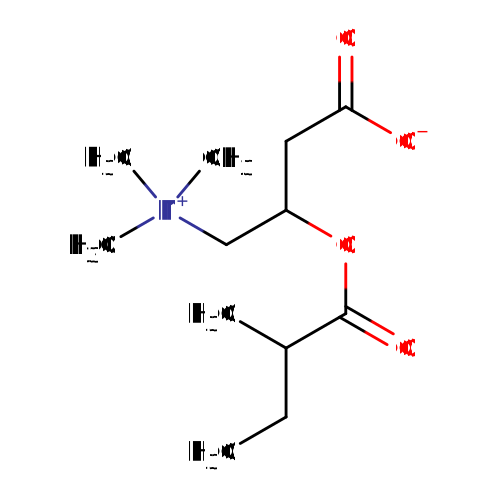
| Record Information |
|---|
| Version | 5.0 |
|---|
| Status | Detected but not Quantified |
|---|
| Creation Date | 2005-11-16 15:48:42 UTC |
|---|
| Update Date | 2022-10-24 19:27:59 UTC |
|---|
| HMDB ID | HMDB0000378 |
|---|
| Secondary Accession Numbers | - HMDB0001963
- HMDB00378
- HMDB01963
|
|---|
| Metabolite Identification |
|---|
| Common Name | 2-Methylbutyroylcarnitine |
|---|
| Description | 2-Methylbutyroylcarnitine is an acylcarnitine. More specifically, it is an 2-methylbutanoic acid ester of carnitine. Acylcarnitines were first discovered more than 70 year ago (PMID: 13825279 ). It is believed that there are more than 1000 types of acylcarnitines in the human body. The general role of acylcarnitines is to transport acyl-groups (organic acids and fatty acids) from the cytoplasm into the mitochondria so that they can be broken down to produce energy. This process is known as beta-oxidation. According to a recent review (PMID: 35710135 ), acylcarnitines (ACs) can be classified into 9 different categories depending on the type and size of their acyl-group: 1) short-chain ACs; 2) medium-chain ACs; 3) long-chain ACs; 4) very long-chain ACs; 5) hydroxy ACs; 6) branched chain ACs; 7) unsaturated ACs; 8) dicarboxylic ACs and 9) miscellaneous ACs. Short-chain ACs have acyl-groups with two to five carbons (C2-C5), medium-chain ACs have acyl-groups with six to thirteen carbons (C6-C13), long-chain ACs have acyl-groups with fourteen to twenty once carbons (C14-C21) and very long-chain ACs have acyl groups with more than 22 carbons. 2-Methylbutyroylcarnitine is therefore classified as a short chain AC. As a short-chain acylcarnitine 2-methylbutyroylcarnitine is a member of the most abundant group of carnitines in the body, comprising more than 50% of all acylcarnitines quantified in tissues and biofluids (PMID: 31920980 ). Some short-chain carnitines have been studied as supplements or treatments for a number of diseases, including neurological disorders and inborn errors of metabolism. In particular 2-methylbutyroylcarnitine is elevated in the blood or plasma of individuals with exudative age-related macular degeneration (PMID: 32120889 ), type 2 Diabetes Mellitus (PMID: 31782507 , PMID: 20111019 ), obesity (PMID: 20111019 ), acute cerebral infarction (PMID: 29265114 ), diastolic heart failure (PMID: 26010610 ), systolic heart failure (PMID: 26010610 ). It is also decreased in the blood or plasma of individuals with pregnancy (PMID: 24704061 - in serum of pregnant women with fetus with CHD). Carnitine acetyltransferase (CrAT, EC:2.3.1.7) is responsible for the synthesis of all short-chain and short branched-chain acylcarnitines (PMID: 23485643 ). The study of acylcarnitines is an active area of research and it is likely that many novel acylcarnitines will be discovered in the coming years. It is also likely that many novel roles in health and disease will be uncovered. An excellent review of the current state of knowledge for acylcarnitines is available (PMID: 35710135 ). |
|---|
| Structure | CCC(C)C(=O)OC(CC([O-])=O)C[N+](C)(C)C InChI=1S/C12H23NO4/c1-6-9(2)12(16)17-10(7-11(14)15)8-13(3,4)5/h9-10H,6-8H2,1-5H3 |
|---|
| Synonyms | | Value | Source |
|---|
| 3-[(2-Methylbutanoyl)oxy]-4-(trimethylammonio)butanoate | ChEBI | | 3-[(2-Methylbutanoyl)oxy]-4-(trimethylammonio)butanoic acid | Generator | | (2-Methylbutyryl)carnitine | HMDB | | L-2-Methylbutyrate (3-carboxy-2-hydroxypropyl)trimethyl-hydroxide ammonium inner salt | HMDB | | Methylbutyroyl-carnitine | HMDB |
|
|---|
| Chemical Formula | C12H23NO4 |
|---|
| Average Molecular Weight | 245.3153 |
|---|
| Monoisotopic Molecular Weight | 245.162708229 |
|---|
| IUPAC Name | 3-[(2-methylbutanoyl)oxy]-4-(trimethylazaniumyl)butanoate |
|---|
| Traditional Name | 2-methylbutyroylcarnitine |
|---|
| CAS Registry Number | 31023-25-3 |
|---|
| SMILES | CCC(C)C(=O)OC(CC([O-])=O)C[N+](C)(C)C |
|---|
| InChI Identifier | InChI=1S/C12H23NO4/c1-6-9(2)12(16)17-10(7-11(14)15)8-13(3,4)5/h9-10H,6-8H2,1-5H3 |
|---|
| InChI Key | IHCPDBBYTYJYIL-UHFFFAOYSA-N |
|---|
| Chemical Taxonomy |
|---|
| Description | Belongs to the class of organic compounds known as acyl carnitines. These are organic compounds containing a fatty acid with the carboxylic acid attached to carnitine through an ester bond. |
|---|
| Kingdom | Organic compounds |
|---|
| Super Class | Lipids and lipid-like molecules |
|---|
| Class | Fatty Acyls |
|---|
| Sub Class | Fatty acid esters |
|---|
| Direct Parent | Acyl carnitines |
|---|
| Alternative Parents | |
|---|
| Substituents | - Acyl-carnitine
- Branched fatty acid
- Dicarboxylic acid or derivatives
- Tetraalkylammonium salt
- Quaternary ammonium salt
- Carboxylic acid ester
- Carboxylic acid salt
- Carboxylic acid derivative
- Carboxylic acid
- Organonitrogen compound
- Hydrocarbon derivative
- Organic oxide
- Organopnictogen compound
- Organic nitrogen compound
- Carbonyl group
- Organic oxygen compound
- Amine
- Organooxygen compound
- Organic salt
- Aliphatic acyclic compound
|
|---|
| Molecular Framework | Aliphatic acyclic compounds |
|---|
| External Descriptors | |
|---|
| Ontology |
|---|
| Physiological effect | |
|---|
| Disposition | |
|---|
| Process | |
|---|
| Role | |
|---|
| Physical Properties |
|---|
| State | Solid |
|---|
| Experimental Molecular Properties | | Property | Value | Reference |
|---|
| Melting Point | Not Available | Not Available | | Boiling Point | Not Available | Not Available | | Water Solubility | Not Available | Not Available | | LogP | Not Available | Not Available |
|
|---|
| Experimental Chromatographic Properties | Not Available |
|---|
| Predicted Molecular Properties | |
|---|
| Predicted Chromatographic Properties | Predicted Collision Cross SectionsPredicted Retention Times Underivatized| Chromatographic Method | Retention Time | Reference |
|---|
| Measured using a Waters Acquity ultraperformance liquid chromatography (UPLC) ethylene-bridged hybrid (BEH) C18 column (100 mm × 2.1 mm; 1.7 μmparticle diameter). Predicted by Afia on May 17, 2022. Predicted by Afia on May 17, 2022. | 2.42 minutes | 32390414 | | Predicted by Siyang on May 30, 2022 | 10.7097 minutes | 33406817 | | Predicted by Siyang using ReTip algorithm on June 8, 2022 | 4.6 minutes | 32390414 | | AjsUoB = Accucore 150 Amide HILIC with 10mM Ammonium Formate, 0.1% Formic Acid | 216.5 seconds | 40023050 | | Fem_Long = Waters ACQUITY UPLC HSS T3 C18 with Water:MeOH and 0.1% Formic Acid | 1140.4 seconds | 40023050 | | Fem_Lipids = Ascentis Express C18 with (60:40 water:ACN):(90:10 IPA:ACN) and 10mM NH4COOH + 0.1% Formic Acid | 198.9 seconds | 40023050 | | Life_Old = Waters ACQUITY UPLC BEH C18 with Water:(20:80 acetone:ACN) and 0.1% Formic Acid | 129.9 seconds | 40023050 | | Life_New = RP Waters ACQUITY UPLC HSS T3 C18 with Water:(30:70 MeOH:ACN) and 0.1% Formic Acid | 154.0 seconds | 40023050 | | RIKEN = Waters ACQUITY UPLC BEH C18 with Water:ACN and 0.1% Formic Acid | 71.3 seconds | 40023050 | | Eawag_XBridgeC18 = XBridge C18 3.5u 2.1x50 mm with Water:MeOH and 0.1% Formic Acid | 402.1 seconds | 40023050 | | BfG_NTS_RP1 =Agilent Zorbax Eclipse Plus C18 (2.1 mm x 150 mm, 3.5 um) with Water:ACN and 0.1% Formic Acid | 398.8 seconds | 40023050 | | HILIC_BDD_2 = Merck SeQuant ZIC-HILIC with ACN(0.1% formic acid):water(16 mM ammonium formate) | 567.0 seconds | 40023050 | | UniToyama_Atlantis = RP Waters Atlantis T3 (2.1 x 150 mm, 5 um) with ACN:Water and 0.1% Formic Acid | 959.9 seconds | 40023050 | | BDD_C18 = Hypersil Gold 1.9µm C18 with Water:ACN and 0.1% Formic Acid | 289.3 seconds | 40023050 | | UFZ_Phenomenex = Kinetex Core-Shell C18 2.6 um, 3.0 x 100 mm, Phenomenex with Water:MeOH and 0.1% Formic Acid | 1484.4 seconds | 40023050 | | SNU_RIKEN_POS = Waters ACQUITY UPLC BEH C18 with Water:ACN and 0.1% Formic Acid | 204.7 seconds | 40023050 | | RPMMFDA = Waters ACQUITY UPLC BEH C18 with Water:ACN and 0.1% Formic Acid | 268.2 seconds | 40023050 | | MTBLS87 = Merck SeQuant ZIC-pHILIC column with ACN:Water and :ammonium carbonate | 320.4 seconds | 40023050 | | KI_GIAR_zic_HILIC_pH2_7 = Merck SeQuant ZIC-HILIC with ACN:Water and 0.1% FA | 227.4 seconds | 40023050 | | Meister zic-pHILIC pH9.3 = Merck SeQuant ZIC-pHILIC column with ACN:Water 5mM NH4Ac pH9.3 and 5mM ammonium acetate in water | 26.0 seconds | 40023050 |
Predicted Kovats Retention IndicesUnderivatized |
|---|
| General References | - Kidouchi K, Niwa T, Nohara D, Asai K, Sugiyama N, Morishita H, Kobayashi M, Wada Y: Urinary acylcarnitines in a patient with neonatal multiple acyl-CoA dehydrogenation deficiency, quantified by a carboxylic acid analyzer with a reversed-phase column. Clin Chim Acta. 1988 Apr 29;173(3):263-72. [PubMed:3383426 ]
- Salamino F, Di Lisa F, Burlina AB, Menabo R, Barbato R, De Tullio R, Siliprandi N: Involvement of erythrocyte calpain in glycine- and carnitine-treated isovaleric acidemia. Pediatr Res. 1994 Aug;36(2):182-6. [PubMed:7970932 ]
- Abdenur JE, Chamoles NA, Guinle AE, Schenone AB, Fuertes AN: Diagnosis of isovaleric acidaemia by tandem mass spectrometry: false positive result due to pivaloylcarnitine in a newborn screening programme. J Inherit Metab Dis. 1998 Aug;21(6):624-30. [PubMed:9762597 ]
- Fries MH, Rinaldo P, Schmidt-Sommerfeld E, Jurecki E, Packman S: Isovaleric acidemia: response to a leucine load after three weeks of supplementation with glycine, L-carnitine, and combined glycine-carnitine therapy. J Pediatr. 1996 Sep;129(3):449-52. [PubMed:8804338 ]
- Millington DS, Roe CR, Maltby DA, Inoue F: Endogenous catabolism is the major source of toxic metabolites in isovaleric acidemia. J Pediatr. 1987 Jan;110(1):56-60. [PubMed:3794887 ]
- Minkler PE, Ingalls ST, Hoppel CL: High-performance liquid chromatographic separation of acylcarnitines following derivatization with 4'-bromophenacyl trifluoromethanesulfonate. Anal Biochem. 1990 Feb 15;185(1):29-35. [PubMed:2344045 ]
- Chalmers RA, Roe CR, Stacey TE, Hoppel CL: Urinary excretion of l-carnitine and acylcarnitines by patients with disorders of organic acid metabolism: evidence for secondary insufficiency of l-carnitine. Pediatr Res. 1984 Dec;18(12):1325-8. [PubMed:6441143 ]
- Roe CR, Millington DS, Maltby DA, Kahler SG, Bohan TP: L-carnitine therapy in isovaleric acidemia. J Clin Invest. 1984 Dec;74(6):2290-5. [PubMed:6549017 ]
- Roe CR, Cederbaum SD, Roe DS, Mardach R, Galindo A, Sweetman L: Isolated isobutyryl-CoA dehydrogenase deficiency: an unrecognized defect in human valine metabolism. Mol Genet Metab. 1998 Dec;65(4):264-71. [PubMed:9889013 ]
- Sakuma T, Sugiyama N, Ichiki T, Kobayashi M, Wada Y, Nohara D: Analysis of acylcarnitines in maternal urine for prenatal diagnosis of glutaric aciduria type 2. Prenat Diagn. 1991 Feb;11(2):77-82. [PubMed:2062823 ]
- Matern D, He M, Berry SA, Rinaldo P, Whitley CB, Madsen PP, van Calcar SC, Lussky RC, Andresen BS, Wolff JA, Vockley J: Prospective diagnosis of 2-methylbutyryl-CoA dehydrogenase deficiency in the Hmong population by newborn screening using tandem mass spectrometry. Pediatrics. 2003 Jul;112(1 Pt 1):74-8. [PubMed:12837870 ]
- Pontremoli S, Melloni E, Michetti M, Sparatore B, Salamino F, Siliprandi N, Horecker BL: Isovalerylcarnitine is a specific activator of calpain of human neutrophils. Biochem Biophys Res Commun. 1987 Nov 13;148(3):1189-95. [PubMed:2825678 ]
- Ferrara F, Bertelli A, Falchi M: Evaluation of carnitine, acetylcarnitine and isovalerylcarnitine on immune function and apoptosis. Drugs Exp Clin Res. 2005;31(3):109-14. [PubMed:16033249 ]
- Bene J, Komlosi K, Havasi V, Talian G, Gasztonyi B, Horvath K, Mozsik G, Hunyady B, Melegh B, Figler M: Changes of plasma fasting carnitine ester profile in patients with ulcerative colitis. World J Gastroenterol. 2006 Jan 7;12(1):110-3. [PubMed:16440427 ]
- Fontaine M, Briand G, Vallee L, Ricart G, Degand P, Divry P, Vianey-Saban C, Vamecq J: Acylcarnitine removal in a patient with acyl-CoA beta-oxidation deficiency disorder: effect of L-carnitine therapy and starvation. Clin Chim Acta. 1996 Aug 30;252(2):109-22. [PubMed:8853559 ]
- Shigematsu Y, Kikawa Y, Sudo M, Kanaoka H, Fujioka M, Dan M: Prenatal diagnosis of isovaleric acidemia by fast atom bombardment and tandem mass spectrometry. Clin Chim Acta. 1991 Dec 16;203(2-3):369-74. [PubMed:1777996 ]
- Bahado-Singh RO, Ertl R, Mandal R, Bjorndahl TC, Syngelaki A, Han B, Dong E, Liu PB, Alpay-Savasan Z, Wishart DS, Nicolaides KH: Metabolomic prediction of fetal congenital heart defect in the first trimester. Am J Obstet Gynecol. 2014 Sep;211(3):240.e1-240.e14. doi: 10.1016/j.ajog.2014.03.056. Epub 2014 Apr 1. [PubMed:24704061 ]
- Zordoky BN, Sung MM, Ezekowitz J, Mandal R, Han B, Bjorndahl TC, Bouatra S, Anderson T, Oudit GY, Wishart DS, Dyck JR: Metabolomic fingerprint of heart failure with preserved ejection fraction. PLoS One. 2015 May 26;10(5):e0124844. doi: 10.1371/journal.pone.0124844. eCollection 2015. [PubMed:26010610 ]
- Violante S, Ijlst L, Ruiter J, Koster J, van Lenthe H, Duran M, de Almeida IT, Wanders RJ, Houten SM, Ventura FV: Substrate specificity of human carnitine acetyltransferase: Implications for fatty acid and branched-chain amino acid metabolism. Biochim Biophys Acta. 2013 Jun;1832(6):773-9. doi: 10.1016/j.bbadis.2013.02.012. Epub 2013 Feb 24. [PubMed:23485643 ]
- Elshenawy S, Pinney SE, Stuart T, Doulias PT, Zura G, Parry S, Elovitz MA, Bennett MJ, Bansal A, Strauss JF 3rd, Ischiropoulos H, Simmons RA: The Metabolomic Signature of the Placenta in Spontaneous Preterm Birth. Int J Mol Sci. 2020 Feb 4;21(3). pii: ijms21031043. doi: 10.3390/ijms21031043. [PubMed:32033212 ]
- FRITZ IB: Action of carnitine on long chain fatty acid oxidation by liver. Am J Physiol. 1959 Aug;197:297-304. doi: 10.1152/ajplegacy.1959.197.2.297. [PubMed:13825279 ]
- Makarova E, Makrecka-Kuka M, Vilks K, Volska K, Sevostjanovs E, Grinberga S, Zarkova-Malkova O, Dambrova M, Liepinsh E: Decreases in Circulating Concentrations of Long-Chain Acylcarnitines and Free Fatty Acids During the Glucose Tolerance Test Represent Tissue-Specific Insulin Sensitivity. Front Endocrinol (Lausanne). 2019 Dec 17;10:870. doi: 10.3389/fendo.2019.00870. eCollection 2019. [PubMed:31920980 ]
- Zhang X, Li Y, Liang Y, Sun P, Wu X, Song J, Sun X, Hong M, Gao P, Deng D: Distinguishing Intracerebral Hemorrhage from Acute Cerebral Infarction through Metabolomics. Rev Invest Clin. 2017 Nov-Dec;69(6):319-328. doi: 10.24875/RIC.17002348. [PubMed:29265114 ]
- Mihalik SJ, Goodpaster BH, Kelley DE, Chace DH, Vockley J, Toledo FG, DeLany JP: Increased levels of plasma acylcarnitines in obesity and type 2 diabetes and identification of a marker of glucolipotoxicity. Obesity (Silver Spring). 2010 Sep;18(9):1695-700. doi: 10.1038/oby.2009.510. Epub 2010 Jan 28. [PubMed:20111019 ]
- Chao de la Barca JM, Rondet-Courbis B, Ferre M, Muller J, Buisset A, Leruez S, Plubeau G, Mace T, Moureauzeau L, Chupin S, Tessier L, Blanchet O, Lenaers G, Procaccio V, Mirebeau-Prunier D, Simard G, Gohier P, Milea D, Reynier P: A Plasma Metabolomic Profiling of Exudative Age-Related Macular Degeneration Showing Carnosine and Mitochondrial Deficiencies. J Clin Med. 2020 Feb 27;9(3). pii: jcm9030631. doi: 10.3390/jcm9030631. [PubMed:32120889 ]
- Sun Y, Gao HY, Fan ZY, He Y, Yan YX: Metabolomics Signatures in Type 2 Diabetes: A Systematic Review and Integrative Analysis. J Clin Endocrinol Metab. 2020 Apr 1;105(4). pii: 5645632. doi: 10.1210/clinem/dgz240. [PubMed:31782507 ]
- Dambrova M, Makrecka-Kuka M, Kuka J, Vilskersts R, Nordberg D, Attwood MM, Smesny S, Sen ZD, Guo AC, Oler E, Tian S, Zheng J, Wishart DS, Liepinsh E, Schioth HB: Acylcarnitines: Nomenclature, Biomarkers, Therapeutic Potential, Drug Targets, and Clinical Trials. Pharmacol Rev. 2022 Jul;74(3):506-551. doi: 10.1124/pharmrev.121.000408. [PubMed:35710135 ]
|
|---|