| Record Information |
|---|
| Version | 5.0 |
|---|
| Status | Detected and Quantified |
|---|
| Creation Date | 2005-11-16 15:48:42 UTC |
|---|
| Update Date | 2022-03-07 02:49:05 UTC |
|---|
| HMDB ID | HMDB0000688 |
|---|
| Secondary Accession Numbers | |
|---|
| Metabolite Identification |
|---|
| Common Name | Isovalerylcarnitine |
|---|
| Description | Isovalerylcarnitine is the phenotypic abnormality in isovaleric acidemia (OMIM 243500 ) resulting from an accumulation of isovaleric acid, which is toxic to the central nervous system. Isovaleric acidemia is an autosomal recessive inborn error of leucine metabolism caused by a deficiency of the mitochondrial enzyme isovaleryl-CoA dehydrogenase (EC 1.3.99.10) resulting in the accumulation of derivatives of isovaleryl-CoA. It was the first organic acidemia recognized in humans and can cause significant morbidity and mortality. Early diagnosis and treatment with a protein restricted diet and supplementation with carnitine and glycine are effective in promoting normal development in severely affected individuals. An alternative pathway through glycine-N-acylase (EC 2.3.1.13) allows detoxification by producing isovalerylglycine, which is excreted. Thus, isovalerylcarnitine and isovalerylglycine are the hallmarks of this disorder in plasma and urine, respectively, and are elevated regardless of a patient's metabolic condition (PMID: 16602101 ). Moreover, isovalerylcarnitine is found to be associated with celiac disease and very long-chain acyl-CoA dehydrogenase deficiency (VLCAD), which are also inborn errors of metabolism. |
|---|
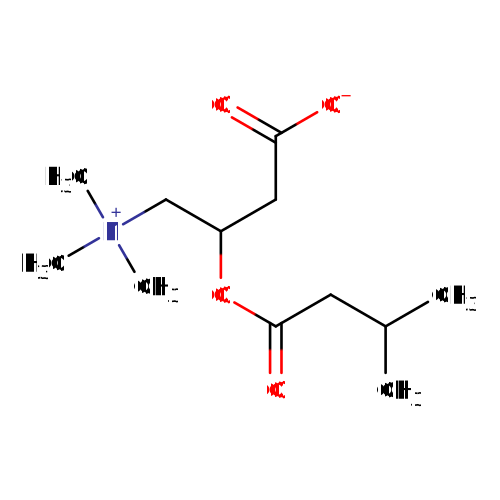
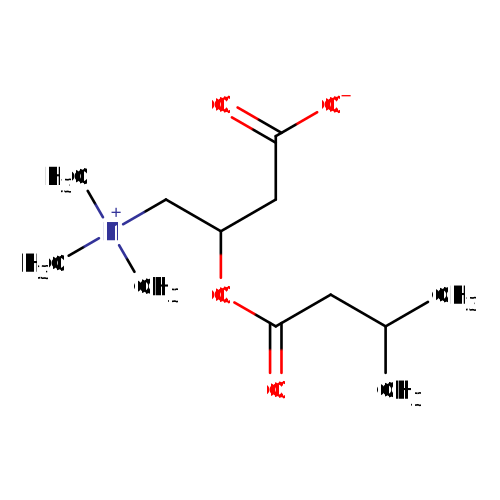
| Structure | CC(C)CC(=O)OC(CC([O-])=O)C[N+](C)(C)C InChI=1S/C12H23NO4/c1-9(2)6-12(16)17-10(7-11(14)15)8-13(3,4)5/h9-10H,6-8H2,1-5H3 |
|---|
| Synonyms | | Value | Source |
|---|
| 3-Methylbutyrylcarnitine | ChEBI | | Isovaleryl L-carnitine | HMDB | | 3-Methylbutyrylcarnitine, (+-)-isomer | MeSH, HMDB |
|
|---|
| Chemical Formula | C12H23NO4 |
|---|
| Average Molecular Weight | 245.3153 |
|---|
| Monoisotopic Molecular Weight | 245.162708229 |
|---|
| IUPAC Name | 3-[(3-methylbutanoyl)oxy]-4-(trimethylazaniumyl)butanoate |
|---|
| Traditional Name | isovalerylcarnitine |
|---|
| CAS Registry Number | 31023-24-2 |
|---|
| SMILES | CC(C)CC(=O)OC(CC([O-])=O)C[N+](C)(C)C |
|---|
| InChI Identifier | InChI=1S/C12H23NO4/c1-9(2)6-12(16)17-10(7-11(14)15)8-13(3,4)5/h9-10H,6-8H2,1-5H3 |
|---|
| InChI Key | IGQBPDJNUXPEMT-UHFFFAOYSA-N |
|---|
| Chemical Taxonomy |
|---|
| Description | Belongs to the class of organic compounds known as acyl carnitines. These are organic compounds containing a fatty acid with the carboxylic acid attached to carnitine through an ester bond. |
|---|
| Kingdom | Organic compounds |
|---|
| Super Class | Lipids and lipid-like molecules |
|---|
| Class | Fatty Acyls |
|---|
| Sub Class | Fatty acid esters |
|---|
| Direct Parent | Acyl carnitines |
|---|
| Alternative Parents | |
|---|
| Substituents | - Acyl-carnitine
- Branched fatty acid
- Dicarboxylic acid or derivatives
- Tetraalkylammonium salt
- Quaternary ammonium salt
- Carboxylic acid ester
- Carboxylic acid salt
- Carboxylic acid derivative
- Carboxylic acid
- Organonitrogen compound
- Hydrocarbon derivative
- Organic oxide
- Organopnictogen compound
- Organic nitrogen compound
- Carbonyl group
- Organic oxygen compound
- Amine
- Organooxygen compound
- Organic salt
- Aliphatic acyclic compound
|
|---|
| Molecular Framework | Aliphatic acyclic compounds |
|---|
| External Descriptors | |
|---|
| Ontology |
|---|
| Not Available | Not Available |
|---|
| Physical Properties |
|---|
| State | Solid |
|---|
| Experimental Molecular Properties | | Property | Value | Reference |
|---|
| Melting Point | Not Available | Not Available | | Boiling Point | Not Available | Not Available | | Water Solubility | Not Available | Not Available | | LogP | Not Available | Not Available |
|
|---|
| Experimental Chromatographic Properties | Not Available |
|---|
| Predicted Molecular Properties | |
|---|
| Predicted Chromatographic Properties | Predicted Collision Cross SectionsPredicted Retention Times Underivatized| Chromatographic Method | Retention Time | Reference |
|---|
| Measured using a Waters Acquity ultraperformance liquid chromatography (UPLC) ethylene-bridged hybrid (BEH) C18 column (100 mm × 2.1 mm; 1.7 μmparticle diameter). Predicted by Afia on May 17, 2022. Predicted by Afia on May 17, 2022. | 2.45 minutes | 32390414 | | Predicted by Siyang on May 30, 2022 | 10.4644 minutes | 33406817 | | Predicted by Siyang using ReTip algorithm on June 8, 2022 | 5.15 minutes | 32390414 | | AjsUoB = Accucore 150 Amide HILIC with 10mM Ammonium Formate, 0.1% Formic Acid | 202.9 seconds | 40023050 |
Predicted Kovats Retention IndicesUnderivatized |
|---|
| Spectra |
|---|
| |
|---|
| Biological Properties |
|---|
| Cellular Locations | |
|---|
| Biospecimen Locations | |
|---|
| Tissue Locations | |
|---|
| Pathways | |
|---|
| Normal Concentrations |
|---|
| |
| Blood | Detected and Quantified | 0.138 +/- 0.010 uM | Adult (>18 years old) | Both | Normal | | details | | Blood | Detected and Quantified | 0.049 (0.032-0.082) uM | Children (1-13 years old) | Both | Normal | | details | | Blood | Detected and Quantified | <0.400 uM | Not Specified | Not Specified | Normal | | details | | Blood | Detected and Quantified | <0.600 uM | Not Specified | Not Specified | Normal | | details | | Blood | Detected and Quantified | 0.46 uM | Newborn (0-30 days old) | Not Specified | Normal | | details | | Blood | Detected and Quantified | <0.110 uM | Not Specified | Not Specified | Normal | | details | | Blood | Detected but not Quantified | Not Quantified | Adult (>18 years old) | Both | Normal | | details | | Saliva | Detected and Quantified | 0.073 +/- 0.035 uM | Adult (>18 years old) | Both | Normal | | details | | Urine | Detected and Quantified | <3.0 umol/mmol creatinine | Newborn (0-30 days old) | Not Specified | Normal | | details | | Urine | Detected but not Quantified | Not Quantified | Adult (>18 years old) | Both | Normal | | details |
|
|---|
| Abnormal Concentrations |
|---|
| |
| Blood | Detected and Quantified | 0.111 +/- 0.010 uM | Adult (>18 years old) | Both | Celiac disease | | details | | Blood | Detected and Quantified | 0.052 (0.022-0.068) uM | Adult (>18 years old) | Both | Very long-chain acyl-CoA dehydrogenase deficiency (vLCAD) | | details | | Blood | Detected and Quantified | 27.300-48.200 uM | Not Specified | Not Specified | Isovaleric acidemia | | details |
|
|---|
| Associated Disorders and Diseases |
|---|
| Disease References | | Celiac disease |
|---|
- Bene J, Komlosi K, Gasztonyi B, Juhasz M, Tulassay Z, Melegh B: Plasma carnitine ester profile in adult celiac disease patients maintained on long-term gluten free diet. World J Gastroenterol. 2005 Nov 14;11(42):6671-5. [PubMed:16425363 ]
| | Very Long Chain Acyl-CoA Dehydrogenase Deficiency |
|---|
- Costa CG, Struys EA, Bootsma A, ten Brink HJ, Dorland L, Tavares de Almeida I, Duran M, Jakobs C: Quantitative analysis of plasma acylcarnitines using gas chromatography chemical ionization mass fragmentography. J Lipid Res. 1997 Jan;38(1):173-82. [PubMed:9034211 ]
| | Isovaleric acidemia |
|---|
- Matern D, He M, Berry SA, Rinaldo P, Whitley CB, Madsen PP, van Calcar SC, Lussky RC, Andresen BS, Wolff JA, Vockley J: Prospective diagnosis of 2-methylbutyryl-CoA dehydrogenase deficiency in the Hmong population by newborn screening using tandem mass spectrometry. Pediatrics. 2003 Jul;112(1 Pt 1):74-8. [PubMed:12837870 ]
|
|
|---|
| Associated OMIM IDs | - 212750 (Celiac disease)
- 201475 (Very Long Chain Acyl-CoA Dehydrogenase Deficiency)
- 243500 (Isovaleric acidemia)
|
|---|
| External Links |
|---|
| DrugBank ID | Not Available |
|---|
| Phenol Explorer Compound ID | Not Available |
|---|
| FooDB ID | FDB022183 |
|---|
| KNApSAcK ID | Not Available |
|---|
| Chemspider ID | 4932271 |
|---|
| KEGG Compound ID | Not Available |
|---|
| BioCyc ID | Not Available |
|---|
| BiGG ID | Not Available |
|---|
| Wikipedia Link | Not Available |
|---|
| METLIN ID | Not Available |
|---|
| PubChem Compound | Not Available |
|---|
| PDB ID | Not Available |
|---|
| ChEBI ID | 73025 |
|---|
| Food Biomarker Ontology | Not Available |
|---|
| VMH ID | Not Available |
|---|
| MarkerDB ID | MDB00000219 |
|---|
| Good Scents ID | Not Available |
|---|
| References |
|---|
| Synthesis Reference | Nakanishi, Toyofumi; Shimizu, Akira; Arimoto, Masao; Kanai, Michiko. Synthesis of acylcarnitines for differential diagnosis of metabolic disorders. Nippon Iyo Masu Supekutoru Gakkai Koenshu (1993), 18 129-32. |
|---|
| Material Safety Data Sheet (MSDS) | Not Available |
|---|
| General References | - Salamino F, Di Lisa F, Burlina AB, Menabo R, Barbato R, De Tullio R, Siliprandi N: Involvement of erythrocyte calpain in glycine- and carnitine-treated isovaleric acidemia. Pediatr Res. 1994 Aug;36(2):182-6. [PubMed:7970932 ]
- Fries MH, Rinaldo P, Schmidt-Sommerfeld E, Jurecki E, Packman S: Isovaleric acidemia: response to a leucine load after three weeks of supplementation with glycine, L-carnitine, and combined glycine-carnitine therapy. J Pediatr. 1996 Sep;129(3):449-52. [PubMed:8804338 ]
- Silva MF, Selhorst J, Overmars H, van Gennip AH, Maya M, Wanders RJ, de Almeida IT, Duran M: Characterization of plasma acylcarnitines in patients under valproate monotherapy using ESI-MS/MS. Clin Biochem. 2001 Nov;34(8):635-8. [PubMed:11849623 ]
- Vockley J, Ensenauer R: Isovaleric acidemia: new aspects of genetic and phenotypic heterogeneity. Am J Med Genet C Semin Med Genet. 2006 May 15;142C(2):95-103. [PubMed:16602101 ]
- Brunk E, Sahoo S, Zielinski DC, Altunkaya A, Drager A, Mih N, Gatto F, Nilsson A, Preciat Gonzalez GA, Aurich MK, Prlic A, Sastry A, Danielsdottir AD, Heinken A, Noronha A, Rose PW, Burley SK, Fleming RMT, Nielsen J, Thiele I, Palsson BO: Recon3D enables a three-dimensional view of gene variation in human metabolism. Nat Biotechnol. 2018 Mar;36(3):272-281. doi: 10.1038/nbt.4072. Epub 2018 Feb 19. [PubMed:29457794 ]
- Elshenawy S, Pinney SE, Stuart T, Doulias PT, Zura G, Parry S, Elovitz MA, Bennett MJ, Bansal A, Strauss JF 3rd, Ischiropoulos H, Simmons RA: The Metabolomic Signature of the Placenta in Spontaneous Preterm Birth. Int J Mol Sci. 2020 Feb 4;21(3). pii: ijms21031043. doi: 10.3390/ijms21031043. [PubMed:32033212 ]
|
|---|