| Record Information |
|---|
| Version | 5.0 |
|---|
| Status | Detected and Quantified |
|---|
| Creation Date | 2005-11-16 15:48:42 UTC |
|---|
| Update Date | 2023-02-21 17:15:09 UTC |
|---|
| HMDB ID | HMDB0000755 |
|---|
| Secondary Accession Numbers | |
|---|
| Metabolite Identification |
|---|
| Common Name | Hydroxyphenyllactic acid |
|---|
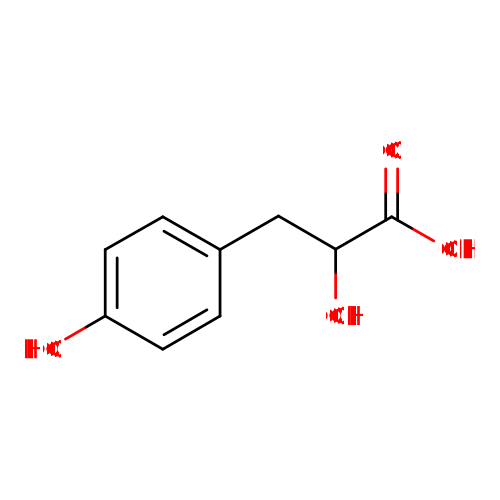
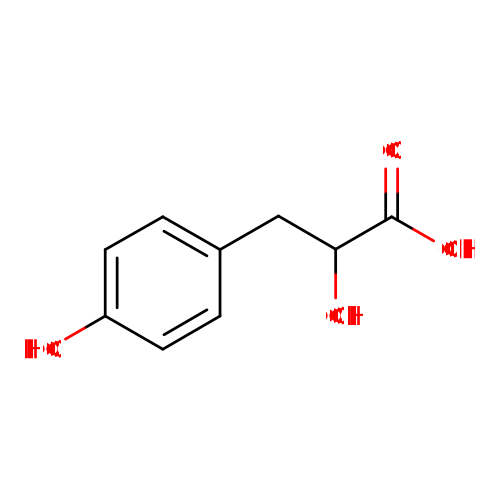
| Description | Hydroxyphenyllactic acid or 4-hydroxyphenyllactate (the L-form) is a tyrosine metabolite. The level of L-hydroxyphenyllactic acid is elevated in patients with a deficiency of the enzyme p-hydroxyphenylpyruvate oxidase (EC 1.14.2.2) (PMID: 4720815 ). L-hydroxyphenyllactate is present in relatively higher concentrations in the cerebrospinal fluid and urine of patients with phenylketonuria (PKU) and tyrosinemia (PMID: 3126358 ). However, the D-form of hydroxyphenyllactate is of bacterial origin and is also found in individuals with bacterial overgrowth or unusual gut microflora (PMID: 3126358 ). Microbial hydroxyphenyllactate is likely derived from phenolic or polyphenolic compounds in the diet. Bifidobacteria and lactobacilli produce considerable amounts of phenyllactic and p-hydroxyphenyllactic acids (PMID: 23061754 ). It has also been shown that hydroxyphenyllactate decreases ROS (reactive oxygen species) production in both mitochondria and neutrophils and so hydroxyphenyllactate may function as a natural anti-oxidant (PMID: 23061754 ). Hydroxyphenyllactic acid is a microbial metabolite found in Acinetobacter, Bacteroides, Bifidobacteria, Bifidobacterium, Clostridium, Enterococcus, Escherichia, Eubacterium, Klebsiella, Lactobacillus, Pseudomonas and Staphylococcus (PMID: 19961416 ). |
|---|
| Structure | OC(CC1=CC=C(O)C=C1)C(O)=O InChI=1S/C9H10O4/c10-7-3-1-6(2-4-7)5-8(11)9(12)13/h1-4,8,10-11H,5H2,(H,12,13) |
|---|
| Synonyms | | Value | Source |
|---|
| 2-Hydroxy-3-(4-hydroxyphenyl)propanoate | ChEBI | | 2-Hydroxy-3-(p-hydroxyphenyl)propionic acid | ChEBI | | 4-Hydroxyphenyllactic acid | ChEBI | | beta-(4-Hydroxyphenyl)lactic acid | ChEBI | | beta-(p-Hydroxyphenyl)lactic acid | ChEBI | | DL-p-Hydroxyphenyllactic acid | ChEBI | | p-Hydroxyphenyl lactic acid | ChEBI | | 4-Hydroxyphenyllactate | Kegg | | p-Hydroxyphenyllactate | Kegg | | 2-Hydroxy-3-(4-hydroxyphenyl)propanoic acid | Generator | | 2-Hydroxy-3-(p-hydroxyphenyl)propionate | Generator | | b-(4-Hydroxyphenyl)lactate | Generator | | b-(4-Hydroxyphenyl)lactic acid | Generator | | beta-(4-Hydroxyphenyl)lactate | Generator | | Β-(4-hydroxyphenyl)lactate | Generator | | Β-(4-hydroxyphenyl)lactic acid | Generator | | b-(p-Hydroxyphenyl)lactate | Generator | | b-(p-Hydroxyphenyl)lactic acid | Generator | | beta-(p-Hydroxyphenyl)lactate | Generator | | Β-(p-hydroxyphenyl)lactate | Generator | | Β-(p-hydroxyphenyl)lactic acid | Generator | | DL-p-Hydroxyphenyllactate | Generator | | p-Hydroxyphenyl lactate | Generator | | p-Hydroxyphenyllactic acid | Generator | | Hydroxyphenyllactate | Generator | | (RS)-3-(4-Hydroxyphenyl)lactate | HMDB | | (RS)-3-(4-Hydroxyphenyl)lactic acid | HMDB | | 3-(4-Hydroxyphenyl)-DL-lactate | HMDB | | 3-(4-Hydroxyphenyl)-DL-lactic acid | HMDB | | 3-(4-Hydroxyphenyl)lactate | HMDB | | 3-(p-Hydroxyphenyl)-lactate | HMDB | | 3-(p-Hydroxyphenyl)-lactic acid | HMDB | | a,4-Dihydroxybenzenepropanoate | HMDB | | a,4-Dihydroxybenzenepropanoic acid | HMDB | | b-(p-Hydroxyphenyl)-DL-lactate | HMDB | | b-(p-Hydroxyphenyl)-DL-lactic acid | HMDB | | beta-(p-Hydroxyphenyl)-DL-lactate | HMDB | | beta-(p-Hydroxyphenyl)-DL-lactic acid | HMDB | | DL-3-(4-Hydroxyphenyl)lactate | HMDB | | DL-3-(4-Hydroxyphenyl)lactic acid | HMDB | | HPLA | HMDB | | 4-Hydroxyphenyllactic acid, (DL)-isomer | HMDB | | Para-hydroxyphenyllactic acid | HMDB | | 2-Hydroxyphloretate | HMDB | | 2-Hydroxy-3-(4'-hydroxyphenyl)propanoic acid | HMDB | | 2-Hydroxy-3-(4'-hydroxyphenyl)propanoic acid | HMDB |
|
|---|
| Chemical Formula | C9H10O4 |
|---|
| Average Molecular Weight | 182.1733 |
|---|
| Monoisotopic Molecular Weight | 182.057908808 |
|---|
| IUPAC Name | 2-hydroxy-3-(4-hydroxyphenyl)propanoic acid |
|---|
| Traditional Name | hydroxyphenyllactic acid |
|---|
| CAS Registry Number | 306-23-0 |
|---|
| SMILES | OC(CC1=CC=C(O)C=C1)C(O)=O |
|---|
| InChI Identifier | InChI=1S/C9H10O4/c10-7-3-1-6(2-4-7)5-8(11)9(12)13/h1-4,8,10-11H,5H2,(H,12,13) |
|---|
| InChI Key | JVGVDSSUAVXRDY-UHFFFAOYSA-N |
|---|
| Chemical Taxonomy |
|---|
| Description | Belongs to the class of organic compounds known as phenylpropanoic acids. Phenylpropanoic acids are compounds with a structure containing a benzene ring conjugated to a propanoic acid. |
|---|
| Kingdom | Organic compounds |
|---|
| Super Class | Phenylpropanoids and polyketides |
|---|
| Class | Phenylpropanoic acids |
|---|
| Sub Class | Not Available |
|---|
| Direct Parent | Phenylpropanoic acids |
|---|
| Alternative Parents | |
|---|
| Substituents | - 3-phenylpropanoic-acid
- 1-hydroxy-2-unsubstituted benzenoid
- Phenol
- Alpha-hydroxy acid
- Monocyclic benzene moiety
- Benzenoid
- Hydroxy acid
- Secondary alcohol
- Carboxylic acid derivative
- Carboxylic acid
- Monocarboxylic acid or derivatives
- Alcohol
- Organooxygen compound
- Hydrocarbon derivative
- Carbonyl group
- Organic oxide
- Organic oxygen compound
- Aromatic homomonocyclic compound
|
|---|
| Molecular Framework | Aromatic homomonocyclic compounds |
|---|
| External Descriptors | |
|---|
| Ontology |
|---|
| Physiological effect | |
|---|
| Disposition | |
|---|
| Process | |
|---|
| Role | |
|---|
| Physical Properties |
|---|
| State | Solid |
|---|
| Experimental Molecular Properties | |
|---|
| Experimental Chromatographic Properties | Experimental Collision Cross Sections |
|---|
| Predicted Molecular Properties | |
|---|
| Predicted Chromatographic Properties | Predicted Collision Cross SectionsPredicted Retention Times Underivatized| Chromatographic Method | Retention Time | Reference |
|---|
| Measured using a Waters Acquity ultraperformance liquid chromatography (UPLC) ethylene-bridged hybrid (BEH) C18 column (100 mm × 2.1 mm; 1.7 μmparticle diameter). Predicted by Afia on May 17, 2022. Predicted by Afia on May 17, 2022. | 2.96 minutes | 32390414 | | Predicted by Siyang on May 30, 2022 | 9.8335 minutes | 33406817 | | Predicted by Siyang using ReTip algorithm on June 8, 2022 | 3.65 minutes | 32390414 | | AjsUoB = Accucore 150 Amide HILIC with 10mM Ammonium Formate, 0.1% Formic Acid | 115.4 seconds | 40023050 | | Fem_Long = Waters ACQUITY UPLC HSS T3 C18 with Water:MeOH and 0.1% Formic Acid | 1075.4 seconds | 40023050 | | Fem_Lipids = Ascentis Express C18 with (60:40 water:ACN):(90:10 IPA:ACN) and 10mM NH4COOH + 0.1% Formic Acid | 289.9 seconds | 40023050 | | Life_Old = Waters ACQUITY UPLC BEH C18 with Water:(20:80 acetone:ACN) and 0.1% Formic Acid | 93.6 seconds | 40023050 | | Life_New = RP Waters ACQUITY UPLC HSS T3 C18 with Water:(30:70 MeOH:ACN) and 0.1% Formic Acid | 167.7 seconds | 40023050 | | RIKEN = Waters ACQUITY UPLC BEH C18 with Water:ACN and 0.1% Formic Acid | 83.4 seconds | 40023050 | | Eawag_XBridgeC18 = XBridge C18 3.5u 2.1x50 mm with Water:MeOH and 0.1% Formic Acid | 310.3 seconds | 40023050 | | BfG_NTS_RP1 =Agilent Zorbax Eclipse Plus C18 (2.1 mm x 150 mm, 3.5 um) with Water:ACN and 0.1% Formic Acid | 287.9 seconds | 40023050 | | HILIC_BDD_2 = Merck SeQuant ZIC-HILIC with ACN(0.1% formic acid):water(16 mM ammonium formate) | 335.7 seconds | 40023050 | | UniToyama_Atlantis = RP Waters Atlantis T3 (2.1 x 150 mm, 5 um) with ACN:Water and 0.1% Formic Acid | 672.3 seconds | 40023050 | | BDD_C18 = Hypersil Gold 1.9µm C18 with Water:ACN and 0.1% Formic Acid | 293.0 seconds | 40023050 | | UFZ_Phenomenex = Kinetex Core-Shell C18 2.6 um, 3.0 x 100 mm, Phenomenex with Water:MeOH and 0.1% Formic Acid | 918.1 seconds | 40023050 | | SNU_RIKEN_POS = Waters ACQUITY UPLC BEH C18 with Water:ACN and 0.1% Formic Acid | 205.9 seconds | 40023050 | | RPMMFDA = Waters ACQUITY UPLC BEH C18 with Water:ACN and 0.1% Formic Acid | 242.1 seconds | 40023050 | | MTBLS87 = Merck SeQuant ZIC-pHILIC column with ACN:Water and :ammonium carbonate | 489.0 seconds | 40023050 | | KI_GIAR_zic_HILIC_pH2_7 = Merck SeQuant ZIC-HILIC with ACN:Water and 0.1% FA | 273.5 seconds | 40023050 | | Meister zic-pHILIC pH9.3 = Merck SeQuant ZIC-pHILIC column with ACN:Water 5mM NH4Ac pH9.3 and 5mM ammonium acetate in water | 208.1 seconds | 40023050 |
Predicted Kovats Retention IndicesUnderivatizedDerivatized| Derivative Name / Structure | SMILES | Kovats RI Value | Column Type | Reference |
|---|
| Hydroxyphenyllactic acid,1TMS,isomer #1 | C[Si](C)(C)OC(CC1=CC=C(O)C=C1)C(=O)O | 1886.2 | Semi standard non polar | 33892256 | | Hydroxyphenyllactic acid,1TMS,isomer #2 | C[Si](C)(C)OC1=CC=C(CC(O)C(=O)O)C=C1 | 1835.4 | Semi standard non polar | 33892256 | | Hydroxyphenyllactic acid,1TMS,isomer #3 | C[Si](C)(C)OC(=O)C(O)CC1=CC=C(O)C=C1 | 1846.2 | Semi standard non polar | 33892256 | | Hydroxyphenyllactic acid,2TMS,isomer #1 | C[Si](C)(C)OC1=CC=C(CC(O[Si](C)(C)C)C(=O)O)C=C1 | 1887.2 | Semi standard non polar | 33892256 | | Hydroxyphenyllactic acid,2TMS,isomer #2 | C[Si](C)(C)OC(=O)C(CC1=CC=C(O)C=C1)O[Si](C)(C)C | 1884.2 | Semi standard non polar | 33892256 | | Hydroxyphenyllactic acid,2TMS,isomer #3 | C[Si](C)(C)OC(=O)C(O)CC1=CC=C(O[Si](C)(C)C)C=C1 | 1856.0 | Semi standard non polar | 33892256 | | Hydroxyphenyllactic acid,3TMS,isomer #1 | C[Si](C)(C)OC(=O)C(CC1=CC=C(O[Si](C)(C)C)C=C1)O[Si](C)(C)C | 1910.8 | Semi standard non polar | 33892256 | | Hydroxyphenyllactic acid,1TBDMS,isomer #1 | CC(C)(C)[Si](C)(C)OC(CC1=CC=C(O)C=C1)C(=O)O | 2132.7 | Semi standard non polar | 33892256 | | Hydroxyphenyllactic acid,1TBDMS,isomer #2 | CC(C)(C)[Si](C)(C)OC1=CC=C(CC(O)C(=O)O)C=C1 | 2096.9 | Semi standard non polar | 33892256 | | Hydroxyphenyllactic acid,1TBDMS,isomer #3 | CC(C)(C)[Si](C)(C)OC(=O)C(O)CC1=CC=C(O)C=C1 | 2101.6 | Semi standard non polar | 33892256 | | Hydroxyphenyllactic acid,2TBDMS,isomer #1 | CC(C)(C)[Si](C)(C)OC1=CC=C(CC(O[Si](C)(C)C(C)(C)C)C(=O)O)C=C1 | 2386.3 | Semi standard non polar | 33892256 | | Hydroxyphenyllactic acid,2TBDMS,isomer #2 | CC(C)(C)[Si](C)(C)OC(=O)C(CC1=CC=C(O)C=C1)O[Si](C)(C)C(C)(C)C | 2338.7 | Semi standard non polar | 33892256 | | Hydroxyphenyllactic acid,2TBDMS,isomer #3 | CC(C)(C)[Si](C)(C)OC(=O)C(O)CC1=CC=C(O[Si](C)(C)C(C)(C)C)C=C1 | 2376.6 | Semi standard non polar | 33892256 | | Hydroxyphenyllactic acid,3TBDMS,isomer #1 | CC(C)(C)[Si](C)(C)OC(=O)C(CC1=CC=C(O[Si](C)(C)C(C)(C)C)C=C1)O[Si](C)(C)C(C)(C)C | 2604.8 | Semi standard non polar | 33892256 |
|
|---|
| Spectra |
|---|
| |
|---|
| Biological Properties |
|---|
| Cellular Locations | |
|---|
| Biospecimen Locations | - Blood
- Cerebrospinal Fluid (CSF)
- Feces
- Saliva
- Urine
|
|---|
| Tissue Locations | - Epidermis
- Placenta
- Prostate
|
|---|
| Pathways | |
|---|
| Normal Concentrations |
|---|
| |
| Blood | Detected but not Quantified | Not Quantified | Adult (>18 years old) | Both | Normal | | details | | Blood | Detected and Quantified | 0.64 +/- 0.24 uM | Adult (>18 years old) | Both | Normal | | details | | Blood | Detected but not Quantified | Not Quantified | Adult (>18 years old) | Female | Normal | | details | | Feces | Detected but not Quantified | Not Quantified | Adult (>18 years old) | Both | Normal | | details | | Feces | Detected but not Quantified | Not Quantified | Infant (0-1 year old) | Not Specified | Normal | | details | | Feces | Detected but not Quantified | Not Quantified | Infant (0-1 year old) | Not Specified | Normal | | details | | Feces | Detected but not Quantified | Not Quantified | Infant (0-1 year old) | Not Available | Normal | | details | | Feces | Detected but not Quantified | Not Quantified | Children (1-13 years old) | Both | Normal | | details | | Feces | Detected but not Quantified | Not Quantified | Adult (>18 years old) | Both | Normal | | details | | Feces | Detected but not Quantified | Not Quantified | Adult (>18 years old) | Both | Normal | | details | | Feces | Detected but not Quantified | Not Quantified | Adult (>18 years old) | Both | Normal | | details | | Feces | Detected but not Quantified | Not Quantified | Adult (>18 years old) | Both | Normal | | details | | Saliva | Detected and Quantified | 25.10 +/- 14.93 uM | Adult (>18 years old) | Both | Normal | | details | | Saliva | Detected but not Quantified | Not Quantified | Adult (>18 years old) | Male | Normal | | details | | Saliva | Detected but not Quantified | Not Quantified | Adult (>18 years old) | Male | Normal | | details | | Saliva | Detected but not Quantified | Not Quantified | Adult (>18 years old) | Male | Normal | | details | | Saliva | Detected but not Quantified | Not Quantified | Adult (>18 years old) | Male | Normal | | details | | Saliva | Detected but not Quantified | Not Quantified | Adult (>18 years old) | Male | Normal | | details | | Saliva | Detected but not Quantified | Not Quantified | Adult (>18 years old) | Male | Normal | | details | | Saliva | Detected but not Quantified | Not Quantified | Adult (>18 years old) | Male | Normal | | details | | Saliva | Detected but not Quantified | Not Quantified | Adult (>18 years old) | Male | Normal | | details | | Saliva | Detected but not Quantified | Not Quantified | Adult (>18 years old) | Male | Normal | | details | | Saliva | Detected but not Quantified | Not Quantified | Adult (>18 years old) | Male | Normal | | details | | Urine | Detected and Quantified | 33.513 +/- 76.957 umol/mmol creatinine | Infant (0-1 year old) | Both | Normal | | details | | Urine | Detected and Quantified | 22.342 +/- 30.410 umol/mmol creatinine | Infant (0-1 year old) | Both | Normal | | details | | Urine | Detected and Quantified | 17.377 +/- 21.101 umol/mmol creatinine | Infant (0-1 year old) | Both | Normal | | details | | Urine | Detected but not Quantified | Not Quantified | Adult (>18 years old) | Both | Normal | | details | | Urine | Detected and Quantified | 0-1.0 umol/mmol creatinine | Infant (0-1 year old) | Male | Normal | | details | | Urine | Detected and Quantified | 0-1.0 umol/mmol creatinine | Infant (0-1 year old) | Female | Normal | | details | | Urine | Detected and Quantified | 0-2 umol/mmol creatinine | Infant (0-1 year old) | Male | Normal | | details | | Urine | Detected and Quantified | 0-2.3 umol/mmol creatinine | Infant (0-1 year old) | Female | Normal | | details | | Urine | Detected but not Quantified | Not Quantified | Adult (>18 years old) | Both | Normal | | details | | Urine | Detected and Quantified | 5.393 +/- 4.849 umol/mmol creatinine | Children (1 - 13 years old) | Not Specified | Normal | | details | | Urine | Detected and Quantified | 0.51-0.94 umol/mmol creatinine | Adult (>18 years old) | Male | Normal | | details | | Urine | Detected and Quantified | 0.55-1.2 umol/mmol creatinine | Adult (>18 years old) | Female | Normal | | details | | Urine | Detected and Quantified | <50.12 umol/mmol creatinine | Children (1 - 18 years old) | Both | Normal | | details | | Urine | Detected and Quantified | 3.7 (0.1-11.5) umol/mmol creatinine | Newborn (0-30 days old) | Both | Normal | | details | | Urine | Detected and Quantified | 35.939 umol/mmol creatinine | Children (1 - 13 years old) | Not Specified | Normal | | details | | Urine | Detected but not Quantified | Not Quantified | Adult (>18 years old) | Both | Normal | | details | | Urine | Detected and Quantified | 3.2 (1.5-3.9) umol/mmol creatinine | Adult (>18 years old) | Both | Normal | | details | | Urine | Detected and Quantified | 2.8 (2.6-3.0) umol/mmol creatinine | Adult (>18 years old) | Both | Normal | | details | | Urine | Detected and Quantified | 1.1 (0.2-2.6) umol/mmol creatinine | Adult (>18 years old) | Both | Normal | | details | | Urine | Detected and Quantified | 1.05 +/- 0.43 umol/mmol creatinine | Adult (>18 years old) | Male | Normal | | details | | Urine | Detected and Quantified | 1.0 (0.4-7.3) umol/mmol creatinine | Adolescent (13-18 years old) | Both | Normal | | details | | Urine | Detected and Quantified | 1.5 (0.1-8.7) umol/mmol creatinine | Children (1-13 years old) | Both | Normal | | details | | Urine | Detected and Quantified | 1.6 (0.3-5.8) umol/mmol creatinine | Children (1-13 years old) | Both | Normal | | details | | Urine | Detected and Quantified | 4.8 (2.7-5.3) umol/mmol creatinine | Infant (0-1 year old) | Both | Normal | | details |
|
|---|
| Abnormal Concentrations |
|---|
| |
| Cerebrospinal Fluid (CSF) | Detected and Quantified | 0.80 +/- 0.10 uM | Adult (>18 years old) | Both | Morphine treatment | | details | | Feces | Detected but not Quantified | Not Quantified | Adult (>18 years old) | Both | CCD | | details | | Feces | Detected but not Quantified | Not Quantified | Adult (>18 years old) | Both | Ileal Crohn's disease | | details | | Feces | Detected but not Quantified | Not Quantified | Adult (>18 years old) | Both | Colorectal Cancer | | details | | Feces | Detected but not Quantified | Not Quantified | Adult (>18 years old) | Both | Colorectal cancer | | details | | Saliva | Detected but not Quantified | Not Quantified | Adult (>18 years old) | Male | Supragingival Plaque | | details | | Urine | Detected and Quantified | 12.6 +/- 36.00 umol/mmol creatinine | Newborn (0-30 days old) | Both | Phenylketonuria | | details | | Urine | Detected and Quantified | 6.21 +/- 4.38 umol/mmol creatinine | Children (1 - 13 years old) | Not Specified | Eosinophilic esophagitis | | details | | Urine | Detected and Quantified | 5.879 +/- 5.443 umol/mmol creatinine | Children (1 - 13 years old) | Not Specified | Eosinophilic esophagitis | | details | | Urine | Detected and Quantified | 8.512 +/- 4.226 umol/mmol creatinine | Children (1 - 13 years old) | Not Specified | Gastroesophageal reflux disease | | details | | Urine | Detected and Quantified | 139.639 +/- 122.882 umol/mmol creatinine | Children (1-13 years old) | Both | Phenylketonuria | | details | | Urine | Detected and Quantified | 74.474 +/- 94.334 umol/mmol creatinine | Children (1-13 years old) | Both | Phenylketonuria | | details | | Urine | Detected and Quantified | 75.0948 +/- 98.678 umol/mmol creatinine | Children (1-13 years old) | Both | Phenylketonuria | | details |
|
|---|
| Associated Disorders and Diseases |
|---|
| Disease References | | Colorectal cancer |
|---|
- Brown DG, Rao S, Weir TL, O'Malia J, Bazan M, Brown RJ, Ryan EP: Metabolomics and metabolic pathway networks from human colorectal cancers, adjacent mucosa, and stool. Cancer Metab. 2016 Jun 6;4:11. doi: 10.1186/s40170-016-0151-y. eCollection 2016. [PubMed:27275383 ]
- Goedert JJ, Sampson JN, Moore SC, Xiao Q, Xiong X, Hayes RB, Ahn J, Shi J, Sinha R: Fecal metabolomics: assay performance and association with colorectal cancer. Carcinogenesis. 2014 Sep;35(9):2089-96. doi: 10.1093/carcin/bgu131. Epub 2014 Jul 18. [PubMed:25037050 ]
| | Supragingival Plaque |
|---|
- Liebsch C, Pitchika V, Pink C, Samietz S, Kastenmuller G, Artati A, Suhre K, Adamski J, Nauck M, Volzke H, Friedrich N, Kocher T, Holtfreter B, Pietzner M: The Saliva Metabolome in Association to Oral Health Status. J Dent Res. 2019 Jun;98(6):642-651. doi: 10.1177/0022034519842853. Epub 2019 Apr 26. [PubMed:31026179 ]
| | Phenylketonuria |
|---|
- Monch E, Kneer J, Jakobs C, Arnold M, Diehl H, Batzler U: Examination of urine metabolites in the newborn period and during protein loading tests at 6 months of age--Part 1. Eur J Pediatr. 1990;149 Suppl 1:S17-24. [PubMed:2091926 ]
- Rampini S, Vollmin JA, Bosshard HR, Muller M, Curtius HC: Aromatic acids in urine of healthy infants, persistent hyperphenylalaninemia, and phenylketonuria, before and after phenylalanine load. Pediatr Res. 1974 Jul;8(7):704-9. [PubMed:4837567 ]
| | Eosinophilic esophagitis |
|---|
- Slae, M., Huynh, H., Wishart, D.S. (2014). Analysis of 30 normal pediatric urine samples via NMR spectroscopy (unpublished work). NA.
|
|
|---|
| Associated OMIM IDs | |
|---|
| External Links |
|---|
| DrugBank ID | Not Available |
|---|
| Phenol Explorer Compound ID | 577 |
|---|
| FooDB ID | FDB017136 |
|---|
| KNApSAcK ID | C00050491 |
|---|
| Chemspider ID | 9010 |
|---|
| KEGG Compound ID | C03672 |
|---|
| BioCyc ID | 4-HYDROXYPHENYLLACTATE |
|---|
| BiGG ID | 2392410 |
|---|
| Wikipedia Link | Not Available |
|---|
| METLIN ID | 5723 |
|---|
| PubChem Compound | 9378 |
|---|
| PDB ID | Not Available |
|---|
| ChEBI ID | 17385 |
|---|
| Food Biomarker Ontology | Not Available |
|---|
| VMH ID | 34HPL |
|---|
| MarkerDB ID | MDB00029989 |
|---|
| Good Scents ID | rw1622271 |
|---|
| References |
|---|
| Synthesis Reference | Deng, Xi-ling; Wang, Xin-bing; Xiang, Ying; Zhu, Shi-fa. Synthesis of b-(4-hydroxyphenyl)lactic acid. Shihezi Daxue Xuebao, Ziran Kexueban (2005), 23(1), 11-13. |
|---|
| Material Safety Data Sheet (MSDS) | Download (PDF) |
|---|
| General References | - Sreekumar A, Poisson LM, Rajendiran TM, Khan AP, Cao Q, Yu J, Laxman B, Mehra R, Lonigro RJ, Li Y, Nyati MK, Ahsan A, Kalyana-Sundaram S, Han B, Cao X, Byun J, Omenn GS, Ghosh D, Pennathur S, Alexander DC, Berger A, Shuster JR, Wei JT, Varambally S, Beecher C, Chinnaiyan AM: Metabolomic profiles delineate potential role for sarcosine in prostate cancer progression. Nature. 2009 Feb 12;457(7231):910-4. doi: 10.1038/nature07762. [PubMed:19212411 ]
- Guneral F, Bachmann C: Age-related reference values for urinary organic acids in a healthy Turkish pediatric population. Clin Chem. 1994 Jun;40(6):862-6. [PubMed:8087979 ]
- Raw I, Schmidt BJ, Merzel J: Catecholamines and congenital pain insensitivity. Braz J Med Biol Res. 1984;17(3-4):271-9. [PubMed:6085021 ]
- Bennett MJ, Ragni MC, Hood I, Hale DE: Comparison of post-mortem urinary and vitreous humour organic acids. Ann Clin Biochem. 1992 Sep;29 ( Pt 5):541-5. [PubMed:1444166 ]
- Roth K, Cohn R, Yandrasitz J, Preti G, Dodd P, Segal S: Beta-methylcrotonic aciduria associated with lactic acidosis. J Pediatr. 1976 Feb;88(2):229-35. [PubMed:1249684 ]
- Spaapen LJ, Ketting D, Wadman SK, Bruinvis L, Duran M: Urinary D-4-hydroxyphenyllactate, D-phenyllactate and D-2-hydroxyisocaproate, abnormalities of bacterial origin. J Inherit Metab Dis. 1987;10(4):383-90. [PubMed:3126358 ]
- Deutsch JC: Determination of p-hydroxyphenylpyruvate, p-hydroxyphenyllactate and tyrosine in normal human plasma by gas chromatography-mass spectrometry isotope-dilution assay. J Chromatogr B Biomed Sci Appl. 1997 Mar 7;690(1-2):1-6. [PubMed:9106023 ]
- Mrochek JE, Dinsmore SR, Ohrt DW: Monitoring phenylalanine-tyrosine metabolism by high-resolution liquid chromatography of urine. Clin Chem. 1973 Aug;19(8):927-36. [PubMed:4720815 ]
- Higa S, Kishimoto S: Isolation of 2-hydroxycarboxylic acids with a boronate affinity gel. Anal Biochem. 1986 Apr;154(1):71-4. [PubMed:3706738 ]
- Jakobs C, Sweetman L, Nyhan WL: Chemical analysis of succinylacetone and 4-hydroxyphenyllactate in amniotic fluid using selective ion monitoring. Prenat Diagn. 1984 May-Jun;4(3):187-94. [PubMed:6463026 ]
- Beloborodova N, Bairamov I, Olenin A, Shubina V, Teplova V, Fedotcheva N: Effect of phenolic acids of microbial origin on production of reactive oxygen species in mitochondria and neutrophils. J Biomed Sci. 2012 Oct 12;19:89. doi: 10.1186/1423-0127-19-89. [PubMed:23061754 ]
- Beloborodova NV, Khodakova AS, Bairamov IT, Olenin AY: Microbial origin of phenylcarboxylic acids in the human body. Biochemistry (Mosc). 2009 Dec;74(12):1350-5. [PubMed:19961416 ]
- Elshenawy S, Pinney SE, Stuart T, Doulias PT, Zura G, Parry S, Elovitz MA, Bennett MJ, Bansal A, Strauss JF 3rd, Ischiropoulos H, Simmons RA: The Metabolomic Signature of the Placenta in Spontaneous Preterm Birth. Int J Mol Sci. 2020 Feb 4;21(3). pii: ijms21031043. doi: 10.3390/ijms21031043. [PubMed:32033212 ]
- (). Charles Scriver, Arthur Beaudet, William Sly, David Valle, Barton Childs, Kenneth Kinzler, Bert Vogelstein. The Metabolic and Molecular Bases of Inherited Disease. McGraw-Hill Professional; 8 edition (Dec 15 2000). . . [ISBN:978-0079130358 ]
|
|---|