| Record Information |
|---|
| Version | 5.0 |
|---|
| Status | Detected and Quantified |
|---|
| Creation Date | 2006-05-22 14:17:31 UTC |
|---|
| Update Date | 2022-03-07 02:49:12 UTC |
|---|
| HMDB ID | HMDB0002000 |
|---|
| Secondary Accession Numbers | |
|---|
| Metabolite Identification |
|---|
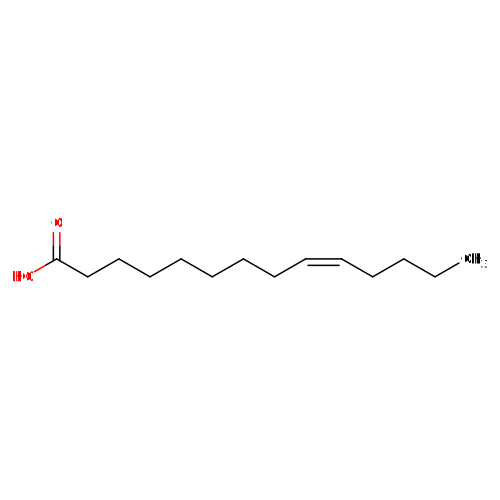
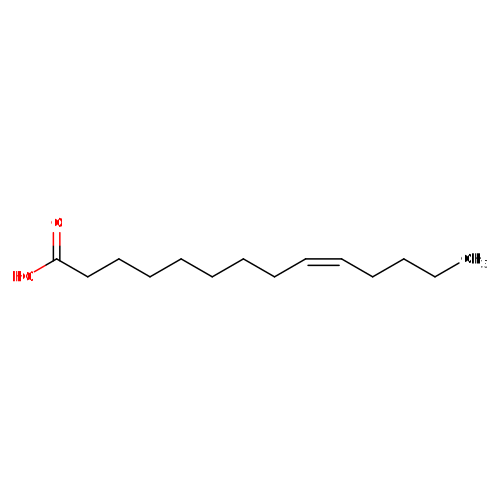
| Common Name | Myristoleic acid |
|---|
| Description | Myristoleic acid, also known as 9-tetradecenoate or myristoleate, belongs to the class of organic compounds known as long-chain fatty acids. These are fatty acids with an aliphatic tail that contains between 13 and 21 carbon atoms. Myristoleic acid is a very hydrophobic molecule, practically insoluble (in water), and relatively neutral. Myristoleic acid exists in all eukaryotes, ranging from yeast to humans. Outside of the human body, myristoleic acid is found in the highest concentration within a few different foods, such as milk (cow), butter, and margarine-like spreads, and in a lower concentration in creams, meat bouillons, and chocolates. Myristoleic acid has also been detected, but not quantified in, several different foods, such as anchovies, loganberries, sunflowers, yellow zucchinis, and dates. This could make myristoleic acid a potential biomarker for the consumption of these foods. Myristoleic acid is a monounsaturated fatty acid that represents approximately 0.3-0.7% of the total fatty acid composition of adipose tissue triacylglycerol in humans (PMID: 10393134 ). It has been suggested that its effective cytotoxic (i.e. cell death inducer) activity could be used for the treatment of prostate cancer (PMID: 11304730 ). |
|---|
| Structure | InChI=1S/C14H26O2/c1-2-3-4-5-6-7-8-9-10-11-12-13-14(15)16/h5-6H,2-4,7-13H2,1H3,(H,15,16)/b6-5- |
|---|
| Synonyms | | Value | Source |
|---|
| (9Z)-Tetradecenoic acid | ChEBI | | (Z)-Tetradec-9-enoic acid | ChEBI | | 9-Tetradecenoic acid | ChEBI | | 9Z-Tetradecenoic acid | ChEBI | | cis-9-Tetradecenoic acid | ChEBI | | cis-Delta(9)-Tetradecenoic acid | ChEBI | | cis-Tetradec-9-enoic acid | ChEBI | | (9Z)-Tetradecenoate | Generator | | (Z)-Tetradec-9-enoate | Generator | | 9-Tetradecenoate | Generator | | 9Z-Tetradecenoate | Generator | | cis-9-Tetradecenoate | Generator | | cis-delta(9)-Tetradecenoate | Generator | | cis-Δ(9)-tetradecenoate | Generator | | cis-Δ(9)-tetradecenoic acid | Generator | | cis-Tetradec-9-enoate | Generator | | Myristoleate | Generator | | (9Z)-Tetradec-9-enoate | HMDB | | (9Z)-Tetradec-9-enoic acid | HMDB | | (9Z)-9-Tetradecenoic acid | HMDB | | (Z)-9-Tetradecenoic acid | HMDB | | 9(Z)-Tetradecenoic acid | HMDB | | 9-cis-Tetradecenoic acid | HMDB | | FA(14:1(9Z)) | HMDB | | FA(14:1n5) | HMDB | | Myristoleic acid | HMDB | | Myristolenic acid | HMDB | | Oleomyristic acid | HMDB | | cis-delta9-Tetradecenoic acid | HMDB | | cis-Δ9-Tetradecenoic acid | HMDB |
|
|---|
| Chemical Formula | C14H26O2 |
|---|
| Average Molecular Weight | 226.355 |
|---|
| Monoisotopic Molecular Weight | 226.193280076 |
|---|
| IUPAC Name | (9Z)-tetradec-9-enoic acid |
|---|
| Traditional Name | myristoleic acid |
|---|
| CAS Registry Number | 544-64-9 |
|---|
| SMILES | CCCC\C=C/CCCCCCCC(O)=O |
|---|
| InChI Identifier | InChI=1S/C14H26O2/c1-2-3-4-5-6-7-8-9-10-11-12-13-14(15)16/h5-6H,2-4,7-13H2,1H3,(H,15,16)/b6-5- |
|---|
| InChI Key | YWWVWXASSLXJHU-WAYWQWQTSA-N |
|---|
| Chemical Taxonomy |
|---|
| Description | Belongs to the class of organic compounds known as long-chain fatty acids. These are fatty acids with an aliphatic tail that contains between 13 and 21 carbon atoms. |
|---|
| Kingdom | Organic compounds |
|---|
| Super Class | Lipids and lipid-like molecules |
|---|
| Class | Fatty Acyls |
|---|
| Sub Class | Fatty acids and conjugates |
|---|
| Direct Parent | Long-chain fatty acids |
|---|
| Alternative Parents | |
|---|
| Substituents | - Long-chain fatty acid
- Unsaturated fatty acid
- Straight chain fatty acid
- Monocarboxylic acid or derivatives
- Carboxylic acid
- Carboxylic acid derivative
- Organic oxygen compound
- Organic oxide
- Hydrocarbon derivative
- Organooxygen compound
- Carbonyl group
- Aliphatic acyclic compound
|
|---|
| Molecular Framework | Aliphatic acyclic compounds |
|---|
| External Descriptors | |
|---|
| Ontology |
|---|
| Physiological effect | Not Available |
|---|
| Disposition | |
|---|
| Process | |
|---|
| Role | |
|---|
| Physical Properties |
|---|
| State | Liquid |
|---|
| Experimental Molecular Properties | |
|---|
| Experimental Chromatographic Properties | Not Available |
|---|
| Predicted Molecular Properties | |
|---|
| Predicted Chromatographic Properties | Predicted Collision Cross SectionsPredicted Retention Times Underivatized| Chromatographic Method | Retention Time | Reference |
|---|
| Measured using a Waters Acquity ultraperformance liquid chromatography (UPLC) ethylene-bridged hybrid (BEH) C18 column (100 mm × 2.1 mm; 1.7 μmparticle diameter). Predicted by Afia on May 17, 2022. Predicted by Afia on May 17, 2022. | 9.61 minutes | 32390414 | | Measured using a Waters Acquity ultraperformance liquid chromatography (UPLC) ethylene-bridged hybrid (BEH) C18 column (100 mm × 2.1 mm; 1.7 μmparticle diameter). Predicted by Afia on May 17, 2022. Predicted by Afia on May 17, 2022. | 8.5 minutes | 32390414 | | Predicted by Siyang on May 30, 2022 | 20.048 minutes | 33406817 | | Predicted by Siyang using ReTip algorithm on June 8, 2022 | 2.01 minutes | 32390414 | | AjsUoB = Accucore 150 Amide HILIC with 10mM Ammonium Formate, 0.1% Formic Acid | 31.2 seconds | 40023050 | | Fem_Long = Waters ACQUITY UPLC HSS T3 C18 with Water:MeOH and 0.1% Formic Acid | 2679.3 seconds | 40023050 | | Fem_Lipids = Ascentis Express C18 with (60:40 water:ACN):(90:10 IPA:ACN) and 10mM NH4COOH + 0.1% Formic Acid | 553.0 seconds | 40023050 | | Life_Old = Waters ACQUITY UPLC BEH C18 with Water:(20:80 acetone:ACN) and 0.1% Formic Acid | 217.5 seconds | 40023050 | | Life_New = RP Waters ACQUITY UPLC HSS T3 C18 with Water:(30:70 MeOH:ACN) and 0.1% Formic Acid | 344.3 seconds | 40023050 | | RIKEN = Waters ACQUITY UPLC BEH C18 with Water:ACN and 0.1% Formic Acid | 516.3 seconds | 40023050 | | Eawag_XBridgeC18 = XBridge C18 3.5u 2.1x50 mm with Water:MeOH and 0.1% Formic Acid | 874.9 seconds | 40023050 | | BfG_NTS_RP1 =Agilent Zorbax Eclipse Plus C18 (2.1 mm x 150 mm, 3.5 um) with Water:ACN and 0.1% Formic Acid | 694.5 seconds | 40023050 | | HILIC_BDD_2 = Merck SeQuant ZIC-HILIC with ACN(0.1% formic acid):water(16 mM ammonium formate) | 93.6 seconds | 40023050 | | UniToyama_Atlantis = RP Waters Atlantis T3 (2.1 x 150 mm, 5 um) with ACN:Water and 0.1% Formic Acid | 1856.6 seconds | 40023050 | | BDD_C18 = Hypersil Gold 1.9µm C18 with Water:ACN and 0.1% Formic Acid | 563.7 seconds | 40023050 | | UFZ_Phenomenex = Kinetex Core-Shell C18 2.6 um, 3.0 x 100 mm, Phenomenex with Water:MeOH and 0.1% Formic Acid | 1620.1 seconds | 40023050 | | SNU_RIKEN_POS = Waters ACQUITY UPLC BEH C18 with Water:ACN and 0.1% Formic Acid | 671.4 seconds | 40023050 | | RPMMFDA = Waters ACQUITY UPLC BEH C18 with Water:ACN and 0.1% Formic Acid | 449.1 seconds | 40023050 | | MTBLS87 = Merck SeQuant ZIC-pHILIC column with ACN:Water and :ammonium carbonate | 577.3 seconds | 40023050 | | KI_GIAR_zic_HILIC_pH2_7 = Merck SeQuant ZIC-HILIC with ACN:Water and 0.1% FA | 535.4 seconds | 40023050 | | Meister zic-pHILIC pH9.3 = Merck SeQuant ZIC-pHILIC column with ACN:Water 5mM NH4Ac pH9.3 and 5mM ammonium acetate in water | 7.9 seconds | 40023050 |
Predicted Kovats Retention IndicesUnderivatizedDerivatized |
|---|
| Spectra |
|---|
| GC-MS Spectra| Spectrum Type | Description | Splash Key | Deposition Date | Source | View |
|---|
| Predicted GC-MS | Predicted GC-MS Spectrum - Myristoleic acid GC-MS (Non-derivatized) - 70eV, Positive | splash10-0006-9800000000-71fb52f9fefd5cb3790e | 2016-09-22 | Wishart Lab | View Spectrum | | Predicted GC-MS | Predicted GC-MS Spectrum - Myristoleic acid GC-MS (1 TMS) - 70eV, Positive | splash10-00a9-9520000000-b85c6ba98a1ce24c3518 | 2017-10-06 | Wishart Lab | View Spectrum | | Predicted GC-MS | Predicted GC-MS Spectrum - Myristoleic acid GC-MS (Non-derivatized) - 70eV, Positive | Not Available | 2021-10-12 | Wishart Lab | View Spectrum | | MS | Mass Spectrum (Electron Ionization) | splash10-0aou-9100000000-1823acbf402fe87fba5b | 2015-03-01 | Not Available | View Spectrum |
MS/MS Spectra| Spectrum Type | Description | Splash Key | Deposition Date | Source | View |
|---|
| Experimental LC-MS/MS | LC-MS/MS Spectrum - Myristoleic acid LC-ESI-QQ , negative-QTOF | splash10-004i-0090000000-57b079c6d11a9714cb51 | 2017-09-14 | HMDB team, MONA | View Spectrum | | Experimental LC-MS/MS | LC-MS/MS Spectrum - Myristoleic acid LC-ESI-QQ , negative-QTOF | splash10-004i-0090000000-4fcda40660e1f5947eb6 | 2017-09-14 | HMDB team, MONA | View Spectrum | | Experimental LC-MS/MS | LC-MS/MS Spectrum - Myristoleic acid LC-ESI-QQ , negative-QTOF | splash10-0a4i-9120000000-50121015a2477be41bec | 2017-09-14 | HMDB team, MONA | View Spectrum | | Experimental LC-MS/MS | LC-MS/MS Spectrum - Myristoleic acid LC-ESI-QQ , negative-QTOF | splash10-0595-9000000000-98c3d58fb9e1e7c41c90 | 2017-09-14 | HMDB team, MONA | View Spectrum | | Experimental LC-MS/MS | LC-MS/MS Spectrum - Myristoleic acid LC-ESI-IT , negative-QTOF | splash10-004i-0090000000-e588f40ae851251aee81 | 2017-09-14 | HMDB team, MONA | View Spectrum | | Predicted LC-MS/MS | Predicted LC-MS/MS Spectrum - Myristoleic acid 10V, Positive-QTOF | splash10-056r-0390000000-6a2bf4ff780562d5fdd9 | 2016-08-03 | Wishart Lab | View Spectrum | | Predicted LC-MS/MS | Predicted LC-MS/MS Spectrum - Myristoleic acid 20V, Positive-QTOF | splash10-00lr-6930000000-bd53c7ac25c8930728e7 | 2016-08-03 | Wishart Lab | View Spectrum | | Predicted LC-MS/MS | Predicted LC-MS/MS Spectrum - Myristoleic acid 40V, Positive-QTOF | splash10-052f-9300000000-cd017bd3efd7fa06ee6e | 2016-08-03 | Wishart Lab | View Spectrum | | Predicted LC-MS/MS | Predicted LC-MS/MS Spectrum - Myristoleic acid 10V, Negative-QTOF | splash10-004i-0190000000-c6a068748e37ad83d1d8 | 2016-08-03 | Wishart Lab | View Spectrum | | Predicted LC-MS/MS | Predicted LC-MS/MS Spectrum - Myristoleic acid 20V, Negative-QTOF | splash10-0059-1590000000-999dd13c5871dbb32a3f | 2016-08-03 | Wishart Lab | View Spectrum | | Predicted LC-MS/MS | Predicted LC-MS/MS Spectrum - Myristoleic acid 40V, Negative-QTOF | splash10-0a4i-9400000000-97121a85c8e202172ecf | 2016-08-03 | Wishart Lab | View Spectrum | | Predicted LC-MS/MS | Predicted LC-MS/MS Spectrum - Myristoleic acid 10V, Negative-QTOF | splash10-004i-0090000000-6c6d923a7644bf907b73 | 2021-09-22 | Wishart Lab | View Spectrum | | Predicted LC-MS/MS | Predicted LC-MS/MS Spectrum - Myristoleic acid 20V, Negative-QTOF | splash10-056r-1090000000-bf30a380076470239567 | 2021-09-22 | Wishart Lab | View Spectrum | | Predicted LC-MS/MS | Predicted LC-MS/MS Spectrum - Myristoleic acid 40V, Negative-QTOF | splash10-0006-9300000000-b037435cdbd96f2e828d | 2021-09-22 | Wishart Lab | View Spectrum | | Predicted LC-MS/MS | Predicted LC-MS/MS Spectrum - Myristoleic acid 10V, Positive-QTOF | splash10-0a7j-9330000000-790a04dc9533b3b6607b | 2021-09-22 | Wishart Lab | View Spectrum | | Predicted LC-MS/MS | Predicted LC-MS/MS Spectrum - Myristoleic acid 20V, Positive-QTOF | splash10-05o1-9000000000-fa6bdbb819001b908171 | 2021-09-22 | Wishart Lab | View Spectrum | | Predicted LC-MS/MS | Predicted LC-MS/MS Spectrum - Myristoleic acid 40V, Positive-QTOF | splash10-0aou-9000000000-aaba2dc5fc19c49556c2 | 2021-09-22 | Wishart Lab | View Spectrum |
NMR Spectra| Spectrum Type | Description | Deposition Date | Source | View |
|---|
| Predicted 1D NMR | 13C NMR Spectrum (1D, 100 MHz, H2O, predicted) | 2022-08-22 | Wishart Lab | View Spectrum | | Predicted 1D NMR | 1H NMR Spectrum (1D, 100 MHz, H2O, predicted) | 2022-08-22 | Wishart Lab | View Spectrum | | Predicted 1D NMR | 13C NMR Spectrum (1D, 1000 MHz, H2O, predicted) | 2022-08-22 | Wishart Lab | View Spectrum | | Predicted 1D NMR | 1H NMR Spectrum (1D, 1000 MHz, H2O, predicted) | 2022-08-22 | Wishart Lab | View Spectrum | | Predicted 1D NMR | 13C NMR Spectrum (1D, 200 MHz, H2O, predicted) | 2022-08-22 | Wishart Lab | View Spectrum | | Predicted 1D NMR | 1H NMR Spectrum (1D, 200 MHz, H2O, predicted) | 2022-08-22 | Wishart Lab | View Spectrum | | Predicted 1D NMR | 13C NMR Spectrum (1D, 300 MHz, H2O, predicted) | 2022-08-22 | Wishart Lab | View Spectrum | | Predicted 1D NMR | 1H NMR Spectrum (1D, 300 MHz, H2O, predicted) | 2022-08-22 | Wishart Lab | View Spectrum | | Predicted 1D NMR | 13C NMR Spectrum (1D, 400 MHz, H2O, predicted) | 2022-08-22 | Wishart Lab | View Spectrum | | Predicted 1D NMR | 1H NMR Spectrum (1D, 400 MHz, H2O, predicted) | 2022-08-22 | Wishart Lab | View Spectrum | | Predicted 1D NMR | 13C NMR Spectrum (1D, 500 MHz, H2O, predicted) | 2022-08-22 | Wishart Lab | View Spectrum | | Predicted 1D NMR | 1H NMR Spectrum (1D, 500 MHz, H2O, predicted) | 2022-08-22 | Wishart Lab | View Spectrum | | Predicted 1D NMR | 13C NMR Spectrum (1D, 600 MHz, H2O, predicted) | 2022-08-22 | Wishart Lab | View Spectrum | | Predicted 1D NMR | 1H NMR Spectrum (1D, 600 MHz, H2O, predicted) | 2022-08-22 | Wishart Lab | View Spectrum | | Predicted 1D NMR | 13C NMR Spectrum (1D, 700 MHz, H2O, predicted) | 2022-08-22 | Wishart Lab | View Spectrum | | Predicted 1D NMR | 1H NMR Spectrum (1D, 700 MHz, H2O, predicted) | 2022-08-22 | Wishart Lab | View Spectrum | | Predicted 1D NMR | 13C NMR Spectrum (1D, 800 MHz, H2O, predicted) | 2022-08-22 | Wishart Lab | View Spectrum | | Predicted 1D NMR | 1H NMR Spectrum (1D, 800 MHz, H2O, predicted) | 2022-08-22 | Wishart Lab | View Spectrum | | Predicted 1D NMR | 13C NMR Spectrum (1D, 900 MHz, H2O, predicted) | 2022-08-22 | Wishart Lab | View Spectrum | | Predicted 1D NMR | 1H NMR Spectrum (1D, 900 MHz, H2O, predicted) | 2022-08-22 | Wishart Lab | View Spectrum |
|
|---|
| Biological Properties |
|---|
| Cellular Locations | - Extracellular
- Membrane (predicted from logP)
|
|---|
| Biospecimen Locations | |
|---|
| Tissue Locations | |
|---|
| Pathways | |
|---|
| Normal Concentrations |
|---|
| |
| Blood | Detected and Quantified | 2.016 +/- 0.733 uM | Adult (>18 years old) | Both | Normal | | details | | Feces | Detected but not Quantified | Not Quantified | Infant (0-1 year old) | Both | Normal | | details | | Feces | Detected but not Quantified | Not Quantified | Adult (>18 years old) | Both | Normal | | details | | Feces | Detected but not Quantified | Not Quantified | Adult (>18 years old) | Both | Normal | | details | | Feces | Detected but not Quantified | Not Quantified | Adult (>18 years old) | Both | Normal | | details | | Saliva | Detected but not Quantified | Not Quantified | Adult (>18 years old) | Both | Normal | | details |
|
|---|
| Abnormal Concentrations |
|---|
| |
| Feces | Detected but not Quantified | Not Quantified | Adult (>18 years old) | Both | Colorectal Cancer | | details | | Feces | Detected but not Quantified | Not Quantified | Adult (>18 years old) | Both | Colorectal Cancer | | details | | Feces | Detected but not Quantified | Not Quantified | Adult (>18 years old) | Both | Colorectal cancer | | details |
|
|---|
| Associated Disorders and Diseases |
|---|
| Disease References | | Colorectal cancer |
|---|
- Sinha R, Ahn J, Sampson JN, Shi J, Yu G, Xiong X, Hayes RB, Goedert JJ: Fecal Microbiota, Fecal Metabolome, and Colorectal Cancer Interrelations. PLoS One. 2016 Mar 25;11(3):e0152126. doi: 10.1371/journal.pone.0152126. eCollection 2016. [PubMed:27015276 ]
- Brown DG, Rao S, Weir TL, O'Malia J, Bazan M, Brown RJ, Ryan EP: Metabolomics and metabolic pathway networks from human colorectal cancers, adjacent mucosa, and stool. Cancer Metab. 2016 Jun 6;4:11. doi: 10.1186/s40170-016-0151-y. eCollection 2016. [PubMed:27275383 ]
- Goedert JJ, Sampson JN, Moore SC, Xiao Q, Xiong X, Hayes RB, Ahn J, Shi J, Sinha R: Fecal metabolomics: assay performance and association with colorectal cancer. Carcinogenesis. 2014 Sep;35(9):2089-96. doi: 10.1093/carcin/bgu131. Epub 2014 Jul 18. [PubMed:25037050 ]
|
|
|---|
| Associated OMIM IDs | |
|---|
| External Links |
|---|
| DrugBank ID | Not Available |
|---|
| Phenol Explorer Compound ID | Not Available |
|---|
| FooDB ID | FDB012633 |
|---|
| KNApSAcK ID | C00001229 |
|---|
| Chemspider ID | 4444564 |
|---|
| KEGG Compound ID | C08322 |
|---|
| BioCyc ID | Not Available |
|---|
| BiGG ID | Not Available |
|---|
| Wikipedia Link | Myristoleic_acid |
|---|
| METLIN ID | 6424 |
|---|
| PubChem Compound | 5281119 |
|---|
| PDB ID | Not Available |
|---|
| ChEBI ID | 27781 |
|---|
| Food Biomarker Ontology | Not Available |
|---|
| VMH ID | Not Available |
|---|
| MarkerDB ID | Not Available |
|---|
| Good Scents ID | rw1261901 |
|---|
| References |
|---|
| Synthesis Reference | Not Available |
|---|
| Material Safety Data Sheet (MSDS) | Not Available |
|---|
| General References | - Mamalakis G, Kafatos A, Board S: Type A behavior and adipose tissue linoleic acid: implications for stress management. J Am Coll Nutr. 1994 Jun;13(3):292-7. [PubMed:8077579 ]
- Jiang J, Wolk A, Vessby B: Relation between the intake of milk fat and the occurrence of conjugated linoleic acid in human adipose tissue. Am J Clin Nutr. 1999 Jul;70(1):21-7. [PubMed:10393134 ]
- Iguchi K, Okumura N, Usui S, Sajiki H, Hirota K, Hirano K: Myristoleic acid, a cytotoxic component in the extract from Serenoa repens, induces apoptosis and necrosis in human prostatic LNCaP cells. Prostate. 2001 Apr;47(1):59-65. [PubMed:11304730 ]
- Elshenawy S, Pinney SE, Stuart T, Doulias PT, Zura G, Parry S, Elovitz MA, Bennett MJ, Bansal A, Strauss JF 3rd, Ischiropoulos H, Simmons RA: The Metabolomic Signature of the Placenta in Spontaneous Preterm Birth. Int J Mol Sci. 2020 Feb 4;21(3). pii: ijms21031043. doi: 10.3390/ijms21031043. [PubMed:32033212 ]
|
|---|