| Record Information |
|---|
| Version | 5.0 |
|---|
| Status | Detected and Quantified |
|---|
| Creation Date | 2006-05-22 14:17:50 UTC |
|---|
| Update Date | 2025-05-29 22:15:39 UTC |
|---|
| HMDB ID | HMDB0002366 |
|---|
| Secondary Accession Numbers | |
|---|
| Metabolite Identification |
|---|
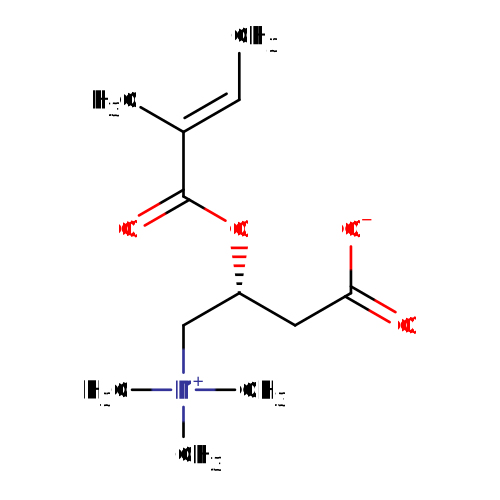
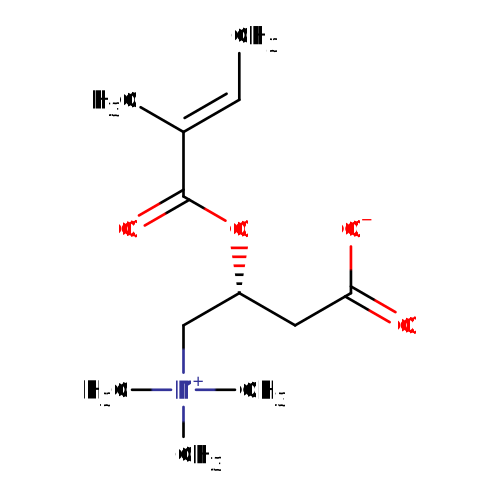
| Common Name | Tiglylcarnitine |
|---|
| Description | Tiglylcarnitine is an acylcarnitine. More specifically, it is an tiglic acid ester of carnitine. Acylcarnitines were first discovered more than 70 year ago (PMID: 13825279 ). It is believed that there are more than 1000 types of acylcarnitines in the human body. The general role of acylcarnitines is to transport acyl-groups (organic acids and fatty acids) from the cytoplasm into the mitochondria so that they can be broken down to produce energy. This process is known as beta-oxidation. According to a recent review (PMID: 35710135 ), acylcarnitines (ACs) can be classified into 9 different categories depending on the type and size of their acyl-group: 1) short-chain ACs; 2) medium-chain ACs; 3) long-chain ACs; 4) very long-chain ACs; 5) hydroxy ACs; 6) branched chain ACs; 7) unsaturated ACs; 8) dicarboxylic ACs and 9) miscellaneous ACs. Short-chain ACs have acyl-groups with two to five carbons (C2-C5), medium-chain ACs have acyl-groups with six to thirteen carbons (C6-C13), long-chain ACs have acyl-groups with fourteen to twenty once carbons (C14-C21) and very long-chain ACs have acyl groups with more than 22 carbons. Tiglylcarnitine is therefore classified as a short chain AC. As a short-chain acylcarnitine Tiglylcarnitine is a member of the most abundant group of carnitines in the body, comprising more than 50% of all acylcarnitines quantified in tissues and biofluids (PMID: 31920980 ). Some short-chain carnitines have been studied as supplements or treatments for a number of diseases, including neurological disorders and inborn errors of metabolism. In particular Tiglylcarnitine is elevated in the blood or plasma of individuals with beta ketothiolase deficiency/acat1 gene mutation (PMID: 27264805 , PMID: 14518824 , PMID: 3435793 ), and ECHS1 deficiency (PMID: 31908952 ). It is also decreased in the blood or plasma of individuals with familial mediterranean fever (PMID: 29900937 ), carcinoma, lewis lung (PMID: 30839735 ), metabolic syndrome, type 2 diabetes mellitus, and cardiovascular diseases (PMID: 24710945 ). Tiglylcarnitine is also detected in the urinary organic acid and blood spot acylcarnitine profiles in patients with mitochondrial acetoacetyl-CoA thiolase (T2) deficiency, an inborn error of metabolism affecting isoleucine and ketone bodies in the catabolic process (PMID: 14518824 ). Tiglylcarnitine is found to be associated with celiac disease, which is also an inborn error of metabolism. Tiglylcarnitine has been identified in the human placenta (PMID: 32033212 ). Carnitine acetyltransferase (CrAT, EC:2.3.1.7) is responsible for the synthesis of all short-chain and short branched-chain acylcarnitines (PMID: 23485643 ). The study of acylcarnitines is an active area of research and it is likely that many novel acylcarnitines will be discovered in the coming years. It is also likely that many novel roles in health and disease will be uncovered. An excellent review of the current state of knowledge for acylcarnitines is available (PMID: 35710135 ). |
|---|
| Structure | C\C=C(/C)C(=O)O[C@H](CC([O-])=O)C[N+](C)(C)C InChI=1S/C12H21NO4/c1-6-9(2)12(16)17-10(7-11(14)15)8-13(3,4)5/h6,10H,7-8H2,1-5H3/b9-6+/t10-/m1/s1 |
|---|
| Synonyms | | Value | Source |
|---|
| (R)-Tiglyl-carnitine | ChEBI | | O-Tiglylcarnitine | HMDB | | O-Tiglyl-L-carnitine | HMDB | | Tiglyl carnitine | HMDB | | Tiglylcarnitine | HMDB |
|
|---|
| Chemical Formula | C12H21NO4 |
|---|
| Average Molecular Weight | 243.303 |
|---|
| Monoisotopic Molecular Weight | 243.14705816 |
|---|
| IUPAC Name | (3R)-3-{[(2E)-2-methylbut-2-enoyl]oxy}-4-(trimethylazaniumyl)butanoate |
|---|
| Traditional Name | (3R)-3-{[(2E)-2-methylbut-2-enoyl]oxy}-4-(trimethylammonio)butanoate |
|---|
| CAS Registry Number | 64681-36-3 |
|---|
| SMILES | C\C=C(/C)C(=O)O[C@H](CC([O-])=O)C[N+](C)(C)C |
|---|
| InChI Identifier | InChI=1S/C12H21NO4/c1-6-9(2)12(16)17-10(7-11(14)15)8-13(3,4)5/h6,10H,7-8H2,1-5H3/b9-6+/t10-/m1/s1 |
|---|
| InChI Key | WURBQCVBQNMUQT-OLKPEBQYSA-N |
|---|
| Chemical Taxonomy |
|---|
| Description | Belongs to the class of organic compounds known as acyl carnitines. These are organic compounds containing a fatty acid with the carboxylic acid attached to carnitine through an ester bond. |
|---|
| Kingdom | Organic compounds |
|---|
| Super Class | Lipids and lipid-like molecules |
|---|
| Class | Fatty Acyls |
|---|
| Sub Class | Fatty acid esters |
|---|
| Direct Parent | Acyl carnitines |
|---|
| Alternative Parents | |
|---|
| Substituents | - Acyl-carnitine
- Branched fatty acid
- Dicarboxylic acid or derivatives
- Tetraalkylammonium salt
- Alpha,beta-unsaturated carboxylic ester
- Enoate ester
- Quaternary ammonium salt
- Carboxylic acid ester
- Carboxylic acid salt
- Carboxylic acid derivative
- Carboxylic acid
- Organic nitrogen compound
- Organonitrogen compound
- Organooxygen compound
- Organic salt
- Hydrocarbon derivative
- Organic oxide
- Organopnictogen compound
- Carbonyl group
- Organic oxygen compound
- Amine
- Aliphatic acyclic compound
|
|---|
| Molecular Framework | Aliphatic acyclic compounds |
|---|
| External Descriptors | |
|---|
| Ontology |
|---|
| Not Available | Not Available |
|---|
| Physical Properties |
|---|
| State | Solid |
|---|
| Experimental Molecular Properties | | Property | Value | Reference |
|---|
| Melting Point | Not Available | Not Available | | Boiling Point | Not Available | Not Available | | Water Solubility | Not Available | Not Available | | LogP | Not Available | Not Available |
|
|---|
| Experimental Chromatographic Properties | Not Available |
|---|
| Predicted Molecular Properties | |
|---|
| Predicted Chromatographic Properties | Predicted Collision Cross SectionsPredicted Retention Times Underivatized| Chromatographic Method | Retention Time | Reference |
|---|
| Measured using a Waters Acquity ultraperformance liquid chromatography (UPLC) ethylene-bridged hybrid (BEH) C18 column (100 mm × 2.1 mm; 1.7 μmparticle diameter). Predicted by Afia on May 17, 2022. Predicted by Afia on May 17, 2022. | 2.54 minutes | 32390414 | | Predicted by Siyang on May 30, 2022 | 9.9584 minutes | 33406817 | | Predicted by Siyang using ReTip algorithm on June 8, 2022 | 4.9 minutes | 32390414 | | AjsUoB = Accucore 150 Amide HILIC with 10mM Ammonium Formate, 0.1% Formic Acid | 254.7 seconds | 40023050 | | Fem_Long = Waters ACQUITY UPLC HSS T3 C18 with Water:MeOH and 0.1% Formic Acid | 1041.6 seconds | 40023050 | | Fem_Lipids = Ascentis Express C18 with (60:40 water:ACN):(90:10 IPA:ACN) and 10mM NH4COOH + 0.1% Formic Acid | 199.0 seconds | 40023050 | | Life_Old = Waters ACQUITY UPLC BEH C18 with Water:(20:80 acetone:ACN) and 0.1% Formic Acid | 105.5 seconds | 40023050 | | Life_New = RP Waters ACQUITY UPLC HSS T3 C18 with Water:(30:70 MeOH:ACN) and 0.1% Formic Acid | 153.2 seconds | 40023050 | | RIKEN = Waters ACQUITY UPLC BEH C18 with Water:ACN and 0.1% Formic Acid | 49.8 seconds | 40023050 | | Eawag_XBridgeC18 = XBridge C18 3.5u 2.1x50 mm with Water:MeOH and 0.1% Formic Acid | 274.1 seconds | 40023050 | | BfG_NTS_RP1 =Agilent Zorbax Eclipse Plus C18 (2.1 mm x 150 mm, 3.5 um) with Water:ACN and 0.1% Formic Acid | 313.8 seconds | 40023050 | | HILIC_BDD_2 = Merck SeQuant ZIC-HILIC with ACN(0.1% formic acid):water(16 mM ammonium formate) | 667.5 seconds | 40023050 | | UniToyama_Atlantis = RP Waters Atlantis T3 (2.1 x 150 mm, 5 um) with ACN:Water and 0.1% Formic Acid | 847.3 seconds | 40023050 | | BDD_C18 = Hypersil Gold 1.9µm C18 with Water:ACN and 0.1% Formic Acid | 215.0 seconds | 40023050 | | UFZ_Phenomenex = Kinetex Core-Shell C18 2.6 um, 3.0 x 100 mm, Phenomenex with Water:MeOH and 0.1% Formic Acid | 1198.4 seconds | 40023050 | | SNU_RIKEN_POS = Waters ACQUITY UPLC BEH C18 with Water:ACN and 0.1% Formic Acid | 187.8 seconds | 40023050 | | RPMMFDA = Waters ACQUITY UPLC BEH C18 with Water:ACN and 0.1% Formic Acid | 224.2 seconds | 40023050 | | MTBLS87 = Merck SeQuant ZIC-pHILIC column with ACN:Water and :ammonium carbonate | 395.4 seconds | 40023050 | | KI_GIAR_zic_HILIC_pH2_7 = Merck SeQuant ZIC-HILIC with ACN:Water and 0.1% FA | 328.7 seconds | 40023050 | | Meister zic-pHILIC pH9.3 = Merck SeQuant ZIC-pHILIC column with ACN:Water 5mM NH4Ac pH9.3 and 5mM ammonium acetate in water | 40.5 seconds | 40023050 |
Predicted Kovats Retention IndicesUnderivatized |
|---|
| General References | - Fontaine M, Briand G, Ser N, Armelin I, Rolland MO, Degand P, Vamecq J: Metabolic studies in twin brothers with 2-methylacetoacetyl-CoA thiolase deficiency. Clin Chim Acta. 1996 Nov 15;255(1):67-83. [PubMed:8930414 ]
- Fukao T, Zhang GX, Sakura N, Kubo T, Yamaga H, Hazama A, Kohno Y, Matsuo N, Kondo M, Yamaguchi S, Shigematsu Y, Kondo N: The mitochondrial acetoacetyl-CoA thiolase (T2) deficiency in Japanese patients: urinary organic acid and blood acylcarnitine profiles under stable conditions have subtle abnormalities in T2-deficient patients with some residual T2 activity. J Inherit Metab Dis. 2003;26(5):423-31. [PubMed:14518824 ]
- Millington DS, Roe CR, Maltby DA: Characterization of new diagnostic acylcarnitines in patients with beta-ketothiolase deficiency and glutaric aciduria type I using mass spectrometry. Biomed Environ Mass Spectrom. 1987 Dec;14(12):711-6. [PubMed:3435793 ]
- Violante S, Ijlst L, Ruiter J, Koster J, van Lenthe H, Duran M, de Almeida IT, Wanders RJ, Houten SM, Ventura FV: Substrate specificity of human carnitine acetyltransferase: Implications for fatty acid and branched-chain amino acid metabolism. Biochim Biophys Acta. 2013 Jun;1832(6):773-9. doi: 10.1016/j.bbadis.2013.02.012. Epub 2013 Feb 24. [PubMed:23485643 ]
- Elshenawy S, Pinney SE, Stuart T, Doulias PT, Zura G, Parry S, Elovitz MA, Bennett MJ, Bansal A, Strauss JF 3rd, Ischiropoulos H, Simmons RA: The Metabolomic Signature of the Placenta in Spontaneous Preterm Birth. Int J Mol Sci. 2020 Feb 4;21(3). pii: ijms21031043. doi: 10.3390/ijms21031043. [PubMed:32033212 ]
- FRITZ IB: Action of carnitine on long chain fatty acid oxidation by liver. Am J Physiol. 1959 Aug;197:297-304. doi: 10.1152/ajplegacy.1959.197.2.297. [PubMed:13825279 ]
- Makarova E, Makrecka-Kuka M, Vilks K, Volska K, Sevostjanovs E, Grinberga S, Zarkova-Malkova O, Dambrova M, Liepinsh E: Decreases in Circulating Concentrations of Long-Chain Acylcarnitines and Free Fatty Acids During the Glucose Tolerance Test Represent Tissue-Specific Insulin Sensitivity. Front Endocrinol (Lausanne). 2019 Dec 17;10:870. doi: 10.3389/fendo.2019.00870. eCollection 2019. [PubMed:31920980 ]
- Kiykim E, Aktuglu Zeybek AC, Barut K, Zubarioglu T, Cansever MS, Alsancak S, Kasapcopur O: Screening of Free Carnitine and Acylcarnitine Status in Children With Familial Mediterranean Fever. Arch Rheumatol. 2016 Mar 10;31(2):133-138. doi: 10.5606/ArchRheumatol.2016.5696. eCollection 2016 Jun. [PubMed:29900937 ]
- Wen P, Chen Z, Wang G, Su Z, Zhang X, Tang G, Cui D, Liu X, Li C: [Analysis of clinical phenotype and ACAT1 gene mutation in a family affected with beta-ketothiolase deficiency]. Zhonghua Yi Xue Yi Chuan Xue Za Zhi. 2016 Jun;33(3):286-91. doi: 10.3760/cma.j.issn.1003-9406.2016.03.002. [PubMed:27264805 ]
- Pajares S, Lopez RM, Gort L, Argudo-Ramirez A, Marin JL, Gonzalez de Aledo-Castillo JM, Garcia-Villoria J, Arranz JA, Del Toro M, Tort F, Ugarteburu O, Casellas MD, Fernandez R, Ribes A: An incidental finding in newborn screening leading to the diagnosis of a patient with ECHS1 mutations. Mol Genet Metab Rep. 2020 Jan 2;22:100553. doi: 10.1016/j.ymgmr.2019.100553. eCollection 2020 Mar. [PubMed:31908952 ]
- Wu H, Chen Y, Li Z, Liu X: Untargeted metabolomics profiles delineate metabolic alterations in mouse plasma during lung carcinoma development using UPLC-QTOF/MS in MS(E) mode. R Soc Open Sci. 2018 Sep 19;5(9):181143. doi: 10.1098/rsos.181143. eCollection 2018 Sep. [PubMed:30839735 ]
- Yu ZR, Ning Y, Yu H, Tang NJ: A HPLC-Q-TOF-MS-based urinary metabolomic approach to identification of potential biomarkers of metabolic syndrome. J Huazhong Univ Sci Technolog Med Sci. 2014 Apr;34(2):276-283. doi: 10.1007/s11596-014-1271-7. Epub 2014 Apr 8. [PubMed:24710945 ]
- Dambrova M, Makrecka-Kuka M, Kuka J, Vilskersts R, Nordberg D, Attwood MM, Smesny S, Sen ZD, Guo AC, Oler E, Tian S, Zheng J, Wishart DS, Liepinsh E, Schioth HB: Acylcarnitines: Nomenclature, Biomarkers, Therapeutic Potential, Drug Targets, and Clinical Trials. Pharmacol Rev. 2022 Jul;74(3):506-551. doi: 10.1124/pharmrev.121.000408. [PubMed:35710135 ]
|
|---|