| Record Information |
|---|
| Version | 5.0 |
|---|
| Status | Detected and Quantified |
|---|
| Creation Date | 2006-05-22 14:17:54 UTC |
|---|
| Update Date | 2023-02-21 17:16:25 UTC |
|---|
| HMDB ID | HMDB0002466 |
|---|
| Secondary Accession Numbers | |
|---|
| Metabolite Identification |
|---|
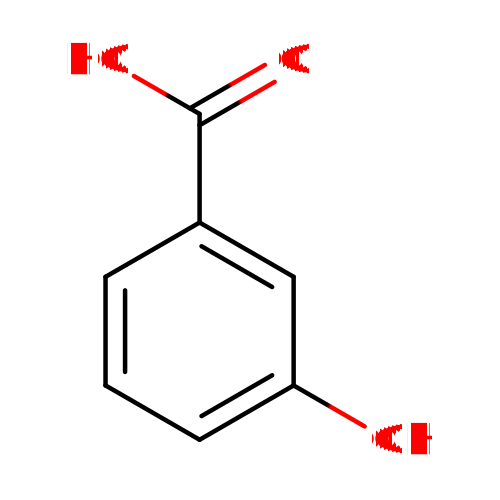
| Common Name | 3-Hydroxybenzoic acid |
|---|
| Description | 3-Hydroxybenzoic acid, also known as 3-hydroxybenzoate or 3-carboxyphenol, belongs to the class of organic compounds known as hydroxybenzoic acid derivatives. Hydroxybenzoic acid derivatives are compounds containing a hydroxybenzoic acid (or a derivative), which is a benzene ring bearing a carboxyl and a hydroxyl groups. 3-Hydroxybenzoic acid exists in all living organisms, ranging from bacteria to humans. Outside of the human body, 3-hydroxybenzoic acid is found, on average, in the highest concentration in american cranberries and beers. 3-hydroxybenzoic acid has also been detected, but not quantified in a few different foods, such as bilberries, citrus, and corns. As well, 3-Hydroxybenzoic Acid can be found in the pineapple fruit. It can also be formed by a Pseudomonas species from 3-Chlorobenzoic acid. 3-Hydroxybenzoic acid is a monohydroxybenzoic acid. 3-Hydroxybenzoic acid can be obtained by the alkali fusion of 3-sulfobenzoic acid between 210-220 °C. 3-Hydroxybenzoic acid is a component of castoreum, the exudate from the castor sacs of the mature North American beaver (Castor canadensis) and the European beaver (Castor fiber), used in perfumery. |
|---|
| Structure | InChI=1S/C7H6O3/c8-6-3-1-2-5(4-6)7(9)10/h1-4,8H,(H,9,10) |
|---|
| Synonyms | | Value | Source |
|---|
| 3-Carboxyphenol | ChEBI | | m-Hydroxybenzoic acid | ChEBI | | m-Salicylic acid | ChEBI | | m-Hydroxybenzoate | Generator | | m-Salicylate | Generator | | 3-Hydroxybenzoate | Generator | | 3-Hydroxybenzoic acid, monosodium salt | HMDB | | Sodium 3-hydroxybenzoic acid | HMDB | | 3-Hydroxybenzoic acid, copper (2+) (1:1) salt | HMDB | | 3-Hydroxy benzoate | HMDB | | 3-Hydroxy benzoic acid | HMDB | | Acido m-idrossibenzoico | HMDB | | Kyselina 3-hydroxybenzoova | HMDB | | m-Hba | HMDB | | Meta-hydroxybenzoate | HMDB | | Meta-hydroxybenzoic acid | HMDB | | 3-Hydroxybenzoic acid | KEGG | | 3-Hydroxybenzenecarboxylic acid | HMDB |
|
|---|
| Chemical Formula | C7H6O3 |
|---|
| Average Molecular Weight | 138.122 |
|---|
| Monoisotopic Molecular Weight | 138.031694053 |
|---|
| IUPAC Name | 3-hydroxybenzoic acid |
|---|
| Traditional Name | 3-hydroxybenzoic acid |
|---|
| CAS Registry Number | 99-06-9 |
|---|
| SMILES | OC(=O)C1=CC(O)=CC=C1 |
|---|
| InChI Identifier | InChI=1S/C7H6O3/c8-6-3-1-2-5(4-6)7(9)10/h1-4,8H,(H,9,10) |
|---|
| InChI Key | IJFXRHURBJZNAO-UHFFFAOYSA-N |
|---|
| Chemical Taxonomy |
|---|
| Description | Belongs to the class of organic compounds known as hydroxybenzoic acid derivatives. Hydroxybenzoic acid derivatives are compounds containing a hydroxybenzoic acid (or a derivative), which is a benzene ring bearing a carboxyl and a hydroxyl groups. |
|---|
| Kingdom | Organic compounds |
|---|
| Super Class | Benzenoids |
|---|
| Class | Benzene and substituted derivatives |
|---|
| Sub Class | Benzoic acids and derivatives |
|---|
| Direct Parent | Hydroxybenzoic acid derivatives |
|---|
| Alternative Parents | |
|---|
| Substituents | - Hydroxybenzoic acid
- Benzoic acid
- Benzoyl
- 1-hydroxy-4-unsubstituted benzenoid
- 1-hydroxy-2-unsubstituted benzenoid
- Phenol
- Monocarboxylic acid or derivatives
- Carboxylic acid
- Carboxylic acid derivative
- Organic oxygen compound
- Organic oxide
- Hydrocarbon derivative
- Organooxygen compound
- Aromatic homomonocyclic compound
|
|---|
| Molecular Framework | Aromatic homomonocyclic compounds |
|---|
| External Descriptors | |
|---|
| Ontology |
|---|
| Physiological effect | Not Available |
|---|
| Disposition | |
|---|
| Process | Not Available |
|---|
| Role | |
|---|
| Physical Properties |
|---|
| State | Solid |
|---|
| Experimental Molecular Properties | | Property | Value | Reference |
|---|
| Melting Point | 202 °C | Not Available | | Boiling Point | Not Available | Not Available | | Water Solubility | 7.25 mg/mL at 25 °C | Not Available | | LogP | 1.50 | HANSCH,C ET AL. (1995) |
|
|---|
| Experimental Chromatographic Properties | Experimental Collision Cross Sections |
|---|
| Predicted Molecular Properties | |
|---|
| Predicted Chromatographic Properties | Predicted Collision Cross SectionsPredicted Retention Times Underivatized| Chromatographic Method | Retention Time | Reference |
|---|
| Measured using a Waters Acquity ultraperformance liquid chromatography (UPLC) ethylene-bridged hybrid (BEH) C18 column (100 mm × 2.1 mm; 1.7 μmparticle diameter). Predicted by Afia on May 17, 2022. Predicted by Afia on May 17, 2022. | 2.61 minutes | 32390414 | | Predicted by Siyang on May 30, 2022 | 9.8958 minutes | 33406817 | | Predicted by Siyang using ReTip algorithm on June 8, 2022 | 3.45 minutes | 32390414 | | AjsUoB = Accucore 150 Amide HILIC with 10mM Ammonium Formate, 0.1% Formic Acid | 64.8 seconds | 40023050 | | Fem_Long = Waters ACQUITY UPLC HSS T3 C18 with Water:MeOH and 0.1% Formic Acid | 1151.3 seconds | 40023050 | | Fem_Lipids = Ascentis Express C18 with (60:40 water:ACN):(90:10 IPA:ACN) and 10mM NH4COOH + 0.1% Formic Acid | 340.7 seconds | 40023050 | | Life_Old = Waters ACQUITY UPLC BEH C18 with Water:(20:80 acetone:ACN) and 0.1% Formic Acid | 105.4 seconds | 40023050 | | Life_New = RP Waters ACQUITY UPLC HSS T3 C18 with Water:(30:70 MeOH:ACN) and 0.1% Formic Acid | 215.7 seconds | 40023050 | | RIKEN = Waters ACQUITY UPLC BEH C18 with Water:ACN and 0.1% Formic Acid | 125.7 seconds | 40023050 | | Eawag_XBridgeC18 = XBridge C18 3.5u 2.1x50 mm with Water:MeOH and 0.1% Formic Acid | 358.8 seconds | 40023050 | | BfG_NTS_RP1 =Agilent Zorbax Eclipse Plus C18 (2.1 mm x 150 mm, 3.5 um) with Water:ACN and 0.1% Formic Acid | 360.9 seconds | 40023050 | | HILIC_BDD_2 = Merck SeQuant ZIC-HILIC with ACN(0.1% formic acid):water(16 mM ammonium formate) | 111.4 seconds | 40023050 | | UniToyama_Atlantis = RP Waters Atlantis T3 (2.1 x 150 mm, 5 um) with ACN:Water and 0.1% Formic Acid | 739.5 seconds | 40023050 | | BDD_C18 = Hypersil Gold 1.9µm C18 with Water:ACN and 0.1% Formic Acid | 288.8 seconds | 40023050 | | UFZ_Phenomenex = Kinetex Core-Shell C18 2.6 um, 3.0 x 100 mm, Phenomenex with Water:MeOH and 0.1% Formic Acid | 990.2 seconds | 40023050 | | SNU_RIKEN_POS = Waters ACQUITY UPLC BEH C18 with Water:ACN and 0.1% Formic Acid | 236.3 seconds | 40023050 | | RPMMFDA = Waters ACQUITY UPLC BEH C18 with Water:ACN and 0.1% Formic Acid | 302.9 seconds | 40023050 | | MTBLS87 = Merck SeQuant ZIC-pHILIC column with ACN:Water and :ammonium carbonate | 509.4 seconds | 40023050 | | KI_GIAR_zic_HILIC_pH2_7 = Merck SeQuant ZIC-HILIC with ACN:Water and 0.1% FA | 225.1 seconds | 40023050 | | Meister zic-pHILIC pH9.3 = Merck SeQuant ZIC-pHILIC column with ACN:Water 5mM NH4Ac pH9.3 and 5mM ammonium acetate in water | 190.3 seconds | 40023050 |
Predicted Kovats Retention IndicesUnderivatizedDerivatized| Derivative Name / Structure | SMILES | Kovats RI Value | Column Type | Reference |
|---|
| 3-Hydroxybenzoic acid,1TMS,isomer #1 | C[Si](C)(C)OC(=O)C1=CC=CC(O)=C1 | 1561.6 | Semi standard non polar | 33892256 | | 3-Hydroxybenzoic acid,1TMS,isomer #2 | C[Si](C)(C)OC1=CC=CC(C(=O)O)=C1 | 1565.5 | Semi standard non polar | 33892256 | | 3-Hydroxybenzoic acid,2TMS,isomer #1 | C[Si](C)(C)OC(=O)C1=CC=CC(O[Si](C)(C)C)=C1 | 1583.1 | Semi standard non polar | 33892256 | | 3-Hydroxybenzoic acid,1TBDMS,isomer #1 | CC(C)(C)[Si](C)(C)OC(=O)C1=CC=CC(O)=C1 | 1816.2 | Semi standard non polar | 33892256 | | 3-Hydroxybenzoic acid,1TBDMS,isomer #2 | CC(C)(C)[Si](C)(C)OC1=CC=CC(C(=O)O)=C1 | 1791.2 | Semi standard non polar | 33892256 | | 3-Hydroxybenzoic acid,2TBDMS,isomer #1 | CC(C)(C)[Si](C)(C)OC(=O)C1=CC=CC(O[Si](C)(C)C(C)(C)C)=C1 | 2044.2 | Semi standard non polar | 33892256 |
|
|---|
| GC-MS Spectra| Spectrum Type | Description | Splash Key | Deposition Date | Source | View |
|---|
| Experimental GC-MS | GC-MS Spectrum - 3-Hydroxybenzoic acid GC-MS (2 TMS) | splash10-00r6-4970000000-64e7f8ae165c16e980cb | 2014-06-16 | HMDB team, MONA, MassBank | View Spectrum | | Experimental GC-MS | GC-MS Spectrum - 3-Hydroxybenzoic acid EI-B (Non-derivatized) | splash10-000i-9500000000-d9aa814a2f50d1d836f5 | 2017-09-12 | HMDB team, MONA, MassBank | View Spectrum | | Experimental GC-MS | GC-MS Spectrum - 3-Hydroxybenzoic acid EI-B (Non-derivatized) | splash10-01b9-0490000000-8dc7d3f9d21b46e65fce | 2017-09-12 | HMDB team, MONA, MassBank | View Spectrum | | Experimental GC-MS | GC-MS Spectrum - 3-Hydroxybenzoic acid GC-MS (Non-derivatized) | splash10-00r6-4970000000-64e7f8ae165c16e980cb | 2017-09-12 | HMDB team, MONA, MassBank | View Spectrum | | Experimental GC-MS | GC-MS Spectrum - 3-Hydroxybenzoic acid GC-EI-TOF (Non-derivatized) | splash10-01bc-2970000000-477e1a234b54225b30d5 | 2017-09-12 | HMDB team, MONA, MassBank | View Spectrum | | Predicted GC-MS | Predicted GC-MS Spectrum - 3-Hydroxybenzoic acid GC-MS (Non-derivatized) - 70eV, Positive | splash10-0079-6900000000-5fa59abbf3516f7f1f5d | 2017-07-27 | Wishart Lab | View Spectrum | | Predicted GC-MS | Predicted GC-MS Spectrum - 3-Hydroxybenzoic acid GC-MS (2 TMS) - 70eV, Positive | splash10-00r6-7950000000-6f1a99dee5c832c26f1f | 2017-10-06 | Wishart Lab | View Spectrum | | Predicted GC-MS | Predicted GC-MS Spectrum - 3-Hydroxybenzoic acid GC-MS (Non-derivatized) - 70eV, Positive | Not Available | 2021-10-12 | Wishart Lab | View Spectrum | | MS | Mass Spectrum (Electron Ionization) | splash10-0079-9800000000-3a33a2ce526649dfab2e | 2015-03-01 | Not Available | View Spectrum |
MS/MS Spectra| Spectrum Type | Description | Splash Key | Deposition Date | Source | View |
|---|
| Experimental LC-MS/MS | LC-MS/MS Spectrum - 3-Hydroxybenzoic acid LC-ESI-QQ , negative-QTOF | splash10-000i-0900000000-3af4e5d6be21011f5230 | 2017-09-14 | HMDB team, MONA | View Spectrum | | Experimental LC-MS/MS | LC-MS/MS Spectrum - 3-Hydroxybenzoic acid LC-ESI-QQ , negative-QTOF | splash10-0006-9200000000-3ab18be5287b6641a69d | 2017-09-14 | HMDB team, MONA | View Spectrum | | Experimental LC-MS/MS | LC-MS/MS Spectrum - 3-Hydroxybenzoic acid LC-ESI-QQ , negative-QTOF | splash10-0006-9000000000-0d35a29dba0bb2378516 | 2017-09-14 | HMDB team, MONA | View Spectrum | | Experimental LC-MS/MS | LC-MS/MS Spectrum - 3-Hydroxybenzoic acid LC-ESI-QQ , negative-QTOF | splash10-0006-9000000000-7e857f89355a610eeaff | 2017-09-14 | HMDB team, MONA | View Spectrum | | Experimental LC-MS/MS | LC-MS/MS Spectrum - 3-Hydroxybenzoic acid LC-ESI-QQ , negative-QTOF | splash10-0006-9000000000-939e8bb535cf95146346 | 2017-09-14 | HMDB team, MONA | View Spectrum | | Experimental LC-MS/MS | LC-MS/MS Spectrum - 3-Hydroxybenzoic acid LC-ESI-ITFT , negative-QTOF | splash10-000l-4900000000-81482c693c488ad8f4c5 | 2017-09-14 | HMDB team, MONA | View Spectrum | | Experimental LC-MS/MS | LC-MS/MS Spectrum - 3-Hydroxybenzoic acid , negative-QTOF | splash10-0006-9300000000-3ea8e8c9716e4cd85094 | 2017-09-14 | HMDB team, MONA | View Spectrum | | Experimental LC-MS/MS | LC-MS/MS Spectrum - 3-Hydroxybenzoic acid 40V, Positive-QTOF | splash10-0v00-9000000000-a7519a6737a56791b32a | 2021-09-20 | HMDB team, MONA | View Spectrum | | Experimental LC-MS/MS | LC-MS/MS Spectrum - 3-Hydroxybenzoic acid 20V, Positive-QTOF | splash10-004i-9100000000-f3ee48547af32228569f | 2021-09-20 | HMDB team, MONA | View Spectrum | | Experimental LC-MS/MS | LC-MS/MS Spectrum - 3-Hydroxybenzoic acid 40V, Negative-QTOF | splash10-002b-9000000000-91492c478336a09f89be | 2021-09-20 | HMDB team, MONA | View Spectrum | | Experimental LC-MS/MS | LC-MS/MS Spectrum - 3-Hydroxybenzoic acid 10V, Negative-QTOF | splash10-0006-9200000000-d2267887d40d9d3f1421 | 2021-09-20 | HMDB team, MONA | View Spectrum | | Experimental LC-MS/MS | LC-MS/MS Spectrum - 3-Hydroxybenzoic acid 10V, Positive-QTOF | splash10-0002-9100000000-a69645e9bb295c644ecb | 2021-09-20 | HMDB team, MONA | View Spectrum | | Experimental LC-MS/MS | LC-MS/MS Spectrum - 3-Hydroxybenzoic acid 10V, Positive-QTOF | splash10-0002-9100000000-6b4d7fb8d228954a5f4e | 2021-09-20 | HMDB team, MONA | View Spectrum | | Experimental LC-MS/MS | LC-MS/MS Spectrum - 3-Hydroxybenzoic acid 20V, Positive-QTOF | splash10-004i-9000000000-44051ba8922f4aa46637 | 2021-09-20 | HMDB team, MONA | View Spectrum | | Experimental LC-MS/MS | LC-MS/MS Spectrum - 3-Hydroxybenzoic acid 40V, Positive-QTOF | splash10-0ufr-9000000000-0d14d8fa47f3fce12bbf | 2021-09-20 | HMDB team, MONA | View Spectrum | | Experimental LC-MS/MS | LC-MS/MS Spectrum - 3-Hydroxybenzoic acid 20V, Negative-QTOF | splash10-0006-9000000000-32454e9da3c7f75adb07 | 2021-09-20 | HMDB team, MONA | View Spectrum | | Experimental LC-MS/MS | LC-MS/MS Spectrum - 3-Hydroxybenzoic acid 40V, Negative-QTOF | splash10-014i-9000000000-c278e100585f9519c40d | 2021-09-20 | HMDB team, MONA | View Spectrum | | Experimental LC-MS/MS | LC-MS/MS Spectrum - 3-Hydroxybenzoic acid 50V, Negative-QTOF | splash10-000l-4900000000-4b5c001da72732066e47 | 2021-09-20 | HMDB team, MONA | View Spectrum | | Experimental LC-MS/MS | LC-MS/MS Spectrum - 3-Hydroxybenzoic acid 10V, Negative-QTOF | splash10-0006-9200000000-da1c26e4fbbf500035ee | 2021-09-20 | HMDB team, MONA | View Spectrum | | Predicted LC-MS/MS | Predicted LC-MS/MS Spectrum - 3-Hydroxybenzoic acid 10V, Positive-QTOF | splash10-000i-3900000000-8414bbe165f560962094 | 2015-04-24 | Wishart Lab | View Spectrum | | Predicted LC-MS/MS | Predicted LC-MS/MS Spectrum - 3-Hydroxybenzoic acid 20V, Positive-QTOF | splash10-000f-9400000000-65d56d101aeab33c87bd | 2015-04-24 | Wishart Lab | View Spectrum | | Predicted LC-MS/MS | Predicted LC-MS/MS Spectrum - 3-Hydroxybenzoic acid 40V, Positive-QTOF | splash10-00kf-9000000000-8e8d3089786e50374c30 | 2015-04-24 | Wishart Lab | View Spectrum | | Predicted LC-MS/MS | Predicted LC-MS/MS Spectrum - 3-Hydroxybenzoic acid 10V, Negative-QTOF | splash10-000i-3900000000-09f6fef5d396e66708ec | 2015-04-25 | Wishart Lab | View Spectrum | | Predicted LC-MS/MS | Predicted LC-MS/MS Spectrum - 3-Hydroxybenzoic acid 20V, Negative-QTOF | splash10-000f-9500000000-c48f64be4d63def93719 | 2015-04-25 | Wishart Lab | View Spectrum | | Predicted LC-MS/MS | Predicted LC-MS/MS Spectrum - 3-Hydroxybenzoic acid 40V, Negative-QTOF | splash10-0006-9000000000-587072f8cf909dafae1e | 2015-04-25 | Wishart Lab | View Spectrum |
NMR Spectra| Spectrum Type | Description | Deposition Date | Source | View |
|---|
| Predicted 1D NMR | 13C NMR Spectrum (1D, 100 MHz, D2O, predicted) | 2021-09-25 | Wishart Lab | View Spectrum | | Predicted 1D NMR | 1H NMR Spectrum (1D, 100 MHz, D2O, predicted) | 2021-09-25 | Wishart Lab | View Spectrum | | Predicted 1D NMR | 13C NMR Spectrum (1D, 1000 MHz, D2O, predicted) | 2021-09-25 | Wishart Lab | View Spectrum | | Predicted 1D NMR | 1H NMR Spectrum (1D, 1000 MHz, D2O, predicted) | 2021-09-25 | Wishart Lab | View Spectrum | | Predicted 1D NMR | 13C NMR Spectrum (1D, 200 MHz, D2O, predicted) | 2021-09-25 | Wishart Lab | View Spectrum | | Predicted 1D NMR | 1H NMR Spectrum (1D, 200 MHz, D2O, predicted) | 2021-09-25 | Wishart Lab | View Spectrum | | Predicted 1D NMR | 13C NMR Spectrum (1D, 300 MHz, D2O, predicted) | 2021-09-25 | Wishart Lab | View Spectrum | | Predicted 1D NMR | 1H NMR Spectrum (1D, 300 MHz, D2O, predicted) | 2021-09-25 | Wishart Lab | View Spectrum | | Predicted 1D NMR | 13C NMR Spectrum (1D, 400 MHz, D2O, predicted) | 2021-09-25 | Wishart Lab | View Spectrum | | Predicted 1D NMR | 1H NMR Spectrum (1D, 400 MHz, D2O, predicted) | 2021-09-25 | Wishart Lab | View Spectrum | | Predicted 1D NMR | 13C NMR Spectrum (1D, 500 MHz, D2O, predicted) | 2021-09-25 | Wishart Lab | View Spectrum | | Predicted 1D NMR | 1H NMR Spectrum (1D, 500 MHz, D2O, predicted) | 2021-09-25 | Wishart Lab | View Spectrum | | Predicted 1D NMR | 13C NMR Spectrum (1D, 600 MHz, D2O, predicted) | 2021-09-25 | Wishart Lab | View Spectrum | | Predicted 1D NMR | 1H NMR Spectrum (1D, 600 MHz, D2O, predicted) | 2021-09-25 | Wishart Lab | View Spectrum | | Predicted 1D NMR | 13C NMR Spectrum (1D, 700 MHz, D2O, predicted) | 2021-09-25 | Wishart Lab | View Spectrum | | Predicted 1D NMR | 1H NMR Spectrum (1D, 700 MHz, D2O, predicted) | 2021-09-25 | Wishart Lab | View Spectrum | | Predicted 1D NMR | 13C NMR Spectrum (1D, 800 MHz, D2O, predicted) | 2021-09-25 | Wishart Lab | View Spectrum | | Predicted 1D NMR | 1H NMR Spectrum (1D, 800 MHz, D2O, predicted) | 2021-09-25 | Wishart Lab | View Spectrum | | Predicted 1D NMR | 13C NMR Spectrum (1D, 900 MHz, D2O, predicted) | 2021-09-25 | Wishart Lab | View Spectrum | | Predicted 1D NMR | 1H NMR Spectrum (1D, 900 MHz, D2O, predicted) | 2021-09-25 | Wishart Lab | View Spectrum |
IR Spectra| Spectrum Type | Description | Deposition Date | Source | View |
|---|
| Predicted IR Spectrum | IR Ion Spectrum (Predicted IRIS Spectrum, Adduct: [M-H]-) | 2023-02-03 | FELIX lab | View Spectrum | | Predicted IR Spectrum | IR Ion Spectrum (Predicted IRIS Spectrum, Adduct: [M+H]+) | 2023-02-03 | FELIX lab | View Spectrum | | Predicted IR Spectrum | IR Ion Spectrum (Predicted IRIS Spectrum, Adduct: [M+Na]+) | 2023-02-03 | FELIX lab | View Spectrum |
|
|---|
| Disease References | | Colorectal cancer |
|---|
- Brown DG, Rao S, Weir TL, O'Malia J, Bazan M, Brown RJ, Ryan EP: Metabolomics and metabolic pathway networks from human colorectal cancers, adjacent mucosa, and stool. Cancer Metab. 2016 Jun 6;4:11. doi: 10.1186/s40170-016-0151-y. eCollection 2016. [PubMed:27275383 ]
- Sinha R, Ahn J, Sampson JN, Shi J, Yu G, Xiong X, Hayes RB, Goedert JJ: Fecal Microbiota, Fecal Metabolome, and Colorectal Cancer Interrelations. PLoS One. 2016 Mar 25;11(3):e0152126. doi: 10.1371/journal.pone.0152126. eCollection 2016. [PubMed:27015276 ]
- Goedert JJ, Sampson JN, Moore SC, Xiao Q, Xiong X, Hayes RB, Ahn J, Shi J, Sinha R: Fecal metabolomics: assay performance and association with colorectal cancer. Carcinogenesis. 2014 Sep;35(9):2089-96. doi: 10.1093/carcin/bgu131. Epub 2014 Jul 18. [PubMed:25037050 ]
|
|
|---|