| Record Information |
|---|
| Version | 5.0 |
|---|
| Status | Detected but not Quantified |
|---|
| Creation Date | 2007-01-22 13:00:01 UTC |
|---|
| Update Date | 2023-02-21 17:17:07 UTC |
|---|
| HMDB ID | HMDB0005785 |
|---|
| Secondary Accession Numbers | |
|---|
| Metabolite Identification |
|---|
| Common Name | Indole-3-carbinol |
|---|
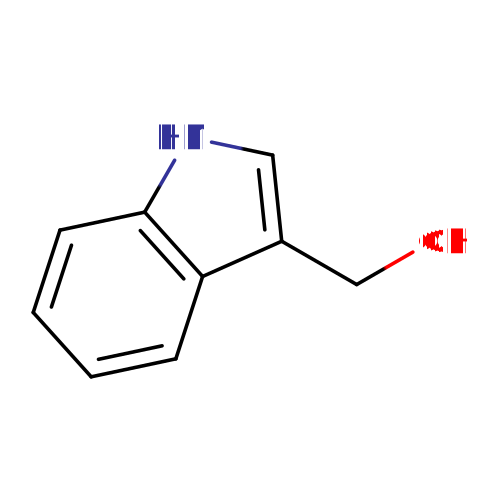
| Description | Indole-3-carbinol, also known as 3-indolylcarbinol or 1H-indole-3-methanol, belongs to the class of organic compounds known as 3-alkylindoles. 3-Alkylindoles are compounds containing an indole moiety that carries an alkyl chain at the 3-position. Indole-3-carbinol is a dietary indole present in cruciferous vegetables that has been shown to influence estradiol metabolism in humans and may provide a new chemopreventive approach to estrogen-dependent diseases (PMID:2342128 ). Indole-3-carbinol is produced by members of the family Cruciferae, particularly members of the genus Brassica (e.g. cabbage, radishes, cauliflower, broccoli, Brussels sprouts, and daikon). Indole-3-carbinol is metabolized into a number of products, including the dimeric 3,3'-diindolylmethane. Both 3,3'-diindolylmethane and indole-3-carbinol are thought to have biological effects. Indole-3-carbinol is a natural chemopreventive compound. It has multiple anticarcinogenic and antitumorigenic properties; it can suppress the proliferation of certain cancer cells, including breast cancer, prostate cancer, endometrial cancer, colon cancer, and leukemic cells (PMID:16634522 , 16082211 ). |
|---|
| Structure | InChI=1S/C9H9NO/c11-6-7-5-10-9-4-2-1-3-8(7)9/h1-5,10-11H,6H2 |
|---|
| Synonyms | | Value | Source |
|---|
| 3-Hydroxymethylindole | ChEBI | | 3-Indolylcarbinol | ChEBI | | 1H-Indole-3-methanol | MeSH | | I3c CPD | MeSH | | Indole-3-methanol | MeSH | | 1H-indol-3-Ylmethanol | HMDB | | 3-(Hydroxymethyl)indole | HMDB | | 3-Indolecarbinol | HMDB | | 3-Indolylmethanol | HMDB | | Indinol | HMDB | | Indole-3-carbinol | ChEBI | | (1H-Indol-3-yl)methanol | HMDB |
|
|---|
| Chemical Formula | C9H9NO |
|---|
| Average Molecular Weight | 147.1739 |
|---|
| Monoisotopic Molecular Weight | 147.068413915 |
|---|
| IUPAC Name | (1H-indol-3-yl)methanol |
|---|
| Traditional Name | indole-3-carbinol |
|---|
| CAS Registry Number | 700-06-1 |
|---|
| SMILES | OCC1=CNC2=C1C=CC=C2 |
|---|
| InChI Identifier | InChI=1S/C9H9NO/c11-6-7-5-10-9-4-2-1-3-8(7)9/h1-5,10-11H,6H2 |
|---|
| InChI Key | IVYPNXXAYMYVSP-UHFFFAOYSA-N |
|---|
| Chemical Taxonomy |
|---|
| Description | Belongs to the class of organic compounds known as 3-alkylindoles. 3-Alkylindoles are compounds containing an indole moiety that carries an alkyl chain at the 3-position. |
|---|
| Kingdom | Organic compounds |
|---|
| Super Class | Organoheterocyclic compounds |
|---|
| Class | Indoles and derivatives |
|---|
| Sub Class | Indoles |
|---|
| Direct Parent | 3-alkylindoles |
|---|
| Alternative Parents | |
|---|
| Substituents | - 3-alkylindole
- Substituted pyrrole
- Benzenoid
- Pyrrole
- Heteroaromatic compound
- Azacycle
- Alcohol
- Hydrocarbon derivative
- Organopnictogen compound
- Aromatic alcohol
- Organic oxygen compound
- Organic nitrogen compound
- Primary alcohol
- Organooxygen compound
- Organonitrogen compound
- Aromatic heteropolycyclic compound
|
|---|
| Molecular Framework | Aromatic heteropolycyclic compounds |
|---|
| External Descriptors | |
|---|
| Ontology |
|---|
| Physiological effect | Not Available |
|---|
| Disposition | |
|---|
| Process | Not Available |
|---|
| Role | |
|---|
| Physical Properties |
|---|
| State | Solid |
|---|
| Experimental Molecular Properties | |
|---|
| Experimental Chromatographic Properties | Not Available |
|---|
| Predicted Molecular Properties | |
|---|
| Predicted Chromatographic Properties | Predicted Collision Cross SectionsPredicted Retention Times Underivatized| Chromatographic Method | Retention Time | Reference |
|---|
| Measured using a Waters Acquity ultraperformance liquid chromatography (UPLC) ethylene-bridged hybrid (BEH) C18 column (100 mm × 2.1 mm; 1.7 μmparticle diameter). Predicted by Afia on May 17, 2022. Predicted by Afia on May 17, 2022. | 3.71 minutes | 32390414 | | Predicted by Siyang on May 30, 2022 | 11.2612 minutes | 33406817 | | Predicted by Siyang using ReTip algorithm on June 8, 2022 | 1.94 minutes | 32390414 | | Fem_Long = Waters ACQUITY UPLC HSS T3 C18 with Water:MeOH and 0.1% Formic Acid | 1722.8 seconds | 40023050 | | Fem_Lipids = Ascentis Express C18 with (60:40 water:ACN):(90:10 IPA:ACN) and 10mM NH4COOH + 0.1% Formic Acid | 394.8 seconds | 40023050 | | Life_Old = Waters ACQUITY UPLC BEH C18 with Water:(20:80 acetone:ACN) and 0.1% Formic Acid | 129.7 seconds | 40023050 | | Life_New = RP Waters ACQUITY UPLC HSS T3 C18 with Water:(30:70 MeOH:ACN) and 0.1% Formic Acid | 234.4 seconds | 40023050 | | RIKEN = Waters ACQUITY UPLC BEH C18 with Water:ACN and 0.1% Formic Acid | 290.2 seconds | 40023050 | | Eawag_XBridgeC18 = XBridge C18 3.5u 2.1x50 mm with Water:MeOH and 0.1% Formic Acid | 389.4 seconds | 40023050 | | BfG_NTS_RP1 =Agilent Zorbax Eclipse Plus C18 (2.1 mm x 150 mm, 3.5 um) with Water:ACN and 0.1% Formic Acid | 353.7 seconds | 40023050 | | HILIC_BDD_2 = Merck SeQuant ZIC-HILIC with ACN(0.1% formic acid):water(16 mM ammonium formate) | 202.5 seconds | 40023050 | | UniToyama_Atlantis = RP Waters Atlantis T3 (2.1 x 150 mm, 5 um) with ACN:Water and 0.1% Formic Acid | 887.3 seconds | 40023050 | | BDD_C18 = Hypersil Gold 1.9µm C18 with Water:ACN and 0.1% Formic Acid | 357.9 seconds | 40023050 | | UFZ_Phenomenex = Kinetex Core-Shell C18 2.6 um, 3.0 x 100 mm, Phenomenex with Water:MeOH and 0.1% Formic Acid | 1185.4 seconds | 40023050 | | SNU_RIKEN_POS = Waters ACQUITY UPLC BEH C18 with Water:ACN and 0.1% Formic Acid | 372.2 seconds | 40023050 | | RPMMFDA = Waters ACQUITY UPLC BEH C18 with Water:ACN and 0.1% Formic Acid | 308.0 seconds | 40023050 | | MTBLS87 = Merck SeQuant ZIC-pHILIC column with ACN:Water and :ammonium carbonate | 427.9 seconds | 40023050 | | KI_GIAR_zic_HILIC_pH2_7 = Merck SeQuant ZIC-HILIC with ACN:Water and 0.1% FA | 305.3 seconds | 40023050 | | Meister zic-pHILIC pH9.3 = Merck SeQuant ZIC-pHILIC column with ACN:Water 5mM NH4Ac pH9.3 and 5mM ammonium acetate in water | 119.7 seconds | 40023050 |
Predicted Kovats Retention IndicesUnderivatizedDerivatized| Derivative Name / Structure | SMILES | Kovats RI Value | Column Type | Reference |
|---|
| Indole-3-carbinol,1TMS,isomer #1 | C[Si](C)(C)OCC1=C[NH]C2=CC=CC=C12 | 1724.7 | Semi standard non polar | 33892256 | | Indole-3-carbinol,1TMS,isomer #2 | C[Si](C)(C)N1C=C(CO)C2=CC=CC=C21 | 1751.7 | Semi standard non polar | 33892256 | | Indole-3-carbinol,2TMS,isomer #1 | C[Si](C)(C)OCC1=CN([Si](C)(C)C)C2=CC=CC=C12 | 1777.9 | Semi standard non polar | 33892256 | | Indole-3-carbinol,2TMS,isomer #1 | C[Si](C)(C)OCC1=CN([Si](C)(C)C)C2=CC=CC=C12 | 1784.8 | Standard non polar | 33892256 | | Indole-3-carbinol,2TMS,isomer #1 | C[Si](C)(C)OCC1=CN([Si](C)(C)C)C2=CC=CC=C12 | 1856.5 | Standard polar | 33892256 | | Indole-3-carbinol,1TBDMS,isomer #1 | CC(C)(C)[Si](C)(C)OCC1=C[NH]C2=CC=CC=C12 | 1990.3 | Semi standard non polar | 33892256 | | Indole-3-carbinol,1TBDMS,isomer #2 | CC(C)(C)[Si](C)(C)N1C=C(CO)C2=CC=CC=C21 | 2001.8 | Semi standard non polar | 33892256 | | Indole-3-carbinol,2TBDMS,isomer #1 | CC(C)(C)[Si](C)(C)OCC1=CN([Si](C)(C)C(C)(C)C)C2=CC=CC=C12 | 2225.8 | Semi standard non polar | 33892256 | | Indole-3-carbinol,2TBDMS,isomer #1 | CC(C)(C)[Si](C)(C)OCC1=CN([Si](C)(C)C(C)(C)C)C2=CC=CC=C12 | 2202.8 | Standard non polar | 33892256 | | Indole-3-carbinol,2TBDMS,isomer #1 | CC(C)(C)[Si](C)(C)OCC1=CN([Si](C)(C)C(C)(C)C)C2=CC=CC=C12 | 2129.6 | Standard polar | 33892256 |
|
|---|