Hmdb loader
Record Information
Version5.0
StatusDetected and Quantified
Creation Date2007-01-22 22:39:32 UTC
Update Date2022-03-07 02:49:29 UTC
HMDB IDHMDB0005800
Secondary Accession Numbers
  • HMDB05800
Metabolite Identification
Common NameLuteolin
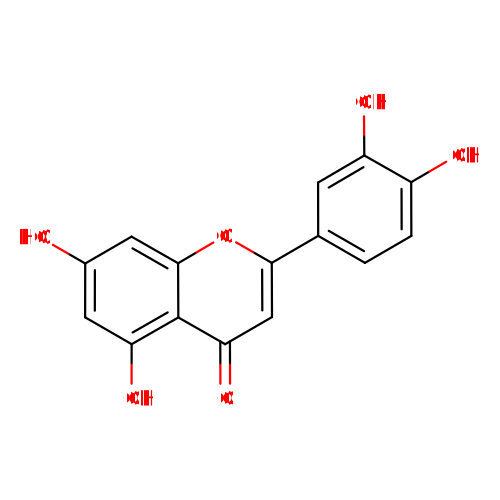
DescriptionLuteolin is a naturally occurring flavonoid. (PMID:17168665 ). The flavonoids are polyphenolic compounds found as integral components of the human diet. They are universally present as constituents of flowering plants, particularly of food plants. The flavonoids are phenyl substituted chromones (benzopyran derivatives) consisting of a 15-carbon basic skeleton (C6-C3-C6), composed of a chroman (C6-C3) nucleus (the benzo ring A and the heterocyclic ring C), also shared by the tocopherols, with a phenyl (the aromatic ring B) substitution usually at the 2-position. Different substitutions can typically occur in the rings, A and B. Several plants and spices containing flavonoid derivatives have found application as disease preventive and therapeutic agents in traditional medicine in Asia for thousands of years. The selection of a particular food plant, plant tissue or herb for its potential health benefits appears to mirror its flavonoid composition. The much lower risk of colon, prostate and breast cancers in Asians, who consume more vegetables, fruits and tea than populations in the Western hemisphere do, raises the question of whether flavonoid components mediate the protective effects of diets rich in these foodstuffs by acting as natural chemopreventive and anticancer agents. An impressive body of information exists on the antitumoral action of plant flavonoids. In vitro work has concentrated on the direct and indirect actions of flavonoids on tumor cells, and has found a variety of anticancer effects such as cell growth and kinase activity inhibition, apoptosis induction, suppression of the secretion of matrix metalloproteinases and of tumor invasive behavior. Furthermore, some studies have reported the impairment of in vivo angiogenesis by dietary flavonoids. Experimental animal studies indicate that certain dietary flavonoids possess antitumoral activity. The hydroxylation pattern of the B ring of the flavones and flavonols, such as luteolin seems to critically influence their activities, especially the inhibition of protein kinase activity and antiproliferation. The different mechanisms underlying the potential anticancer action of plant flavonoids await further elucidation. Certain dietary flavonols and flavones targeting cell surface signal transduction enzymes, such as protein tyrosine and focal adhesion kinases, and the processes of angiogenesis appear to be promising candidates as anticancer agents. Further in vivo studies of these bioactive constituents is deemed necessary in order to develop flavonoid-based anticancer strategies. In view of the increasing interest in the association between dietary flavonoids and cancer initiation and progression, this important field is likely to witness expanded effort and to attract and stimulate further vigorous investigations (PMID:16097445 ).
Structure
Data?1582752365
Synonyms
ValueSource
2-(3,4-Dihydroxyphenyl)-5,7-dihydroxy-4-benzopyroneChEBI
2-(3,4-Dihydroxyphenyl)-5,7-dihydroxy-4H-1-benzopyran-4-oneChEBI
3',4',5,7-TetrahydroxyflavoneChEBI
5,7,3',4'-TetrahydroxyflavoneChEBI
DigitoflavoneChEBI
FlacitranChEBI
LuteololChEBI
SalifazideChEBI
2-(3,4-Dihydroxyphenyl)-5,7-dihydroxy-4H-benzopyrone-4-oneHMDB
2-(3,4-Dihydroxyphenyl)-5,7-dihydroxy-4H-chromen-4-oneHMDB
LuteolineMeSH, HMDB
3',4',5,7-Tetrahydroxy-flavoneMeSH, HMDB
2-(3,4-Dihydroxyphenyl)-5,7-dihydroxy-4H-benzopyran-4-onePhytoBank
3’,4’,5,7-TetrahydroxyflavonePhytoBank
5,7,3’,4’-TetrahydroxyflavonePhytoBank
CyanidenonPhytoBank
Chemical FormulaC15H10O6
Average Molecular Weight286.2363
Monoisotopic Molecular Weight286.047738052
IUPAC Name2-(3,4-dihydroxyphenyl)-5,7-dihydroxy-4H-chromen-4-one
Traditional Nameluteolin
CAS Registry Number491-70-3
SMILES
OC1=CC2=C(C(O)=C1)C(=O)C=C(O2)C1=CC=C(O)C(O)=C1
InChI Identifier
InChI=1S/C15H10O6/c16-8-4-11(19)15-12(20)6-13(21-14(15)5-8)7-1-2-9(17)10(18)3-7/h1-6,16-19H
InChI KeyIQPNAANSBPBGFQ-UHFFFAOYSA-N
Chemical Taxonomy
Description Belongs to the class of organic compounds known as flavones. These are flavonoids with a structure based on the backbone of 2-phenylchromen-4-one (2-phenyl-1-benzopyran-4-one).
KingdomOrganic compounds
Super ClassPhenylpropanoids and polyketides
ClassFlavonoids
Sub ClassFlavones
Direct ParentFlavones
Alternative Parents
Substituents
  • 3'-hydroxyflavonoid
  • 4'-hydroxyflavonoid
  • 5-hydroxyflavonoid
  • 7-hydroxyflavonoid
  • Flavone
  • Hydroxyflavonoid
  • Chromone
  • Benzopyran
  • 1-benzopyran
  • Catechol
  • 1-hydroxy-4-unsubstituted benzenoid
  • 1-hydroxy-2-unsubstituted benzenoid
  • Phenol
  • Pyranone
  • Monocyclic benzene moiety
  • Pyran
  • Benzenoid
  • Vinylogous acid
  • Heteroaromatic compound
  • Organoheterocyclic compound
  • Oxacycle
  • Organooxygen compound
  • Hydrocarbon derivative
  • Organic oxygen compound
  • Organic oxide
  • Aromatic heteropolycyclic compound
Molecular FrameworkAromatic heteropolycyclic compounds
External Descriptors
Ontology
Not AvailableNot Available
Physical Properties
StateSolid
Experimental Molecular Properties
PropertyValueReference
Melting Point329.5 °CNot Available
Boiling Point616.00 to 617.00 °C. @ 760.00 mm Hg (est)The Good Scents Company Information System
Water Solubility387.5 mg/L @ 25 °C (est)The Good Scents Company Information System
LogP2.53PERRISSOUD,D & TESTA,B (1986)
Experimental Chromatographic PropertiesNot Available
Predicted Molecular Properties
PropertyValueSource
Water Solubility0.14 g/LALOGPS
logP2.73ALOGPS
logP2.4ChemAxon
logS-3.3ALOGPS
pKa (Strongest Acidic)6.57ChemAxon
pKa (Strongest Basic)-5.4ChemAxon
Physiological Charge-1ChemAxon
Hydrogen Acceptor Count6ChemAxon
Hydrogen Donor Count4ChemAxon
Polar Surface Area107.22 ŲChemAxon
Rotatable Bond Count1ChemAxon
Refractivity74.89 m³·mol⁻¹ChemAxon
Polarizability27.73 ųChemAxon
Number of Rings3ChemAxon
BioavailabilityYesChemAxon
Rule of FiveYesChemAxon
Ghose FilterYesChemAxon
Veber's RuleNoChemAxon
MDDR-like RuleNoChemAxon
Predicted Chromatographic Properties

Predicted Collision Cross Sections

PredictorAdduct TypeCCS Value (Å2)Reference
DeepCCS[M+H]+166.58730932474
DeepCCS[M-H]-164.22930932474
DeepCCS[M-2H]-197.71930932474
DeepCCS[M+Na]+172.94630932474
AllCCS[M+H]+164.532859911
AllCCS[M+H-H2O]+160.732859911
AllCCS[M+NH4]+168.032859911
AllCCS[M+Na]+169.132859911
AllCCS[M-H]-163.432859911
AllCCS[M+Na-2H]-162.732859911
AllCCS[M+HCOO]-162.032859911

Predicted Retention Times

Underivatized

Chromatographic MethodRetention TimeReference
Measured using a Waters Acquity ultraperformance liquid chromatography (UPLC) ethylene-bridged hybrid (BEH) C18 column (100 mm × 2.1 mm; 1.7 μmparticle diameter). Predicted by Afia on May 17, 2022. Predicted by Afia on May 17, 2022.6.11 minutes32390414
Predicted by Siyang on May 30, 202211.4383 minutes33406817
Predicted by Siyang using ReTip algorithm on June 8, 20221.61 minutes32390414
AjsUoB = Accucore 150 Amide HILIC with 10mM Ammonium Formate, 0.1% Formic Acid29.5 seconds40023050
Fem_Long = Waters ACQUITY UPLC HSS T3 C18 with Water:MeOH and 0.1% Formic Acid1908.0 seconds40023050
Fem_Lipids = Ascentis Express C18 with (60:40 water:ACN):(90:10 IPA:ACN) and 10mM NH4COOH + 0.1% Formic Acid276.3 seconds40023050
Life_Old = Waters ACQUITY UPLC BEH C18 with Water:(20:80 acetone:ACN) and 0.1% Formic Acid113.9 seconds40023050
Life_New = RP Waters ACQUITY UPLC HSS T3 C18 with Water:(30:70 MeOH:ACN) and 0.1% Formic Acid160.2 seconds40023050
RIKEN = Waters ACQUITY UPLC BEH C18 with Water:ACN and 0.1% Formic Acid449.0 seconds40023050
Eawag_XBridgeC18 = XBridge C18 3.5u 2.1x50 mm with Water:MeOH and 0.1% Formic Acid540.0 seconds40023050
BfG_NTS_RP1 =Agilent Zorbax Eclipse Plus C18 (2.1 mm x 150 mm, 3.5 um) with Water:ACN and 0.1% Formic Acid444.2 seconds40023050
HILIC_BDD_2 = Merck SeQuant ZIC-HILIC with ACN(0.1% formic acid):water(16 mM ammonium formate)190.0 seconds40023050
UniToyama_Atlantis = RP Waters Atlantis T3 (2.1 x 150 mm, 5 um) with ACN:Water and 0.1% Formic Acid784.3 seconds40023050
BDD_C18 = Hypersil Gold 1.9µm C18 with Water:ACN and 0.1% Formic Acid376.7 seconds40023050
UFZ_Phenomenex = Kinetex Core-Shell C18 2.6 um, 3.0 x 100 mm, Phenomenex with Water:MeOH and 0.1% Formic Acid1384.5 seconds40023050
SNU_RIKEN_POS = Waters ACQUITY UPLC BEH C18 with Water:ACN and 0.1% Formic Acid311.0 seconds40023050
RPMMFDA = Waters ACQUITY UPLC BEH C18 with Water:ACN and 0.1% Formic Acid342.9 seconds40023050
MTBLS87 = Merck SeQuant ZIC-pHILIC column with ACN:Water and :ammonium carbonate528.5 seconds40023050
KI_GIAR_zic_HILIC_pH2_7 = Merck SeQuant ZIC-HILIC with ACN:Water and 0.1% FA247.7 seconds40023050
Meister zic-pHILIC pH9.3 = Merck SeQuant ZIC-pHILIC column with ACN:Water 5mM NH4Ac pH9.3 and 5mM ammonium acetate in water242.6 seconds40023050

Predicted Kovats Retention Indices

Underivatized

MetaboliteSMILESKovats RI ValueColumn TypeReference
LuteolinOC1=CC2=C(C(O)=C1)C(=O)C=C(O2)C1=CC=C(O)C(O)=C15101.5Standard polar33892256
LuteolinOC1=CC2=C(C(O)=C1)C(=O)C=C(O2)C1=CC=C(O)C(O)=C13118.6Standard non polar33892256
LuteolinOC1=CC2=C(C(O)=C1)C(=O)C=C(O2)C1=CC=C(O)C(O)=C13285.9Semi standard non polar33892256

Derivatized

Derivative Name / StructureSMILESKovats RI ValueColumn TypeReference
Luteolin,1TMS,isomer #1C[Si](C)(C)OC1=CC(O)=C2C(=O)C=C(C3=CC=C(O)C(O)=C3)OC2=C13321.5Semi standard non polar33892256
Luteolin,1TMS,isomer #2C[Si](C)(C)OC1=CC(O)=CC2=C1C(=O)C=C(C1=CC=C(O)C(O)=C1)O23267.0Semi standard non polar33892256
Luteolin,1TMS,isomer #3C[Si](C)(C)OC1=CC=C(C2=CC(=O)C3=C(O)C=C(O)C=C3O2)C=C1O3339.1Semi standard non polar33892256
Luteolin,1TMS,isomer #4C[Si](C)(C)OC1=CC(C2=CC(=O)C3=C(O)C=C(O)C=C3O2)=CC=C1O3316.9Semi standard non polar33892256
Luteolin,2TMS,isomer #1C[Si](C)(C)OC1=CC(O[Si](C)(C)C)=C2C(=O)C=C(C3=CC=C(O)C(O)=C3)OC2=C13228.0Semi standard non polar33892256
Luteolin,2TMS,isomer #2C[Si](C)(C)OC1=CC(O)=C2C(=O)C=C(C3=CC=C(O[Si](C)(C)C)C(O)=C3)OC2=C13318.8Semi standard non polar33892256
Luteolin,2TMS,isomer #3C[Si](C)(C)OC1=CC(O)=C2C(=O)C=C(C3=CC=C(O)C(O[Si](C)(C)C)=C3)OC2=C13286.4Semi standard non polar33892256
Luteolin,2TMS,isomer #4C[Si](C)(C)OC1=CC=C(C2=CC(=O)C3=C(O[Si](C)(C)C)C=C(O)C=C3O2)C=C1O3223.0Semi standard non polar33892256
Luteolin,2TMS,isomer #5C[Si](C)(C)OC1=CC(C2=CC(=O)C3=C(O[Si](C)(C)C)C=C(O)C=C3O2)=CC=C1O3190.1Semi standard non polar33892256
Luteolin,2TMS,isomer #6C[Si](C)(C)OC1=CC=C(C2=CC(=O)C3=C(O)C=C(O)C=C3O2)C=C1O[Si](C)(C)C3181.9Semi standard non polar33892256
Luteolin,3TMS,isomer #1C[Si](C)(C)OC1=CC(O[Si](C)(C)C)=C2C(=O)C=C(C3=CC=C(O[Si](C)(C)C)C(O)=C3)OC2=C13235.5Semi standard non polar33892256
Luteolin,3TMS,isomer #2C[Si](C)(C)OC1=CC(O[Si](C)(C)C)=C2C(=O)C=C(C3=CC=C(O)C(O[Si](C)(C)C)=C3)OC2=C13200.6Semi standard non polar33892256
Luteolin,3TMS,isomer #3C[Si](C)(C)OC1=CC(O)=C2C(=O)C=C(C3=CC=C(O[Si](C)(C)C)C(O[Si](C)(C)C)=C3)OC2=C13097.9Semi standard non polar33892256
Luteolin,3TMS,isomer #4C[Si](C)(C)OC1=CC=C(C2=CC(=O)C3=C(O[Si](C)(C)C)C=C(O)C=C3O2)C=C1O[Si](C)(C)C3045.5Semi standard non polar33892256
Luteolin,4TMS,isomer #1C[Si](C)(C)OC1=CC(O[Si](C)(C)C)=C2C(=O)C=C(C3=CC=C(O[Si](C)(C)C)C(O[Si](C)(C)C)=C3)OC2=C13159.3Semi standard non polar33892256
Luteolin,1TBDMS,isomer #1CC(C)(C)[Si](C)(C)OC1=CC(O)=C2C(=O)C=C(C3=CC=C(O)C(O)=C3)OC2=C13594.4Semi standard non polar33892256
Luteolin,1TBDMS,isomer #2CC(C)(C)[Si](C)(C)OC1=CC(O)=CC2=C1C(=O)C=C(C1=CC=C(O)C(O)=C1)O23534.3Semi standard non polar33892256
Luteolin,1TBDMS,isomer #3CC(C)(C)[Si](C)(C)OC1=CC=C(C2=CC(=O)C3=C(O)C=C(O)C=C3O2)C=C1O3594.6Semi standard non polar33892256
Luteolin,1TBDMS,isomer #4CC(C)(C)[Si](C)(C)OC1=CC(C2=CC(=O)C3=C(O)C=C(O)C=C3O2)=CC=C1O3572.9Semi standard non polar33892256
Luteolin,2TBDMS,isomer #1CC(C)(C)[Si](C)(C)OC1=CC(O[Si](C)(C)C(C)(C)C)=C2C(=O)C=C(C3=CC=C(O)C(O)=C3)OC2=C13797.4Semi standard non polar33892256
Luteolin,2TBDMS,isomer #2CC(C)(C)[Si](C)(C)OC1=CC(O)=C2C(=O)C=C(C3=CC=C(O[Si](C)(C)C(C)(C)C)C(O)=C3)OC2=C13860.3Semi standard non polar33892256
Luteolin,2TBDMS,isomer #3CC(C)(C)[Si](C)(C)OC1=CC(O)=C2C(=O)C=C(C3=CC=C(O)C(O[Si](C)(C)C(C)(C)C)=C3)OC2=C13834.2Semi standard non polar33892256
Luteolin,2TBDMS,isomer #4CC(C)(C)[Si](C)(C)OC1=CC=C(C2=CC(=O)C3=C(O[Si](C)(C)C(C)(C)C)C=C(O)C=C3O2)C=C1O3797.1Semi standard non polar33892256
Luteolin,2TBDMS,isomer #5CC(C)(C)[Si](C)(C)OC1=CC(C2=CC(=O)C3=C(O[Si](C)(C)C(C)(C)C)C=C(O)C=C3O2)=CC=C1O3745.5Semi standard non polar33892256
Luteolin,2TBDMS,isomer #6CC(C)(C)[Si](C)(C)OC1=CC=C(C2=CC(=O)C3=C(O)C=C(O)C=C3O2)C=C1O[Si](C)(C)C(C)(C)C3780.0Semi standard non polar33892256
Luteolin,3TBDMS,isomer #1CC(C)(C)[Si](C)(C)OC1=CC(O[Si](C)(C)C(C)(C)C)=C2C(=O)C=C(C3=CC=C(O[Si](C)(C)C(C)(C)C)C(O)=C3)OC2=C14000.9Semi standard non polar33892256
Luteolin,3TBDMS,isomer #2CC(C)(C)[Si](C)(C)OC1=CC(O[Si](C)(C)C(C)(C)C)=C2C(=O)C=C(C3=CC=C(O)C(O[Si](C)(C)C(C)(C)C)=C3)OC2=C13972.2Semi standard non polar33892256
Luteolin,3TBDMS,isomer #3CC(C)(C)[Si](C)(C)OC1=CC(O)=C2C(=O)C=C(C3=CC=C(O[Si](C)(C)C(C)(C)C)C(O[Si](C)(C)C(C)(C)C)=C3)OC2=C13940.9Semi standard non polar33892256
Luteolin,3TBDMS,isomer #4CC(C)(C)[Si](C)(C)OC1=CC=C(C2=CC(=O)C3=C(O[Si](C)(C)C(C)(C)C)C=C(O)C=C3O2)C=C1O[Si](C)(C)C(C)(C)C3863.4Semi standard non polar33892256
Luteolin,4TBDMS,isomer #1CC(C)(C)[Si](C)(C)OC1=CC(O[Si](C)(C)C(C)(C)C)=C2C(=O)C=C(C3=CC=C(O[Si](C)(C)C(C)(C)C)C(O[Si](C)(C)C(C)(C)C)=C3)OC2=C14067.2Semi standard non polar33892256
Spectra
Biological Properties
Cellular Locations
  • Membrane (predicted from logP)
Biospecimen Locations
  • Blood
  • Feces
  • Urine
Tissue LocationsNot Available
Pathways
Normal Concentrations
BiospecimenStatusValueAgeSexConditionReferenceDetails
BloodDetected and Quantified0.0999 +/- 0.0977 uMAdult (>18 years old)BothNormal details
BloodDetected and Quantified0.101 +/- 0.0985 uMAdult (>18 years old)BothNormal details
BloodDetected and Quantified0-0.288 uMAdult (>18 years old)BothNormal details
BloodDetected but not QuantifiedNot QuantifiedAdult (>18 years old)BothNormal details
FecesDetected but not QuantifiedNot QuantifiedAdult (>18 years old)Both
Normal
details
UrineDetected but not QuantifiedNot QuantifiedAdult (>18 years old)BothNormal details
Abnormal Concentrations
BiospecimenStatusValueAgeSexConditionReferenceDetails
FecesDetected but not QuantifiedNot QuantifiedAdult (>18 years old)Both
Colorectal cancer
details
Associated Disorders and Diseases
Disease References
Colorectal cancer
  1. Goedert JJ, Sampson JN, Moore SC, Xiao Q, Xiong X, Hayes RB, Ahn J, Shi J, Sinha R: Fecal metabolomics: assay performance and association with colorectal cancer. Carcinogenesis. 2014 Sep;35(9):2089-96. doi: 10.1093/carcin/bgu131. Epub 2014 Jul 18. [PubMed:25037050 ]
Associated OMIM IDs
DrugBank IDNot Available
Phenol Explorer Compound ID229
FooDB IDFDB013255
KNApSAcK IDC00000674
Chemspider ID4444102
KEGG Compound IDC01514
BioCyc ID5734-TETRAHYDROXYFLAVONE
BiGG IDNot Available
Wikipedia LinkLuteolin
METLIN IDNot Available
PubChem Compound5280445
PDB IDLU2
ChEBI ID15864
Food Biomarker OntologyNot Available
VMH IDNot Available
MarkerDB IDNot Available
Good Scents IDrw1504531
References
Synthesis ReferenceHutchins, W. A.; Wheeler, T. S. Chalcones: A new synthesis of chrysin, apigenin and luteolin. Journal of the Chemical Society (1939), 91-4.
Material Safety Data Sheet (MSDS)Download (PDF)
General References
  1. Lupu R, Menendez JA: Pharmacological inhibitors of Fatty Acid Synthase (FASN)--catalyzed endogenous fatty acid biogenesis: a new family of anti-cancer agents? Curr Pharm Biotechnol. 2006 Dec;7(6):483-93. [PubMed:17168665 ]
  2. Kandaswami C, Lee LT, Lee PP, Hwang JJ, Ke FC, Huang YT, Lee MT: The antitumor activities of flavonoids. In Vivo. 2005 Sep-Oct;19(5):895-909. [PubMed:16097445 ]

Enzymes

General function:
Involved in magnesium ion binding
Specific function:
Catalyzes the O-methylation, and thereby the inactivation, of catecholamine neurotransmitters and catechol hormones. Also shortens the biological half-lives of certain neuroactive drugs, like L-DOPA, alpha-methyl DOPA and isoproterenol.
Gene Name:
COMT
Uniprot ID:
P21964
Molecular weight:
30036.77
Reactions
Luteolin → Chrysoerioldetails
General function:
Involved in transferase activity, transferring hexosyl groups
Specific function:
UDPGT is of major importance in the conjugation and subsequent elimination of potentially toxic xenobiotics and endogenous compounds. This isoform glucuronidates bilirubin IX-alpha to form both the IX-alpha-C8 and IX-alpha-C12 monoconjugates and diconjugate. Is also able to catalyze the glucuronidation of 17beta-estradiol, 17alpha-ethinylestradiol, 1-hydroxypyrene, 4-methylumbelliferone, 1-naphthol, paranitrophenol, scopoletin, and umbelliferone.
Gene Name:
UGT1A1
Uniprot ID:
P22309
Molecular weight:
59590.91
Reactions
Luteolin → 6-{[2-(3,4-dihydroxyphenyl)-7-hydroxy-4-oxo-4H-chromen-5-yl]oxy}-3,4,5-trihydroxyoxane-2-carboxylic aciddetails
Luteolin → 6-{[2-(3,4-dihydroxyphenyl)-5-hydroxy-4-oxo-4H-chromen-7-yl]oxy}-3,4,5-trihydroxyoxane-2-carboxylic aciddetails
Luteolin → 6-[5-(5,7-dihydroxy-4-oxo-4H-chromen-2-yl)-2-hydroxyphenoxy]-3,4,5-trihydroxyoxane-2-carboxylic aciddetails
Luteolin → 6-[4-(5,7-dihydroxy-4-oxo-4H-chromen-2-yl)-2-hydroxyphenoxy]-3,4,5-trihydroxyoxane-2-carboxylic aciddetails
General function:
sulfotransferase activity
Specific function:
Sulfotransferase that utilizes 3'-phospho-5'-adenylyl sulfate (PAPS) as sulfonate donor to catalyze the sulfate conjugation of phenolic monoamines (neurotransmitters such as dopamine, norepinephrine and serotonin) and phenolic and catechol drugs.
Gene Name:
SULT1A3
Uniprot ID:
P0DMM9
Molecular weight:
34195.96
Reactions
Luteolin → [5-(5,7-dihydroxy-4-oxo-4H-chromen-2-yl)-2-hydroxyphenyl]oxidanesulfonic aciddetails