| Record Information |
|---|
| Version | 5.0 |
|---|
| Status | Expected but not Quantified |
|---|
| Creation Date | 2009-04-06 16:22:24 UTC |
|---|
| Update Date | 2023-02-21 17:17:48 UTC |
|---|
| HMDB ID | HMDB0012289 |
|---|
| Secondary Accession Numbers | |
|---|
| Metabolite Identification |
|---|
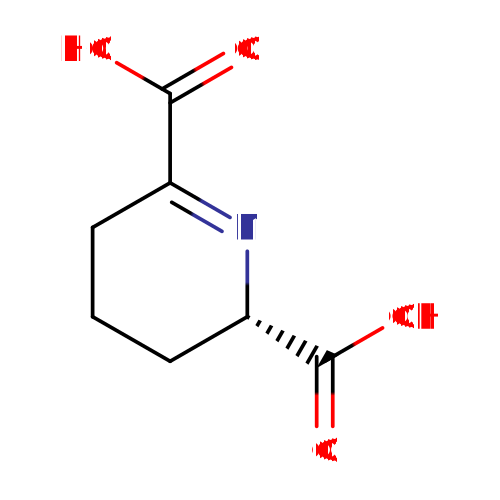
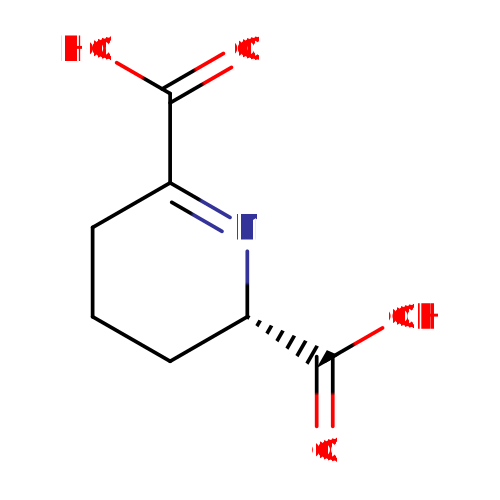
| Common Name | Tetrahydrodipicolinate |
|---|
| Description | Tetrahydrodipicolinate (CAS: 2353-17-5), converted from L-aspartate, is an important intermediate in the lysine biosynthesis pathway. Several pathways are now recognized in bacteria, most algae, fungi, and higher plants for the biosynthesis of lysine. They are divided into two groups: (1) the diaminopimelate (DAP) pathways, and (2) the alpha-aminoadipate (AAA) pathways. In the pathways that belong to the DAP group, lysine is produced from aspartate (along with methionine, threonine, and isoleucine). All of these pathways share the upper segments, which include the four steps required for the conversion of L-aspartate into tetrahydrodipicolinate. They also share the last step, which is the conversion of the intermediate meso-diaminopimelate (D,L-DAP, or meso-DAP) into lysine. However, these pathways differ in the routes leading from tetrahydrodipicolinate to meso-diaminopimelate. The four variations include: (I) the succinylase variant, which involves succinylated intermediates, where tetrahydrodipicolinate is converted into meso-diaminopimelate in four enzymatic steps; (II) the acetylase variant, which involves acetylated intermediates, where tetrahydrodipicolinate is converted into meso-diaminopimelate in four enzymatic steps; (III) the dehydrogenase variant, in which tetrahydrodipicolinate is converted into meso-diaminopimelate in a single enzymatic step; and (IV) the diaminopimelate-aminotransferase variant, in which tetrahydrodipicolinate is converted into meso-diaminopimelate in two steps. In addition to lysine, the pathways in this group also produce meso-DAP, which is an important metabolite on its own. |
|---|
| Structure | OC(=O)[C@@H]1CCCC(=N1)C(O)=O InChI=1S/C7H9NO4/c9-6(10)4-2-1-3-5(8-4)7(11)12/h4H,1-3H2,(H,9,10)(H,11,12)/t4-/m0/s1 |
|---|
| Synonyms | | Value | Source |
|---|
| L-2,3,4,5-Tetrahydrodipicolinic acid | ChEBI | | Delta1-Piperidine-2,6-dicarboxylate | Kegg | | L-2,3,4,5-Tetrahydrodipicolinate | Kegg | | (S)-2,3,4,5-Tetrahydropyridine-2,6-dicarboxylate | Kegg | | delta1-Piperidine-2,6-dicarboxylic acid | Generator | | Δ1-piperidine-2,6-dicarboxylate | Generator | | Δ1-piperidine-2,6-dicarboxylic acid | Generator | | (S)-2,3,4,5-Tetrahydropyridine-2,6-dicarboxylic acid | Generator | | Tetrahydrodipicolinic acid | Generator | | (S)-2,3,4,5-Tetrahydrodipicolinate | HMDB | | (2S)-2,3,4,5-Tetrahydro-2,6-pyridinedicarboxylic acid | HMDB | | (2S)-2,3,4,5-Tetrahydropyridine-2,6-dicarboxylic acid | HMDB | | 2,3,4,5-Tetrahydro-2,6-pyridinedicarboxylic acid | HMDB | | 2,3,4,5-Tetrahydrodipicolinate | HMDB |
|
|---|
| Chemical Formula | C7H9NO4 |
|---|
| Average Molecular Weight | 171.1507 |
|---|
| Monoisotopic Molecular Weight | 171.053157781 |
|---|
| IUPAC Name | (2S)-2,3,4,5-tetrahydropyridine-2,6-dicarboxylic acid |
|---|
| Traditional Name | (2S)-2,3,4,5-tetrahydropyridine-2,6-dicarboxylic acid |
|---|
| CAS Registry Number | 4226-22-6 |
|---|
| SMILES | OC(=O)[C@@H]1CCCC(=N1)C(O)=O |
|---|
| InChI Identifier | InChI=1S/C7H9NO4/c9-6(10)4-2-1-3-5(8-4)7(11)12/h4H,1-3H2,(H,9,10)(H,11,12)/t4-/m0/s1 |
|---|
| InChI Key | CXMBCXQHOXUCEO-BYPYZUCNSA-N |
|---|
| Chemical Taxonomy |
|---|
| Description | Belongs to the class of organic compounds known as alpha amino acids and derivatives. These are amino acids in which the amino group is attached to the carbon atom immediately adjacent to the carboxylate group (alpha carbon), or a derivative thereof. |
|---|
| Kingdom | Organic compounds |
|---|
| Super Class | Organic acids and derivatives |
|---|
| Class | Carboxylic acids and derivatives |
|---|
| Sub Class | Amino acids, peptides, and analogues |
|---|
| Direct Parent | Alpha amino acids and derivatives |
|---|
| Alternative Parents | |
|---|
| Substituents | - Alpha-amino acid or derivatives
- Tetrahydropyridine
- Dicarboxylic acid or derivatives
- Hydropyridine
- Ketimine
- Azacycle
- Organoheterocyclic compound
- Organic 1,3-dipolar compound
- Propargyl-type 1,3-dipolar organic compound
- Carboxylic acid
- Hydrocarbon derivative
- Organic oxygen compound
- Organooxygen compound
- Organonitrogen compound
- Imine
- Organic nitrogen compound
- Carbonyl group
- Organic oxide
- Organopnictogen compound
- Aliphatic heteromonocyclic compound
|
|---|
| Molecular Framework | Aliphatic heteromonocyclic compounds |
|---|
| External Descriptors | - 2,3,4,5-tetrahydrodipicolinic acid (CHEBI:864 )
|
|---|
| Ontology |
|---|
| Not Available | Not Available |
|---|
| Physical Properties |
|---|
| State | Solid |
|---|
| Experimental Molecular Properties | | Property | Value | Reference |
|---|
| Melting Point | Not Available | Not Available | | Boiling Point | Not Available | Not Available | | Water Solubility | Not Available | Not Available | | LogP | Not Available | Not Available |
|
|---|
| Experimental Chromatographic Properties | Not Available |
|---|
| Predicted Molecular Properties | |
|---|
| Predicted Chromatographic Properties | Predicted Collision Cross SectionsPredicted Retention Times Underivatized| Chromatographic Method | Retention Time | Reference |
|---|
| Measured using a Waters Acquity ultraperformance liquid chromatography (UPLC) ethylene-bridged hybrid (BEH) C18 column (100 mm × 2.1 mm; 1.7 μmparticle diameter). Predicted by Afia on May 17, 2022. Predicted by Afia on May 17, 2022. | 2.04 minutes | 32390414 | | Predicted by Siyang on May 30, 2022 | 9.9383 minutes | 33406817 | | Predicted by Siyang using ReTip algorithm on June 8, 2022 | 4.75 minutes | 32390414 | | AjsUoB = Accucore 150 Amide HILIC with 10mM Ammonium Formate, 0.1% Formic Acid | 268.2 seconds | 40023050 | | Fem_Long = Waters ACQUITY UPLC HSS T3 C18 with Water:MeOH and 0.1% Formic Acid | 928.0 seconds | 40023050 | | Fem_Lipids = Ascentis Express C18 with (60:40 water:ACN):(90:10 IPA:ACN) and 10mM NH4COOH + 0.1% Formic Acid | 305.9 seconds | 40023050 | | Life_Old = Waters ACQUITY UPLC BEH C18 with Water:(20:80 acetone:ACN) and 0.1% Formic Acid | 76.9 seconds | 40023050 | | Life_New = RP Waters ACQUITY UPLC HSS T3 C18 with Water:(30:70 MeOH:ACN) and 0.1% Formic Acid | 176.9 seconds | 40023050 | | RIKEN = Waters ACQUITY UPLC BEH C18 with Water:ACN and 0.1% Formic Acid | 76.6 seconds | 40023050 | | Eawag_XBridgeC18 = XBridge C18 3.5u 2.1x50 mm with Water:MeOH and 0.1% Formic Acid | 266.0 seconds | 40023050 | | BfG_NTS_RP1 =Agilent Zorbax Eclipse Plus C18 (2.1 mm x 150 mm, 3.5 um) with Water:ACN and 0.1% Formic Acid | 277.8 seconds | 40023050 | | HILIC_BDD_2 = Merck SeQuant ZIC-HILIC with ACN(0.1% formic acid):water(16 mM ammonium formate) | 365.8 seconds | 40023050 | | UniToyama_Atlantis = RP Waters Atlantis T3 (2.1 x 150 mm, 5 um) with ACN:Water and 0.1% Formic Acid | 666.1 seconds | 40023050 | | BDD_C18 = Hypersil Gold 1.9µm C18 with Water:ACN and 0.1% Formic Acid | 183.3 seconds | 40023050 | | UFZ_Phenomenex = Kinetex Core-Shell C18 2.6 um, 3.0 x 100 mm, Phenomenex with Water:MeOH and 0.1% Formic Acid | 902.9 seconds | 40023050 | | SNU_RIKEN_POS = Waters ACQUITY UPLC BEH C18 with Water:ACN and 0.1% Formic Acid | 188.4 seconds | 40023050 | | RPMMFDA = Waters ACQUITY UPLC BEH C18 with Water:ACN and 0.1% Formic Acid | 197.3 seconds | 40023050 | | MTBLS87 = Merck SeQuant ZIC-pHILIC column with ACN:Water and :ammonium carbonate | 577.8 seconds | 40023050 | | KI_GIAR_zic_HILIC_pH2_7 = Merck SeQuant ZIC-HILIC with ACN:Water and 0.1% FA | 295.1 seconds | 40023050 | | Meister zic-pHILIC pH9.3 = Merck SeQuant ZIC-pHILIC column with ACN:Water 5mM NH4Ac pH9.3 and 5mM ammonium acetate in water | 317.4 seconds | 40023050 |
Predicted Kovats Retention IndicesUnderivatizedDerivatized| Derivative Name / Structure | SMILES | Kovats RI Value | Column Type | Reference |
|---|
| Tetrahydrodipicolinate,1TMS,isomer #1 | C[Si](C)(C)OC(=O)[C@@H]1CCCC(C(=O)O)=N1 | 1671.8 | Semi standard non polar | 33892256 | | Tetrahydrodipicolinate,1TMS,isomer #2 | C[Si](C)(C)OC(=O)C1=N[C@H](C(=O)O)CCC1 | 1687.1 | Semi standard non polar | 33892256 | | Tetrahydrodipicolinate,2TMS,isomer #1 | C[Si](C)(C)OC(=O)C1=N[C@H](C(=O)O[Si](C)(C)C)CCC1 | 1693.4 | Semi standard non polar | 33892256 | | Tetrahydrodipicolinate,1TBDMS,isomer #1 | CC(C)(C)[Si](C)(C)OC(=O)[C@@H]1CCCC(C(=O)O)=N1 | 1886.3 | Semi standard non polar | 33892256 | | Tetrahydrodipicolinate,1TBDMS,isomer #2 | CC(C)(C)[Si](C)(C)OC(=O)C1=N[C@H](C(=O)O)CCC1 | 1900.1 | Semi standard non polar | 33892256 | | Tetrahydrodipicolinate,2TBDMS,isomer #1 | CC(C)(C)[Si](C)(C)OC(=O)C1=N[C@H](C(=O)O[Si](C)(C)C(C)(C)C)CCC1 | 2133.6 | Semi standard non polar | 33892256 |
|
|---|