| Record Information |
|---|
| Version | 5.0 |
|---|
| Status | Detected and Quantified |
|---|
| Creation Date | 2009-04-06 16:22:43 UTC |
|---|
| Update Date | 2023-02-21 17:17:48 UTC |
|---|
| HMDB ID | HMDB0012308 |
|---|
| Secondary Accession Numbers | |
|---|
| Metabolite Identification |
|---|
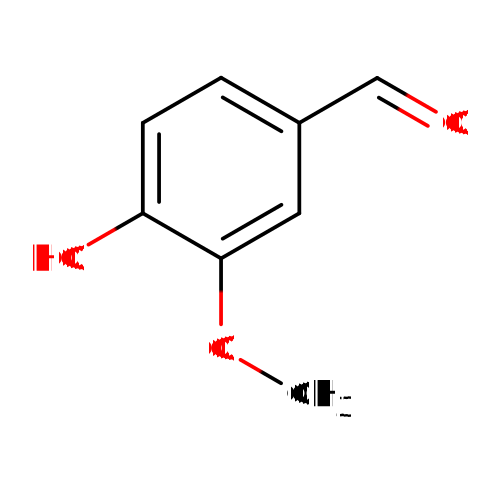
| Common Name | Vanillin |
|---|
| Description | Vanillin, also known as vanillaldehyde or lioxin, belongs to the class of organic compounds known as methoxyphenols. Methoxyphenols are compounds containing a methoxy group attached to the benzene ring of a phenol moiety. It is used by the food industry as well as ethylvanillin. Vanillin exists in all living species, ranging from bacteria to humans. Vanillin is a sweet, chocolate, and creamy tasting compound. Vanillin is found, on average, in the highest concentration within a few different foods, such as corns, ryes, and sherries and in a lower concentration in beers, rums, and oats. Vanillin has also been detected, but not quantified, in several different foods, such as gooseberries, other bread, brazil nuts, shea tree, and ohelo berries. This could make vanillin a potential biomarker for the consumption of these foods. Vanillin is a potentially toxic compound. Synthetic vanillin, instead of natural Vanillin extract, is sometimes used as a flavouring agent in foods, beverages, and pharmaceuticals. Vanillin is the primary component of the extract of the Vanillin bean. Because of the scarcity and expense of natural Vanillin extract, there has long been interest in the synthetic preparation of its predominant component. Artificial Vanillin flavoring is a solution of pure vanillin, usually of synthetic origin. Today, artificial vanillin is made from either guaiacol or from lignin, a constituent of wood which is a byproduct of the paper industry. The first commercial synthesis of vanillin began with the more readily available natural compound eugenol. |
|---|
| Structure | InChI=1S/C8H8O3/c1-11-8-4-6(5-9)2-3-7(8)10/h2-5,10H,1H3 |
|---|
| Synonyms | | Value | Source |
|---|
| 3-Methoxy-4-hydroxybenzaldehyde | ChEBI | | 4-Formyl-2-methoxyphenol | ChEBI | | 4-Hydroxy-3-methoxy-benzaldehyde | ChEBI | | 4-Hydroxy-3-methoxybenzaldehyde | ChEBI | | 4-Hydroxy-m-anisaldehyde | ChEBI | | Methylprotocatechuic aldehyde | ChEBI | | p-Hydroxy-m-methoxybenzaldehyde | ChEBI | | p-Vanillin | ChEBI | | Vaniline | ChEBI | | Vanillaldehyde | ChEBI | | Vanillic aldehyde | ChEBI | | 5-Bromovanillin | MeSH | | 5-Chlorovanillin | MeSH | | Vanillin, sodium salt | MeSH | | 2-Methoxy-4-formylphenol | HMDB | | 4-Hydroxy 3-methoxybenzaldehyde | HMDB | | 4-Hydroxy-3-methoxy-benzaldehyde-5-chlorovanillin | HMDB | | 4-Hydroxy-3-methoxybenzaldehyde (acd/name 4.0) | HMDB | | 4-Hydroxy-5-methoxybenzaldehyde | HMDB | | Lioxin | HMDB | | m-Methoxy-p-hydroxybenzaldehyde | HMDB | | Methyl-protocatechualdehyde | HMDB | | Methylprotcatechuic aldehyde | HMDB | | oleo-Resins vanilla | HMDB | | oleo-Resins vanilla-bean | HMDB | | Oleoresin vanilla | HMDB | | Propenylguaethol | HMDB | | Protocatechualdehyde 3-methyl ether | HMDB | | trans-2-Ethoxy-5-(1-propenyl)phenol | HMDB | | Vanilin | HMDB | | Vanilla | HMDB | | Vanilla oleoresin | HMDB | | Vanillin (3-methoxy-4-hydroxy- benzaldehyde) | HMDB | | Vanillin (natural) | HMDB | | Vanillin (NF) | HMDB | | Vanillin sodium salt | HMDB | | Vanilline | HMDB | | Zimco | HMDB | | 4-Hydroxy-3-methoxy-benzyldehyde | PhytoBank | | Vanillum | PhytoBank | | Vanillin | HMDB |
|
|---|
| Chemical Formula | C8H8O3 |
|---|
| Average Molecular Weight | 152.1473 |
|---|
| Monoisotopic Molecular Weight | 152.047344122 |
|---|
| IUPAC Name | 4-hydroxy-3-methoxybenzaldehyde |
|---|
| Traditional Name | vanillin |
|---|
| CAS Registry Number | 121-33-5 |
|---|
| SMILES | COC1=CC(C=O)=CC=C1O |
|---|
| InChI Identifier | InChI=1S/C8H8O3/c1-11-8-4-6(5-9)2-3-7(8)10/h2-5,10H,1H3 |
|---|
| InChI Key | MWOOGOJBHIARFG-UHFFFAOYSA-N |
|---|
| Chemical Taxonomy |
|---|
| Description | Belongs to the class of organic compounds known as methoxyphenols. Methoxyphenols are compounds containing a methoxy group attached to the benzene ring of a phenol moiety. |
|---|
| Kingdom | Organic compounds |
|---|
| Super Class | Benzenoids |
|---|
| Class | Phenols |
|---|
| Sub Class | Methoxyphenols |
|---|
| Direct Parent | Methoxyphenols |
|---|
| Alternative Parents | |
|---|
| Substituents | - Methoxyphenol
- Hydroxybenzaldehyde
- Anisole
- Benzaldehyde
- Benzoyl
- Phenoxy compound
- Phenol ether
- Methoxybenzene
- Alkyl aryl ether
- Aryl-aldehyde
- 1-hydroxy-2-unsubstituted benzenoid
- Monocyclic benzene moiety
- Ether
- Organooxygen compound
- Aldehyde
- Hydrocarbon derivative
- Organic oxide
- Organic oxygen compound
- Aromatic homomonocyclic compound
|
|---|
| Molecular Framework | Aromatic homomonocyclic compounds |
|---|
| External Descriptors | |
|---|
| Ontology |
|---|
| Physiological effect | |
|---|
| Disposition | |
|---|
| Process | Not Available |
|---|
| Role | |
|---|
| Physical Properties |
|---|
| State | Solid |
|---|
| Experimental Molecular Properties | | Property | Value | Reference |
|---|
| Melting Point | 81.5 °C | Not Available | | Boiling Point | 285.00 to 286.00 °C. @ 760.00 mm Hg | The Good Scents Company Information System | | Water Solubility | 11 mg/mL at 25 °C | Not Available | | LogP | 1.21 | HANSCH,C ET AL. (1995) |
|
|---|
| Experimental Chromatographic Properties | Experimental Collision Cross Sections |
|---|
| Predicted Molecular Properties | |
|---|
| Predicted Chromatographic Properties | Predicted Collision Cross SectionsPredicted Retention Times Underivatized| Chromatographic Method | Retention Time | Reference |
|---|
| Measured using a Waters Acquity ultraperformance liquid chromatography (UPLC) ethylene-bridged hybrid (BEH) C18 column (100 mm × 2.1 mm; 1.7 μmparticle diameter). Predicted by Afia on May 17, 2022. Predicted by Afia on May 17, 2022. | 3.31 minutes | 32390414 | | Predicted by Siyang on May 30, 2022 | 11.2882 minutes | 33406817 | | Predicted by Siyang using ReTip algorithm on June 8, 2022 | 1.14 minutes | 32390414 | | Fem_Long = Waters ACQUITY UPLC HSS T3 C18 with Water:MeOH and 0.1% Formic Acid | 1415.7 seconds | 40023050 | | Fem_Lipids = Ascentis Express C18 with (60:40 water:ACN):(90:10 IPA:ACN) and 10mM NH4COOH + 0.1% Formic Acid | 367.8 seconds | 40023050 | | Life_Old = Waters ACQUITY UPLC BEH C18 with Water:(20:80 acetone:ACN) and 0.1% Formic Acid | 124.2 seconds | 40023050 | | Life_New = RP Waters ACQUITY UPLC HSS T3 C18 with Water:(30:70 MeOH:ACN) and 0.1% Formic Acid | 224.9 seconds | 40023050 | | RIKEN = Waters ACQUITY UPLC BEH C18 with Water:ACN and 0.1% Formic Acid | 106.4 seconds | 40023050 | | Eawag_XBridgeC18 = XBridge C18 3.5u 2.1x50 mm with Water:MeOH and 0.1% Formic Acid | 443.8 seconds | 40023050 | | BfG_NTS_RP1 =Agilent Zorbax Eclipse Plus C18 (2.1 mm x 150 mm, 3.5 um) with Water:ACN and 0.1% Formic Acid | 499.5 seconds | 40023050 | | HILIC_BDD_2 = Merck SeQuant ZIC-HILIC with ACN(0.1% formic acid):water(16 mM ammonium formate) | 127.0 seconds | 40023050 | | UniToyama_Atlantis = RP Waters Atlantis T3 (2.1 x 150 mm, 5 um) with ACN:Water and 0.1% Formic Acid | 949.7 seconds | 40023050 | | BDD_C18 = Hypersil Gold 1.9µm C18 with Water:ACN and 0.1% Formic Acid | 323.6 seconds | 40023050 | | UFZ_Phenomenex = Kinetex Core-Shell C18 2.6 um, 3.0 x 100 mm, Phenomenex with Water:MeOH and 0.1% Formic Acid | 1064.6 seconds | 40023050 | | SNU_RIKEN_POS = Waters ACQUITY UPLC BEH C18 with Water:ACN and 0.1% Formic Acid | 297.0 seconds | 40023050 | | RPMMFDA = Waters ACQUITY UPLC BEH C18 with Water:ACN and 0.1% Formic Acid | 418.0 seconds | 40023050 | | MTBLS87 = Merck SeQuant ZIC-pHILIC column with ACN:Water and :ammonium carbonate | 517.8 seconds | 40023050 | | KI_GIAR_zic_HILIC_pH2_7 = Merck SeQuant ZIC-HILIC with ACN:Water and 0.1% FA | 344.1 seconds | 40023050 | | Meister zic-pHILIC pH9.3 = Merck SeQuant ZIC-pHILIC column with ACN:Water 5mM NH4Ac pH9.3 and 5mM ammonium acetate in water | 167.3 seconds | 40023050 |
Predicted Kovats Retention IndicesUnderivatizedDerivatized |
|---|
| Disease References | | Colorectal cancer |
|---|
- Goedert JJ, Sampson JN, Moore SC, Xiao Q, Xiong X, Hayes RB, Ahn J, Shi J, Sinha R: Fecal metabolomics: assay performance and association with colorectal cancer. Carcinogenesis. 2014 Sep;35(9):2089-96. doi: 10.1093/carcin/bgu131. Epub 2014 Jul 18. [PubMed:25037050 ]
| | Attachment loss |
|---|
- Liebsch C, Pitchika V, Pink C, Samietz S, Kastenmuller G, Artati A, Suhre K, Adamski J, Nauck M, Volzke H, Friedrich N, Kocher T, Holtfreter B, Pietzner M: The Saliva Metabolome in Association to Oral Health Status. J Dent Res. 2019 Jun;98(6):642-651. doi: 10.1177/0022034519842853. Epub 2019 Apr 26. [PubMed:31026179 ]
| | Missing teeth |
|---|
- Liebsch C, Pitchika V, Pink C, Samietz S, Kastenmuller G, Artati A, Suhre K, Adamski J, Nauck M, Volzke H, Friedrich N, Kocher T, Holtfreter B, Pietzner M: The Saliva Metabolome in Association to Oral Health Status. J Dent Res. 2019 Jun;98(6):642-651. doi: 10.1177/0022034519842853. Epub 2019 Apr 26. [PubMed:31026179 ]
| | Periodontal Probing Depth |
|---|
- Liebsch C, Pitchika V, Pink C, Samietz S, Kastenmuller G, Artati A, Suhre K, Adamski J, Nauck M, Volzke H, Friedrich N, Kocher T, Holtfreter B, Pietzner M: The Saliva Metabolome in Association to Oral Health Status. J Dent Res. 2019 Jun;98(6):642-651. doi: 10.1177/0022034519842853. Epub 2019 Apr 26. [PubMed:31026179 ]
|
|
|---|