| Record Information |
|---|
| Version | 5.0 |
|---|
| Status | Expected but not Quantified |
|---|
| Creation Date | 2009-07-25 00:10:07 UTC |
|---|
| Update Date | 2021-09-14 15:45:02 UTC |
|---|
| HMDB ID | HMDB0012933 |
|---|
| Secondary Accession Numbers | |
|---|
| Metabolite Identification |
|---|
| Common Name | Dynorphin A 1-8 |
|---|
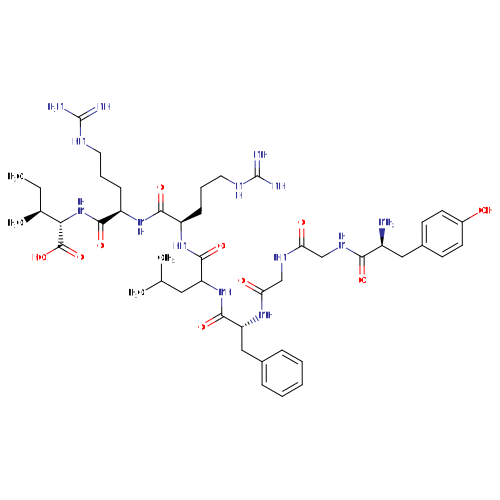
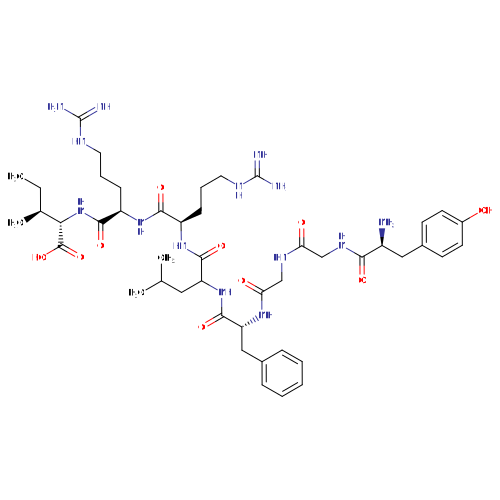
| Description | Dynorphin A (1-8) is a fraction of Dynorphin A with only Tyr-Gly-Gly-Phe-Leu-Arg-Arg-Ile peptide chain. Dynorphin A is an endogenous opioid peptide that produces non-opioid receptor-mediated neural excitation.Dynorphin induces calcium influx via voltage-sensitive calcium channels in sensory neurons by activating bradykinin receptors. This action of dynorphin at bradykinin receptors is distinct from the primary signaling pathway activated by bradykinin and underlies the hyperalgesia produced by pharmacological administration of dynorphin by the spinal route in rats and mice. Blockade of spinal B1 or B2 receptor also reverses persistent neuropathic pain but only when there is sustained elevation of endogenous spinal dynorphin, which is required for maintenance of neuropathic pain. These data reveal a mechanism for endogenous dynorphin to promote pain through its agonist action at bradykinin receptors and suggest new avenues for therapeutic intervention. Dynorphin A is a form of dynorphin.Dynorphins are a class of opioid peptides that arise from the precursor protein prodynorphin. When prodynorphin is cleaved during processing by proprotein convertase 2 (PC2), multiple active peptides are released: dynorphin A, dynorphin B, and a/b-neo-endorphin. Depolarization of a neuron containing prodynorphin stimulates PC2 processing, which occurs within synaptic vesicles in the presynaptic terminal. Occasionally, prodynorphin is not fully processed, leading to the release of "big dynorphin."This 32-amino acid molecule consists of both dynorphin A and dynorphin B.Dynorphin A, dynorphin B, and big dynorphin all contain a high proportion of basic amino acid residues, in particular lysine and arginine (29.4%, 23.1%, and 31.2% basic residues, respectively), as well as many hydrophobic residues (41.2%, 30.8%, and 34.4% hydrophobic residues, respectively). Although dynorphins are found widely distributed in the CNS, they have the highest concentrations in the hypothalamus, medulla, pons, midbrain, and spinal cord. Dynorphins are stored in large (80-120 nm diameter) dense-core vesicles that are considerably larger than vesicles storing neurotransmitters. These large dense-core vesicles differ from small synaptic vesicles in that a more intense and prolonged stimulus is needed to cause the large vesicles to release their contents into the synaptic cleft. Dense-core vesicle storage is characteristic of opioid peptides storage. The first clues to the functionality of dynorphins came from Goldstein et al. in their work with opioid peptides. The group discovered an endogenous opioid peptide in the porcine pituitary that proved difficult to isolate. By sequencing the first 13 amino acids of the peptide, they created a synthetic version of the peptide with a similar potency to the natural peptide. Goldstein et al. applied the synthetic peptide to the guinea ileum longitudinal muscle and found it to be an extraordinarily potent opioid peptide. The peptide was called dynorphin (from the Greek dynamis=power) to describe its potency. Dynorphins exert their effects primarily through the κ-opioid receptor (KOR), a G-protein-coupled receptor. Two subtypes of KORs have been identified: K1 and K2. Although KOR is the primary receptor for all dynorphins, the peptides do have some affinity for the μ-opioid receptor (MOR), d-opioid receptor (DOR), N-methyl-D-aspartic acid (NMDA)-type glutamate receptor. Different dynorphins show different receptor selectivities and potencies at receptors. Big dynorphin and dynorphin A have the same selectivity for human KOR, but dynorphin A is more selective for KOR over MOR and DOR than is big dynorphin. Big dynorphin is more potent at KORs than is dynorphin A. Both big dynorphin and dynorphin A are more potent and more selective than dynorphin B (Wikipedia ). |
|---|
| Structure | CC[C@H](C)[C@H](NC(=O)[C@@H](CCCNC(N)=N)NC(=O)[C@@H](CCCNC(N)=N)NC(=O)C(CC(C)C)NC(=O)[C@@H](CC1=CC=CC=C1)NC(=O)CNC(=O)CNC(=O)[C@@H](N)CC1=CC=C(O)C=C1)C(O)=O InChI=1S/C46H72N14O10/c1-5-27(4)38(44(69)70)60-41(66)33(14-10-20-53-46(50)51)57-40(65)32(13-9-19-52-45(48)49)58-42(67)34(21-26(2)3)59-43(68)35(23-28-11-7-6-8-12-28)56-37(63)25-54-36(62)24-55-39(64)31(47)22-29-15-17-30(61)18-16-29/h6-8,11-12,15-18,26-27,31-35,38,61H,5,9-10,13-14,19-25,47H2,1-4H3,(H,54,62)(H,55,64)(H,56,63)(H,57,65)(H,58,67)(H,59,68)(H,60,66)(H,69,70)(H4,48,49,52)(H4,50,51,53)/t27-,31-,32+,33+,34?,35+,38-/m0/s1 |
|---|
| Synonyms | | Value | Source |
|---|
| PH-8P | MeSH | | Dynorphin a (1-8) | MeSH | | Tyr-gly-gly-phe-leu-arg-arg-ile | MeSH | | Dynorphin (1-8) | MeSH | | Tyrosyl-glycyl-glycyl-phenylalanyl--leucyl-arginyl-arginyl-isoleucine | MeSH | | Dynorphin a fragment 1-8 | HMDB | | (2S,3S)-2-{[(2R)-2-{[(2R)-2-[(2-{[(2R)-2-({2-[(2-{[(2S)-2-amino-1-hydroxy-3-(4-hydroxyphenyl)propylidene]amino}-1-hydroxyethylidene)amino]-1-hydroxyethylidene}amino)-1-hydroxy-3-phenylpropylidene]amino}-1-hydroxy-4-methylpentylidene)amino]-5-carbamimidamido-1-hydroxypentylidene]amino}-5-carbamimidamido-1-hydroxypentylidene]amino}-3-methylpentanoate | Generator |
|
|---|
| Chemical Formula | C46H72N14O10 |
|---|
| Average Molecular Weight | 981.1517 |
|---|
| Monoisotopic Molecular Weight | 980.555584594 |
|---|
| IUPAC Name | (2S,3S)-2-[(2R)-2-[(2R)-2-{2-[(2R)-2-(2-{2-[(2S)-2-amino-3-(4-hydroxyphenyl)propanamido]acetamido}acetamido)-3-phenylpropanamido]-4-methylpentanamido}-5-carbamimidamidopentanamido]-5-carbamimidamidopentanamido]-3-methylpentanoic acid |
|---|
| Traditional Name | (2S,3S)-2-[(2R)-2-[(2R)-2-{2-[(2R)-2-(2-{2-[(2S)-2-amino-3-(4-hydroxyphenyl)propanamido]acetamido}acetamido)-3-phenylpropanamido]-4-methylpentanamido}-5-carbamimidamidopentanamido]-5-carbamimidamidopentanamido]-3-methylpentanoic acid |
|---|
| CAS Registry Number | 75790-53-3 |
|---|
| SMILES | CC[C@H](C)[C@H](NC(=O)[C@@H](CCCNC(N)=N)NC(=O)[C@@H](CCCNC(N)=N)NC(=O)C(CC(C)C)NC(=O)[C@@H](CC1=CC=CC=C1)NC(=O)CNC(=O)CNC(=O)[C@@H](N)CC1=CC=C(O)C=C1)C(O)=O |
|---|
| InChI Identifier | InChI=1S/C46H72N14O10/c1-5-27(4)38(44(69)70)60-41(66)33(14-10-20-53-46(50)51)57-40(65)32(13-9-19-52-45(48)49)58-42(67)34(21-26(2)3)59-43(68)35(23-28-11-7-6-8-12-28)56-37(63)25-54-36(62)24-55-39(64)31(47)22-29-15-17-30(61)18-16-29/h6-8,11-12,15-18,26-27,31-35,38,61H,5,9-10,13-14,19-25,47H2,1-4H3,(H,54,62)(H,55,64)(H,56,63)(H,57,65)(H,58,67)(H,59,68)(H,60,66)(H,69,70)(H4,48,49,52)(H4,50,51,53)/t27-,31-,32+,33+,34?,35+,38-/m0/s1 |
|---|
| InChI Key | WRPLGMBDXVBPEG-PUGOIMMUSA-N |
|---|
| Chemical Taxonomy |
|---|
| Description | Belongs to the class of organic compounds known as oligopeptides. These are organic compounds containing a sequence of between three and ten alpha-amino acids joined by peptide bonds. |
|---|
| Kingdom | Organic compounds |
|---|
| Super Class | Organic acids and derivatives |
|---|
| Class | Carboxylic acids and derivatives |
|---|
| Sub Class | Amino acids, peptides, and analogues |
|---|
| Direct Parent | Oligopeptides |
|---|
| Alternative Parents | |
|---|
| Substituents | - Alpha-oligopeptide
- Tyrosine or derivatives
- Phenylalanine or derivatives
- Isoleucine or derivatives
- Leucine or derivatives
- N-acyl-alpha amino acid or derivatives
- N-acyl-alpha-amino acid
- N-acyl-l-alpha-amino acid
- Alpha-amino acid amide
- Alpha-amino acid or derivatives
- Amphetamine or derivatives
- N-substituted-alpha-amino acid
- 1-hydroxy-2-unsubstituted benzenoid
- Aralkylamine
- Phenol
- N-acyl-amine
- Fatty acyl
- Monocyclic benzene moiety
- Benzenoid
- Fatty amide
- Guanidine
- Secondary carboxylic acid amide
- Carboxamide group
- Amino acid
- Amino acid or derivatives
- Organic 1,3-dipolar compound
- Propargyl-type 1,3-dipolar organic compound
- Carboxylic acid
- Carboximidamide
- Monocarboxylic acid or derivatives
- Amine
- Organopnictogen compound
- Organic oxygen compound
- Carbonyl group
- Organic nitrogen compound
- Hydrocarbon derivative
- Primary amine
- Primary aliphatic amine
- Organic oxide
- Organooxygen compound
- Organonitrogen compound
- Aromatic homomonocyclic compound
|
|---|
| Molecular Framework | Aromatic homomonocyclic compounds |
|---|
| External Descriptors | Not Available |
|---|
| Ontology |
|---|
| Physiological effect | Not Available |
|---|
| Disposition | |
|---|
| Process | Not Available |
|---|
| Role | Not Available |
|---|
| Physical Properties |
|---|
| State | Solid |
|---|
| Experimental Molecular Properties | | Property | Value | Reference |
|---|
| Melting Point | Not Available | Not Available | | Boiling Point | Not Available | Not Available | | Water Solubility | Not Available | Not Available | | LogP | Not Available | Not Available |
|
|---|
| Experimental Chromatographic Properties | Not Available |
|---|
| Predicted Molecular Properties | |
|---|
| Predicted Chromatographic Properties | Predicted Collision Cross SectionsPredicted Retention Times Underivatized| Chromatographic Method | Retention Time | Reference |
|---|
| Measured using a Waters Acquity ultraperformance liquid chromatography (UPLC) ethylene-bridged hybrid (BEH) C18 column (100 mm × 2.1 mm; 1.7 μmparticle diameter). Predicted by Afia on May 17, 2022. Predicted by Afia on May 17, 2022. | 0.15 minutes | 32390414 | | Predicted by Siyang on May 30, 2022 | 14.0851 minutes | 33406817 | | Predicted by Siyang using ReTip algorithm on June 8, 2022 | 6.83 minutes | 32390414 | | AjsUoB = Accucore 150 Amide HILIC with 10mM Ammonium Formate, 0.1% Formic Acid | 400.8 seconds | 40023050 | | Fem_Long = Waters ACQUITY UPLC HSS T3 C18 with Water:MeOH and 0.1% Formic Acid | 1321.8 seconds | 40023050 | | Fem_Lipids = Ascentis Express C18 with (60:40 water:ACN):(90:10 IPA:ACN) and 10mM NH4COOH + 0.1% Formic Acid | 155.7 seconds | 40023050 | | Life_Old = Waters ACQUITY UPLC BEH C18 with Water:(20:80 acetone:ACN) and 0.1% Formic Acid | 193.3 seconds | 40023050 | | Life_New = RP Waters ACQUITY UPLC HSS T3 C18 with Water:(30:70 MeOH:ACN) and 0.1% Formic Acid | 185.4 seconds | 40023050 | | RIKEN = Waters ACQUITY UPLC BEH C18 with Water:ACN and 0.1% Formic Acid | 131.9 seconds | 40023050 | | Eawag_XBridgeC18 = XBridge C18 3.5u 2.1x50 mm with Water:MeOH and 0.1% Formic Acid | 430.6 seconds | 40023050 | | BfG_NTS_RP1 =Agilent Zorbax Eclipse Plus C18 (2.1 mm x 150 mm, 3.5 um) with Water:ACN and 0.1% Formic Acid | 452.4 seconds | 40023050 | | HILIC_BDD_2 = Merck SeQuant ZIC-HILIC with ACN(0.1% formic acid):water(16 mM ammonium formate) | 1274.1 seconds | 40023050 | | UniToyama_Atlantis = RP Waters Atlantis T3 (2.1 x 150 mm, 5 um) with ACN:Water and 0.1% Formic Acid | 957.4 seconds | 40023050 | | BDD_C18 = Hypersil Gold 1.9µm C18 with Water:ACN and 0.1% Formic Acid | 537.6 seconds | 40023050 | | UFZ_Phenomenex = Kinetex Core-Shell C18 2.6 um, 3.0 x 100 mm, Phenomenex with Water:MeOH and 0.1% Formic Acid | 1119.3 seconds | 40023050 | | SNU_RIKEN_POS = Waters ACQUITY UPLC BEH C18 with Water:ACN and 0.1% Formic Acid | 267.2 seconds | 40023050 | | RPMMFDA = Waters ACQUITY UPLC BEH C18 with Water:ACN and 0.1% Formic Acid | 391.0 seconds | 40023050 | | MTBLS87 = Merck SeQuant ZIC-pHILIC column with ACN:Water and :ammonium carbonate | 390.1 seconds | 40023050 | | KI_GIAR_zic_HILIC_pH2_7 = Merck SeQuant ZIC-HILIC with ACN:Water and 0.1% FA | 714.3 seconds | 40023050 | | Meister zic-pHILIC pH9.3 = Merck SeQuant ZIC-pHILIC column with ACN:Water 5mM NH4Ac pH9.3 and 5mM ammonium acetate in water | 89.6 seconds | 40023050 |
Predicted Kovats Retention IndicesNot Available |
|---|
| MS/MS Spectra| Spectrum Type | Description | Splash Key | Deposition Date | Source | View |
|---|
| Predicted LC-MS/MS | Predicted LC-MS/MS Spectrum - Dynorphin A 1-8 10V, Positive-QTOF | splash10-0f76-0940000002-23f38a333b1089d81ae5 | 2017-09-01 | Wishart Lab | View Spectrum | | Predicted LC-MS/MS | Predicted LC-MS/MS Spectrum - Dynorphin A 1-8 20V, Positive-QTOF | splash10-000i-3910000100-5f0c41a1206c097214b8 | 2017-09-01 | Wishart Lab | View Spectrum | | Predicted LC-MS/MS | Predicted LC-MS/MS Spectrum - Dynorphin A 1-8 40V, Positive-QTOF | splash10-000i-2910000000-3dc833cd70607d235de5 | 2017-09-01 | Wishart Lab | View Spectrum | | Predicted LC-MS/MS | Predicted LC-MS/MS Spectrum - Dynorphin A 1-8 10V, Negative-QTOF | splash10-000i-1000000139-fcfe2daae4be5408e21c | 2017-09-01 | Wishart Lab | View Spectrum | | Predicted LC-MS/MS | Predicted LC-MS/MS Spectrum - Dynorphin A 1-8 20V, Negative-QTOF | splash10-0btj-6330221469-81f9d09eac75cafc472c | 2017-09-01 | Wishart Lab | View Spectrum | | Predicted LC-MS/MS | Predicted LC-MS/MS Spectrum - Dynorphin A 1-8 40V, Negative-QTOF | splash10-0006-9241213131-f7c3e2144b0c04986d52 | 2017-09-01 | Wishart Lab | View Spectrum | | Predicted LC-MS/MS | Predicted LC-MS/MS Spectrum - Dynorphin A 1-8 10V, Negative-QTOF | splash10-004i-0000000049-70aaa5b9a0da635f7f07 | 2021-09-22 | Wishart Lab | View Spectrum | | Predicted LC-MS/MS | Predicted LC-MS/MS Spectrum - Dynorphin A 1-8 20V, Negative-QTOF | splash10-001i-1300000094-40f1de3509d444df0ec1 | 2021-09-22 | Wishart Lab | View Spectrum | | Predicted LC-MS/MS | Predicted LC-MS/MS Spectrum - Dynorphin A 1-8 40V, Negative-QTOF | splash10-06r6-3910212111-cb6edd8bbeb2d350ff3c | 2021-09-22 | Wishart Lab | View Spectrum | | Predicted LC-MS/MS | Predicted LC-MS/MS Spectrum - Dynorphin A 1-8 10V, Positive-QTOF | splash10-000i-0100100039-212775a68ade746a78bb | 2021-09-25 | Wishart Lab | View Spectrum | | Predicted LC-MS/MS | Predicted LC-MS/MS Spectrum - Dynorphin A 1-8 20V, Positive-QTOF | splash10-03k9-5200261195-bdb3f9b7c92d254d8dc1 | 2021-09-25 | Wishart Lab | View Spectrum | | Predicted LC-MS/MS | Predicted LC-MS/MS Spectrum - Dynorphin A 1-8 40V, Positive-QTOF | splash10-03di-7910000031-e5386fa952784412f988 | 2021-09-25 | Wishart Lab | View Spectrum |
NMR Spectra| Spectrum Type | Description | Deposition Date | Source | View |
|---|
| Predicted 1D NMR | 13C NMR Spectrum (1D, 100 MHz, D2O, predicted) | 2021-09-25 | Wishart Lab | View Spectrum | | Predicted 1D NMR | 1H NMR Spectrum (1D, 100 MHz, D2O, predicted) | 2021-09-25 | Wishart Lab | View Spectrum | | Predicted 1D NMR | 13C NMR Spectrum (1D, 1000 MHz, D2O, predicted) | 2021-09-25 | Wishart Lab | View Spectrum | | Predicted 1D NMR | 1H NMR Spectrum (1D, 1000 MHz, D2O, predicted) | 2021-09-25 | Wishart Lab | View Spectrum | | Predicted 1D NMR | 13C NMR Spectrum (1D, 200 MHz, D2O, predicted) | 2021-09-25 | Wishart Lab | View Spectrum | | Predicted 1D NMR | 1H NMR Spectrum (1D, 200 MHz, D2O, predicted) | 2021-09-25 | Wishart Lab | View Spectrum | | Predicted 1D NMR | 13C NMR Spectrum (1D, 300 MHz, D2O, predicted) | 2021-09-25 | Wishart Lab | View Spectrum | | Predicted 1D NMR | 1H NMR Spectrum (1D, 300 MHz, D2O, predicted) | 2021-09-25 | Wishart Lab | View Spectrum | | Predicted 1D NMR | 13C NMR Spectrum (1D, 400 MHz, D2O, predicted) | 2021-09-25 | Wishart Lab | View Spectrum | | Predicted 1D NMR | 1H NMR Spectrum (1D, 400 MHz, D2O, predicted) | 2021-09-25 | Wishart Lab | View Spectrum | | Predicted 1D NMR | 13C NMR Spectrum (1D, 500 MHz, D2O, predicted) | 2021-09-25 | Wishart Lab | View Spectrum | | Predicted 1D NMR | 1H NMR Spectrum (1D, 500 MHz, D2O, predicted) | 2021-09-25 | Wishart Lab | View Spectrum | | Predicted 1D NMR | 13C NMR Spectrum (1D, 600 MHz, D2O, predicted) | 2021-09-25 | Wishart Lab | View Spectrum | | Predicted 1D NMR | 1H NMR Spectrum (1D, 600 MHz, D2O, predicted) | 2021-09-25 | Wishart Lab | View Spectrum | | Predicted 1D NMR | 13C NMR Spectrum (1D, 700 MHz, D2O, predicted) | 2021-09-25 | Wishart Lab | View Spectrum | | Predicted 1D NMR | 1H NMR Spectrum (1D, 700 MHz, D2O, predicted) | 2021-09-25 | Wishart Lab | View Spectrum | | Predicted 1D NMR | 13C NMR Spectrum (1D, 800 MHz, D2O, predicted) | 2021-09-25 | Wishart Lab | View Spectrum | | Predicted 1D NMR | 1H NMR Spectrum (1D, 800 MHz, D2O, predicted) | 2021-09-25 | Wishart Lab | View Spectrum | | Predicted 1D NMR | 13C NMR Spectrum (1D, 900 MHz, D2O, predicted) | 2021-09-25 | Wishart Lab | View Spectrum | | Predicted 1D NMR | 1H NMR Spectrum (1D, 900 MHz, D2O, predicted) | 2021-09-25 | Wishart Lab | View Spectrum |
|
|---|