| Record Information |
|---|
| Version | 5.0 |
|---|
| Status | Expected but not Quantified |
|---|
| Creation Date | 2012-09-06 15:16:49 UTC |
|---|
| Update Date | 2022-03-07 02:51:39 UTC |
|---|
| HMDB ID | HMDB0014558 |
|---|
| Secondary Accession Numbers | |
|---|
| Metabolite Identification |
|---|
| Common Name | Acetohexamide |
|---|
| Description | Acetohexamide is only found in individuals that have used or taken this drug. It is a sulfonylurea hypoglycemic agent that is metabolized in the liver to 1-hydrohexamide. [PubChem]Sulfonylureas such as acetohexamide bind to an ATP-dependent K+ channel on the cell membrane of pancreatic beta cells. This inhibits a tonic, hyperpolarizing outflux of potassium, which causes the electric potential over the membrane to become more positive. This depolarization opens voltage-gated Ca2+ channels. The rise in intracellular calcium leads to increased fusion of insulin granulae with the cell membrane, and therefore increased secretion of (pro)insulin. |
|---|
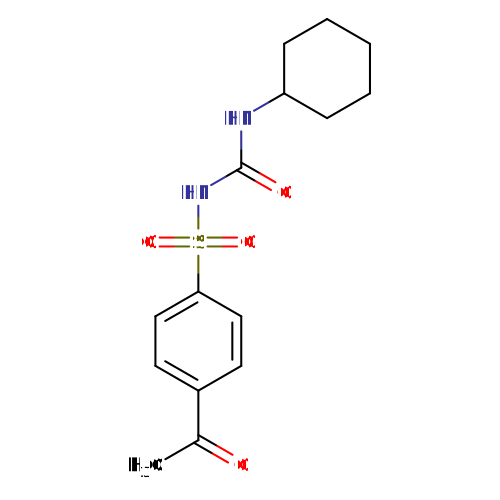
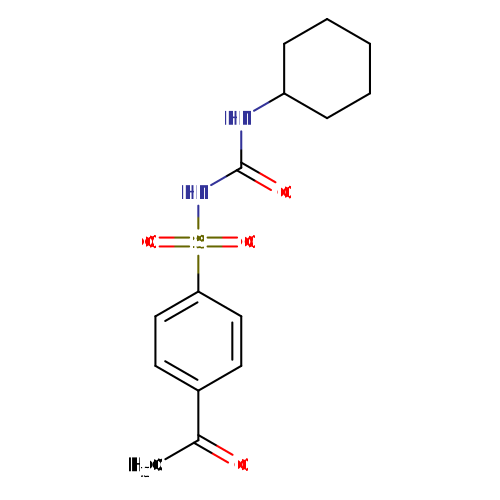
| Structure | CC(=O)C1=CC=C(C=C1)S(=O)(=O)NC(=O)NC1CCCCC1 InChI=1S/C15H20N2O4S/c1-11(18)12-7-9-14(10-8-12)22(20,21)17-15(19)16-13-5-3-2-4-6-13/h7-10,13H,2-6H2,1H3,(H2,16,17,19) |
|---|
| Synonyms | | Value | Source |
|---|
| 1-((p-Acetylphenyl)sulfonyl)-3-cyclohexylurea | ChEBI | | 4-Acetyl-N-((cyclohexylamino)carbonyl)benzenesulfonamide | ChEBI | | Acetohexamida | ChEBI | | Acetohexamidum | ChEBI | | Dymelor | ChEBI | | N-(p-Acetylphenylsulfonyl)-n'-cyclohexylurea | ChEBI | | 1-((p-Acetylphenyl)sulphonyl)-3-cyclohexylurea | Generator | | 4-Acetyl-N-((cyclohexylamino)carbonyl)benzenesulphonamide | Generator | | N-(p-Acetylphenylsulphonyl)-n'-cyclohexylurea | Generator | | Acetohexamid | HMDB | | Gamadiabet | HMDB | | Lilly brand OF acetohexamide | HMDB | | Salvat brand OF acetohexamide | HMDB | | Dimelor | HMDB | | Acetohexamide lilly brand | HMDB | | Acetohexamide salvat brand | HMDB |
|
|---|
| Chemical Formula | C15H20N2O4S |
|---|
| Average Molecular Weight | 324.395 |
|---|
| Monoisotopic Molecular Weight | 324.114377828 |
|---|
| IUPAC Name | 3-(4-acetylbenzenesulfonyl)-1-cyclohexylurea |
|---|
| Traditional Name | acetohexamide |
|---|
| CAS Registry Number | 968-81-0 |
|---|
| SMILES | CC(=O)C1=CC=C(C=C1)S(=O)(=O)NC(=O)NC1CCCCC1 |
|---|
| InChI Identifier | InChI=1S/C15H20N2O4S/c1-11(18)12-7-9-14(10-8-12)22(20,21)17-15(19)16-13-5-3-2-4-6-13/h7-10,13H,2-6H2,1H3,(H2,16,17,19) |
|---|
| InChI Key | VGZSUPCWNCWDAN-UHFFFAOYSA-N |
|---|
| Chemical Taxonomy |
|---|
| Description | Belongs to the class of organic compounds known as alkyl-phenylketones. These are aromatic compounds containing a ketone substituted by one alkyl group, and a phenyl group. |
|---|
| Kingdom | Organic compounds |
|---|
| Super Class | Organic oxygen compounds |
|---|
| Class | Organooxygen compounds |
|---|
| Sub Class | Carbonyl compounds |
|---|
| Direct Parent | Alkyl-phenylketones |
|---|
| Alternative Parents | |
|---|
| Substituents | - Alkyl-phenylketone
- Benzenesulfonamide
- Acetophenone
- Benzenesulfonyl group
- Benzoyl
- Aryl alkyl ketone
- Sulfonylurea
- Benzenoid
- Monocyclic benzene moiety
- Aminosulfonyl compound
- Sulfonyl
- Organosulfonic acid or derivatives
- Organic sulfonic acid or derivatives
- Organic 1,3-dipolar compound
- Propargyl-type 1,3-dipolar organic compound
- Carboximidic acid derivative
- Organic nitrogen compound
- Organosulfur compound
- Organonitrogen compound
- Organic oxide
- Organopnictogen compound
- Hydrocarbon derivative
- Aromatic homomonocyclic compound
|
|---|
| Molecular Framework | Aromatic homomonocyclic compounds |
|---|
| External Descriptors | |
|---|
| Ontology |
|---|
| Physiological effect | Not Available |
|---|
| Disposition | |
|---|
| Process | Not Available |
|---|
| Role | Not Available |
|---|
| Physical Properties |
|---|
| State | Solid |
|---|
| Experimental Molecular Properties | | Property | Value | Reference |
|---|
| Melting Point | 188 - 190 °C | Not Available | | Boiling Point | Not Available | Not Available | | Water Solubility | 0.048 g/L | Not Available | | LogP | 2.7 | Not Available |
|
|---|
| Experimental Chromatographic Properties | Experimental Collision Cross Sections |
|---|
| Predicted Molecular Properties | |
|---|
| Predicted Chromatographic Properties | Predicted Collision Cross SectionsPredicted Retention Times Underivatized| Chromatographic Method | Retention Time | Reference |
|---|
| Measured using a Waters Acquity ultraperformance liquid chromatography (UPLC) ethylene-bridged hybrid (BEH) C18 column (100 mm × 2.1 mm; 1.7 μmparticle diameter). Predicted by Afia on May 17, 2022. Predicted by Afia on May 17, 2022. | 7.14 minutes | 32390414 | | Predicted by Siyang on May 30, 2022 | 11.8455 minutes | 33406817 | | Predicted by Siyang using ReTip algorithm on June 8, 2022 | 1.28 minutes | 32390414 | | Fem_Long = Waters ACQUITY UPLC HSS T3 C18 with Water:MeOH and 0.1% Formic Acid | 1904.5 seconds | 40023050 | | Fem_Lipids = Ascentis Express C18 with (60:40 water:ACN):(90:10 IPA:ACN) and 10mM NH4COOH + 0.1% Formic Acid | 247.2 seconds | 40023050 | | Life_Old = Waters ACQUITY UPLC BEH C18 with Water:(20:80 acetone:ACN) and 0.1% Formic Acid | 148.0 seconds | 40023050 | | Life_New = RP Waters ACQUITY UPLC HSS T3 C18 with Water:(30:70 MeOH:ACN) and 0.1% Formic Acid | 174.0 seconds | 40023050 | | RIKEN = Waters ACQUITY UPLC BEH C18 with Water:ACN and 0.1% Formic Acid | 120.5 seconds | 40023050 | | Eawag_XBridgeC18 = XBridge C18 3.5u 2.1x50 mm with Water:MeOH and 0.1% Formic Acid | 365.1 seconds | 40023050 | | BfG_NTS_RP1 =Agilent Zorbax Eclipse Plus C18 (2.1 mm x 150 mm, 3.5 um) with Water:ACN and 0.1% Formic Acid | 449.1 seconds | 40023050 | | HILIC_BDD_2 = Merck SeQuant ZIC-HILIC with ACN(0.1% formic acid):water(16 mM ammonium formate) | 175.4 seconds | 40023050 | | UniToyama_Atlantis = RP Waters Atlantis T3 (2.1 x 150 mm, 5 um) with ACN:Water and 0.1% Formic Acid | 956.5 seconds | 40023050 | | BDD_C18 = Hypersil Gold 1.9µm C18 with Water:ACN and 0.1% Formic Acid | 413.8 seconds | 40023050 | | UFZ_Phenomenex = Kinetex Core-Shell C18 2.6 um, 3.0 x 100 mm, Phenomenex with Water:MeOH and 0.1% Formic Acid | 1318.2 seconds | 40023050 | | SNU_RIKEN_POS = Waters ACQUITY UPLC BEH C18 with Water:ACN and 0.1% Formic Acid | 264.2 seconds | 40023050 | | RPMMFDA = Waters ACQUITY UPLC BEH C18 with Water:ACN and 0.1% Formic Acid | 303.0 seconds | 40023050 | | MTBLS87 = Merck SeQuant ZIC-pHILIC column with ACN:Water and :ammonium carbonate | 384.4 seconds | 40023050 | | KI_GIAR_zic_HILIC_pH2_7 = Merck SeQuant ZIC-HILIC with ACN:Water and 0.1% FA | 200.4 seconds | 40023050 | | Meister zic-pHILIC pH9.3 = Merck SeQuant ZIC-pHILIC column with ACN:Water 5mM NH4Ac pH9.3 and 5mM ammonium acetate in water | 144.5 seconds | 40023050 |
Predicted Kovats Retention IndicesUnderivatizedDerivatized| Derivative Name / Structure | SMILES | Kovats RI Value | Column Type | Reference |
|---|
| Acetohexamide,1TMS,isomer #1 | CC(=O)C1=CC=C(S(=O)(=O)N(C(=O)NC2CCCCC2)[Si](C)(C)C)C=C1 | 2864.4 | Semi standard non polar | 33892256 | | Acetohexamide,1TMS,isomer #1 | CC(=O)C1=CC=C(S(=O)(=O)N(C(=O)NC2CCCCC2)[Si](C)(C)C)C=C1 | 2598.6 | Standard non polar | 33892256 | | Acetohexamide,1TMS,isomer #1 | CC(=O)C1=CC=C(S(=O)(=O)N(C(=O)NC2CCCCC2)[Si](C)(C)C)C=C1 | 3845.9 | Standard polar | 33892256 | | Acetohexamide,1TMS,isomer #2 | CC(=O)C1=CC=C(S(=O)(=O)NC(=O)N(C2CCCCC2)[Si](C)(C)C)C=C1 | 2844.9 | Semi standard non polar | 33892256 | | Acetohexamide,1TMS,isomer #2 | CC(=O)C1=CC=C(S(=O)(=O)NC(=O)N(C2CCCCC2)[Si](C)(C)C)C=C1 | 2672.3 | Standard non polar | 33892256 | | Acetohexamide,1TMS,isomer #2 | CC(=O)C1=CC=C(S(=O)(=O)NC(=O)N(C2CCCCC2)[Si](C)(C)C)C=C1 | 3783.3 | Standard polar | 33892256 | | Acetohexamide,2TMS,isomer #1 | CC(=O)C1=CC=C(S(=O)(=O)N(C(=O)N(C2CCCCC2)[Si](C)(C)C)[Si](C)(C)C)C=C1 | 2749.9 | Semi standard non polar | 33892256 | | Acetohexamide,2TMS,isomer #1 | CC(=O)C1=CC=C(S(=O)(=O)N(C(=O)N(C2CCCCC2)[Si](C)(C)C)[Si](C)(C)C)C=C1 | 2832.9 | Standard non polar | 33892256 | | Acetohexamide,2TMS,isomer #1 | CC(=O)C1=CC=C(S(=O)(=O)N(C(=O)N(C2CCCCC2)[Si](C)(C)C)[Si](C)(C)C)C=C1 | 3601.4 | Standard polar | 33892256 | | Acetohexamide,1TBDMS,isomer #1 | CC(=O)C1=CC=C(S(=O)(=O)N(C(=O)NC2CCCCC2)[Si](C)(C)C(C)(C)C)C=C1 | 3139.8 | Semi standard non polar | 33892256 | | Acetohexamide,1TBDMS,isomer #1 | CC(=O)C1=CC=C(S(=O)(=O)N(C(=O)NC2CCCCC2)[Si](C)(C)C(C)(C)C)C=C1 | 2829.8 | Standard non polar | 33892256 | | Acetohexamide,1TBDMS,isomer #1 | CC(=O)C1=CC=C(S(=O)(=O)N(C(=O)NC2CCCCC2)[Si](C)(C)C(C)(C)C)C=C1 | 3901.0 | Standard polar | 33892256 | | Acetohexamide,1TBDMS,isomer #2 | CC(=O)C1=CC=C(S(=O)(=O)NC(=O)N(C2CCCCC2)[Si](C)(C)C(C)(C)C)C=C1 | 3104.7 | Semi standard non polar | 33892256 | | Acetohexamide,1TBDMS,isomer #2 | CC(=O)C1=CC=C(S(=O)(=O)NC(=O)N(C2CCCCC2)[Si](C)(C)C(C)(C)C)C=C1 | 2935.7 | Standard non polar | 33892256 | | Acetohexamide,1TBDMS,isomer #2 | CC(=O)C1=CC=C(S(=O)(=O)NC(=O)N(C2CCCCC2)[Si](C)(C)C(C)(C)C)C=C1 | 3829.6 | Standard polar | 33892256 | | Acetohexamide,2TBDMS,isomer #1 | CC(=O)C1=CC=C(S(=O)(=O)N(C(=O)N(C2CCCCC2)[Si](C)(C)C(C)(C)C)[Si](C)(C)C(C)(C)C)C=C1 | 3314.2 | Semi standard non polar | 33892256 | | Acetohexamide,2TBDMS,isomer #1 | CC(=O)C1=CC=C(S(=O)(=O)N(C(=O)N(C2CCCCC2)[Si](C)(C)C(C)(C)C)[Si](C)(C)C(C)(C)C)C=C1 | 3324.6 | Standard non polar | 33892256 | | Acetohexamide,2TBDMS,isomer #1 | CC(=O)C1=CC=C(S(=O)(=O)N(C(=O)N(C2CCCCC2)[Si](C)(C)C(C)(C)C)[Si](C)(C)C(C)(C)C)C=C1 | 3655.1 | Standard polar | 33892256 |
|
|---|