| Record Information |
|---|
| Version | 5.0 |
|---|
| Status | Expected but not Quantified |
|---|
| Creation Date | 2012-09-11 17:45:39 UTC |
|---|
| Update Date | 2022-03-07 02:53:08 UTC |
|---|
| HMDB ID | HMDB0031816 |
|---|
| Secondary Accession Numbers | |
|---|
| Metabolite Identification |
|---|
| Common Name | 3-Hydroxyflavone |
|---|
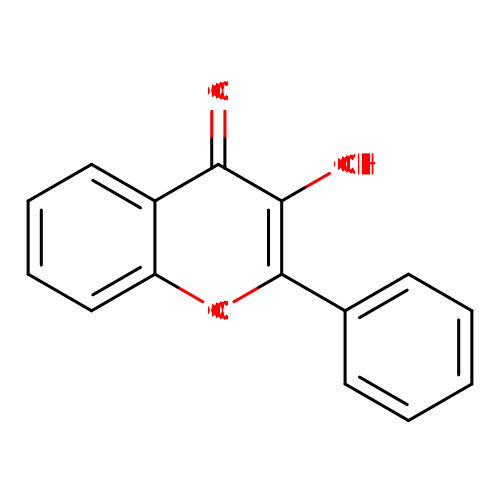
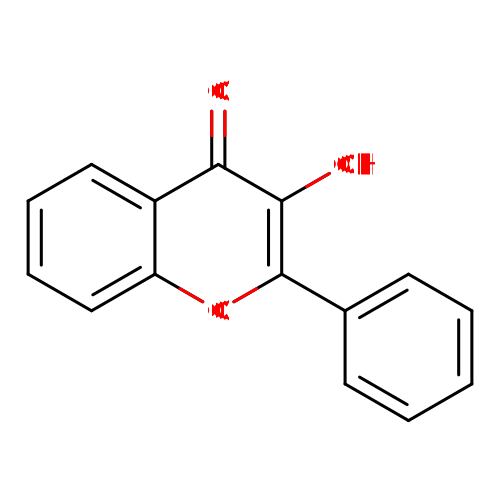
| Description | 3-Hydroxyflavone, also known as flavon-3-ol, belongs to the class of organic compounds known as flavonols. Flavonols are compounds that contain a flavone (2-phenyl-1-benzopyran-4-one) backbone carrying a hydroxyl group at the 3-position. 3-Hydroxyflavone is found, on average, in the highest concentration within papayas (Carica papaya). 3-Hydroxyflavone has also been detected, but not quantified in, several different foods, such as red raspberries (Rubus idaeus), teas (Camellia sinensis), black tea, pomegranates (Punica granatum), and brassicas. This could make 3-hydroxyflavone a potential biomarker for the consumption of these foods. 3-Hydroxyflavone is a primary metabolite. Primary metabolites are metabolically or physiologically essential metabolites. They are directly involved in an organism’s growth, development or reproduction. Based on a literature review a significant number of articles have been published on 3-Hydroxyflavone. |
|---|
| Structure | OC1=C(OC2=CC=CC=C2C1=O)C1=CC=CC=C1 InChI=1S/C15H10O3/c16-13-11-8-4-5-9-12(11)18-15(14(13)17)10-6-2-1-3-7-10/h1-9,17H |
|---|
| Synonyms | | Value | Source |
|---|
| 3-Hydroxy-2-phenyl-4H-1-benzopyran-4-one | ChEBI | | 3-Hydroxy-2-phenylchromone | ChEBI | | Flavon-3-ol | ChEBI | | Flavonol | MeSH | | 3-Hydroxyflavone | ChEBI | | 3,4-Flavandione | HMDB | | 3-Hydroxy-2-phenyl-4H-1-benzopyran-4-one, 9ci | HMDB | | Flavonols | HMDB |
|
|---|
| Chemical Formula | C15H10O3 |
|---|
| Average Molecular Weight | 238.2381 |
|---|
| Monoisotopic Molecular Weight | 238.062994186 |
|---|
| IUPAC Name | 3-hydroxy-2-phenyl-4H-chromen-4-one |
|---|
| Traditional Name | flavonol |
|---|
| CAS Registry Number | 577-85-5 |
|---|
| SMILES | OC1=C(OC2=CC=CC=C2C1=O)C1=CC=CC=C1 |
|---|
| InChI Identifier | InChI=1S/C15H10O3/c16-13-11-8-4-5-9-12(11)18-15(14(13)17)10-6-2-1-3-7-10/h1-9,17H |
|---|
| InChI Key | HVQAJTFOCKOKIN-UHFFFAOYSA-N |
|---|
| Chemical Taxonomy |
|---|
| Description | Belongs to the class of organic compounds known as flavonols. Flavonols are compounds that contain a flavone (2-phenyl-1-benzopyran-4-one) backbone carrying a hydroxyl group at the 3-position. |
|---|
| Kingdom | Organic compounds |
|---|
| Super Class | Phenylpropanoids and polyketides |
|---|
| Class | Flavonoids |
|---|
| Sub Class | Flavones |
|---|
| Direct Parent | Flavonols |
|---|
| Alternative Parents | |
|---|
| Substituents | - 3-hydroxyflavone
- 3-hydroxyflavonoid
- Hydroxyflavonoid
- Chromone
- Benzopyran
- 1-benzopyran
- Pyranone
- Monocyclic benzene moiety
- Pyran
- Benzenoid
- Heteroaromatic compound
- Oxacycle
- Organoheterocyclic compound
- Organooxygen compound
- Hydrocarbon derivative
- Organic oxide
- Organic oxygen compound
- Aromatic heteropolycyclic compound
|
|---|
| Molecular Framework | Aromatic heteropolycyclic compounds |
|---|
| External Descriptors | |
|---|
| Ontology |
|---|
| Physiological effect | Not Available |
|---|
| Disposition | |
|---|
| Process | Not Available |
|---|
| Role | Not Available |
|---|
| Physical Properties |
|---|
| State | Solid |
|---|
| Experimental Molecular Properties | |
|---|
| Experimental Chromatographic Properties | Experimental Collision Cross Sections |
|---|
| Predicted Molecular Properties | |
|---|
| Predicted Chromatographic Properties | Predicted Collision Cross SectionsPredicted Retention Times Underivatized| Chromatographic Method | Retention Time | Reference |
|---|
| Measured using a Waters Acquity ultraperformance liquid chromatography (UPLC) ethylene-bridged hybrid (BEH) C18 column (100 mm × 2.1 mm; 1.7 μmparticle diameter). Predicted by Afia on May 17, 2022. Predicted by Afia on May 17, 2022. | 7.79 minutes | 32390414 | | Predicted by Siyang on May 30, 2022 | 15.8798 minutes | 33406817 | | Predicted by Siyang using ReTip algorithm on June 8, 2022 | 1.21 minutes | 32390414 | | Fem_Long = Waters ACQUITY UPLC HSS T3 C18 with Water:MeOH and 0.1% Formic Acid | 2818.4 seconds | 40023050 | | Fem_Lipids = Ascentis Express C18 with (60:40 water:ACN):(90:10 IPA:ACN) and 10mM NH4COOH + 0.1% Formic Acid | 533.1 seconds | 40023050 | | Life_Old = Waters ACQUITY UPLC BEH C18 with Water:(20:80 acetone:ACN) and 0.1% Formic Acid | 226.2 seconds | 40023050 | | Life_New = RP Waters ACQUITY UPLC HSS T3 C18 with Water:(30:70 MeOH:ACN) and 0.1% Formic Acid | 322.8 seconds | 40023050 | | RIKEN = Waters ACQUITY UPLC BEH C18 with Water:ACN and 0.1% Formic Acid | 464.8 seconds | 40023050 | | Eawag_XBridgeC18 = XBridge C18 3.5u 2.1x50 mm with Water:MeOH and 0.1% Formic Acid | 615.0 seconds | 40023050 | | BfG_NTS_RP1 =Agilent Zorbax Eclipse Plus C18 (2.1 mm x 150 mm, 3.5 um) with Water:ACN and 0.1% Formic Acid | 745.9 seconds | 40023050 | | HILIC_BDD_2 = Merck SeQuant ZIC-HILIC with ACN(0.1% formic acid):water(16 mM ammonium formate) | 152.1 seconds | 40023050 | | UniToyama_Atlantis = RP Waters Atlantis T3 (2.1 x 150 mm, 5 um) with ACN:Water and 0.1% Formic Acid | 1481.5 seconds | 40023050 | | BDD_C18 = Hypersil Gold 1.9µm C18 with Water:ACN and 0.1% Formic Acid | 589.1 seconds | 40023050 | | UFZ_Phenomenex = Kinetex Core-Shell C18 2.6 um, 3.0 x 100 mm, Phenomenex with Water:MeOH and 0.1% Formic Acid | 1462.6 seconds | 40023050 | | SNU_RIKEN_POS = Waters ACQUITY UPLC BEH C18 with Water:ACN and 0.1% Formic Acid | 447.4 seconds | 40023050 | | RPMMFDA = Waters ACQUITY UPLC BEH C18 with Water:ACN and 0.1% Formic Acid | 497.0 seconds | 40023050 | | MTBLS87 = Merck SeQuant ZIC-pHILIC column with ACN:Water and :ammonium carbonate | 458.4 seconds | 40023050 | | KI_GIAR_zic_HILIC_pH2_7 = Merck SeQuant ZIC-HILIC with ACN:Water and 0.1% FA | 332.6 seconds | 40023050 | | Meister zic-pHILIC pH9.3 = Merck SeQuant ZIC-pHILIC column with ACN:Water 5mM NH4Ac pH9.3 and 5mM ammonium acetate in water | 50.0 seconds | 40023050 |
Predicted Kovats Retention IndicesUnderivatizedDerivatized |
|---|