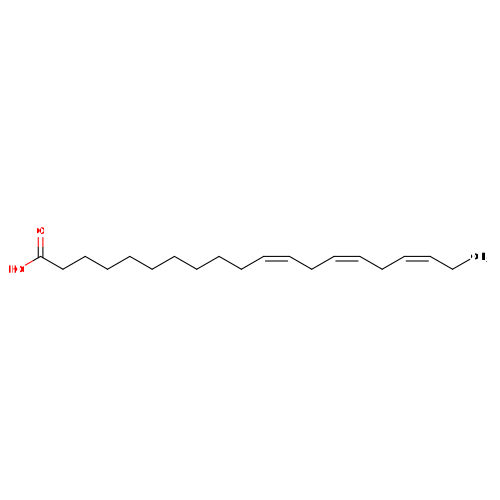
| Record Information |
|---|
| Version | 5.0 |
|---|
| Status | Detected and Quantified |
|---|
| Creation Date | 2013-05-01 17:29:32 UTC |
|---|
| Update Date | 2022-09-22 17:44:09 UTC |
|---|
| HMDB ID | HMDB0060039 |
|---|
| Secondary Accession Numbers | |
|---|
| Metabolite Identification |
|---|
| Common Name | Dihomo-alpha-linolenic acid |
|---|
| Description | Dihomo-alpha-linolenic acid, also known as 11,14,17-eicosatrienoic acid, is a rare polyunsaturated fatty acid of the omega-3 series. In normal humans, it represents less than 0.25% of serum phospholipid fatty acids. However, it is one of the most active essential fatty acids when assayed for the inhibition of fatty acid elongation/desaturation reactions which convert dietary C-18 fatty acids to C-20 eicosanoid precursors. (http://www.caymanchem.com) |
|---|
| Structure | CC\C=C/C\C=C/C\C=C/CCCCCCCCCC(O)=O InChI=1S/C20H34O2/c1-2-3-4-5-6-7-8-9-10-11-12-13-14-15-16-17-18-19-20(21)22/h3-4,6-7,9-10H,2,5,8,11-19H2,1H3,(H,21,22)/b4-3-,7-6-,10-9- |
|---|
| Synonyms | | Value | Source |
|---|
| (11Z,14Z,17Z)-Eicosa-11,14,17-trienoic acid | ChEBI | | (11Z,14Z,17Z)-Icosa-11,14,17-trienoic acid | ChEBI | | (Z,Z,Z)-11,14,17-Eicosatrienoic acid | ChEBI | | 11,14,17-Eicosatrienoic acid | ChEBI | | 11,14,17-Icosatrienoic acid | ChEBI | | 11C,14C,17C-Eicosatrienoic acid | ChEBI | | 11C,14C,17C-Eicosatriensaeure | ChEBI | | 20:3, N-3,6,9 all-cis | ChEBI | | all-cis-11,14,17-Eicosatrienoic acid | ChEBI | | all-cis-Eicosa-11,14,17-trienoic acid | ChEBI | | all-cis-Eicosa-11,14,17-triensaeure | ChEBI | | C20:3, N-3,6,9 all-cis | ChEBI | | cis,cis,cis-11,14,17-Eicosatrienoic acid | ChEBI | | Eicosa-11Z,14Z,17Z-trienoic acid | ChEBI | | Eicosatrienoic acid | ChEBI | | ETA | ChEBI | | ETE | ChEBI | | (11Z,14Z,17Z)-Eicosa-11,14,17-trienoate | Generator | | (11Z,14Z,17Z)-Icosa-11,14,17-trienoate | Generator | | (Z,Z,Z)-11,14,17-Eicosatrienoate | Generator | | 11,14,17-Eicosatrienoate | Generator | | 11,14,17-Icosatrienoate | Generator | | 11C,14C,17C-Eicosatrienoate | Generator | | all-cis-11,14,17-Eicosatrienoate | Generator | | all-cis-Eicosa-11,14,17-trienoate | Generator | | cis,cis,cis-11,14,17-Eicosatrienoate | Generator | | Eicosa-11Z,14Z,17Z-trienoate | Generator | | Eicosatrienoate | Generator | | Dihomo-a-linolenate | Generator | | Dihomo-a-linolenic acid | Generator | | Dihomo-alpha-linolenate | Generator | | Dihomo-α-linolenate | Generator | | Dihomo-α-linolenic acid | Generator | | Dihomolinolenate | HMDB | | 11,14,17-Eicosatrienoic acid, (Z,Z,Z)-isomer | HMDB | | Bishomo-a-linolenate | HMDB | | Bishomo-a-linolenic acid | HMDB | | Bishomo-alpha-linolenate | HMDB | | Bishomo-α-linolenate | HMDB | | Bishomo-α-linolenic acid | HMDB | | Bishomo-alpha-linolenic acid | HMDB | | Dihomo-linolenate | HMDB | | Dihomo-linolenic acid | HMDB | | Dihomolinolenic acid | HMDB | | FA(20:3(11Z,14Z,17Z)) | HMDB | | FA(20:3n3) | HMDB | | Homo-alpha-linolenic acid | HMDB | | Homo-α-linolenic acid | HMDB | | Dihomo-alpha-linolenic acid | HMDB |
|
|---|
| Chemical Formula | C20H34O2 |
|---|
| Average Molecular Weight | 306.4828 |
|---|
| Monoisotopic Molecular Weight | 306.255880332 |
|---|
| IUPAC Name | (11Z,14Z,17Z)-icosa-11,14,17-trienoic acid |
|---|
| Traditional Name | eicosatrienoic acid |
|---|
| CAS Registry Number | 17046-59-2 |
|---|
| SMILES | CC\C=C/C\C=C/C\C=C/CCCCCCCCCC(O)=O |
|---|
| InChI Identifier | InChI=1S/C20H34O2/c1-2-3-4-5-6-7-8-9-10-11-12-13-14-15-16-17-18-19-20(21)22/h3-4,6-7,9-10H,2,5,8,11-19H2,1H3,(H,21,22)/b4-3-,7-6-,10-9- |
|---|
| InChI Key | AHANXAKGNAKFSK-PDBXOOCHSA-N |
|---|
| Chemical Taxonomy |
|---|
| Description | Belongs to the class of organic compounds known as long-chain fatty acids. These are fatty acids with an aliphatic tail that contains between 13 and 21 carbon atoms. |
|---|
| Kingdom | Organic compounds |
|---|
| Super Class | Lipids and lipid-like molecules |
|---|
| Class | Fatty Acyls |
|---|
| Sub Class | Fatty acids and conjugates |
|---|
| Direct Parent | Long-chain fatty acids |
|---|
| Alternative Parents | |
|---|
| Substituents | - Long-chain fatty acid
- Unsaturated fatty acid
- Straight chain fatty acid
- Monocarboxylic acid or derivatives
- Carboxylic acid
- Carboxylic acid derivative
- Organic oxygen compound
- Organic oxide
- Hydrocarbon derivative
- Organooxygen compound
- Carbonyl group
- Aliphatic acyclic compound
|
|---|
| Molecular Framework | Aliphatic acyclic compounds |
|---|
| External Descriptors | |
|---|
| Ontology |
|---|
| Physiological effect | Not Available |
|---|
| Disposition | |
|---|
| Process | |
|---|
| Role | |
|---|
| Physical Properties |
|---|
| State | Not Available |
|---|
| Experimental Molecular Properties | | Property | Value | Reference |
|---|
| Melting Point | Not Available | Not Available | | Boiling Point | Not Available | Not Available | | Water Solubility | Not Available | Not Available | | LogP | Not Available | Not Available |
|
|---|
| Experimental Chromatographic Properties | Not Available |
|---|
| Predicted Molecular Properties | |
|---|
| Predicted Chromatographic Properties | Predicted Collision Cross SectionsPredicted Retention Times Underivatized| Chromatographic Method | Retention Time | Reference |
|---|
| Measured using a Waters Acquity ultraperformance liquid chromatography (UPLC) ethylene-bridged hybrid (BEH) C18 column (100 mm × 2.1 mm; 1.7 μmparticle diameter)). Predicted by Afia on May 17, 2022. | 9.01 minutes | 32390414 | | Predicted by Siyang on May 30, 2022 | 26.0788 minutes | 33406817 | | Predicted by Siyang using ReTip algorithm on June 8, 2022 | 1.65 minutes | 32390414 | | Fem_Long = Waters ACQUITY UPLC HSS T3 C18 with Water:MeOH and 0.1% Formic Acid | 3228.3 seconds | 40023050 | | Fem_Lipids = Ascentis Express C18 with (60:40 water:ACN):(90:10 IPA:ACN) and 10mM NH4COOH + 0.1% Formic Acid | 656.7 seconds | 40023050 | | Life_Old = Waters ACQUITY UPLC BEH C18 with Water:(20:80 acetone:ACN) and 0.1% Formic Acid | 263.9 seconds | 40023050 | | Life_New = RP Waters ACQUITY UPLC HSS T3 C18 with Water:(30:70 MeOH:ACN) and 0.1% Formic Acid | 449.3 seconds | 40023050 | | RIKEN = Waters ACQUITY UPLC BEH C18 with Water:ACN and 0.1% Formic Acid | 715.8 seconds | 40023050 | | Eawag_XBridgeC18 = XBridge C18 3.5u 2.1x50 mm with Water:MeOH and 0.1% Formic Acid | 1182.2 seconds | 40023050 | | BfG_NTS_RP1 =Agilent Zorbax Eclipse Plus C18 (2.1 mm x 150 mm, 3.5 um) with Water:ACN and 0.1% Formic Acid | 776.0 seconds | 40023050 | | HILIC_BDD_2 = Merck SeQuant ZIC-HILIC with ACN(0.1% formic acid):water(16 mM ammonium formate) | 89.0 seconds | 40023050 | | UniToyama_Atlantis = RP Waters Atlantis T3 (2.1 x 150 mm, 5 um) with ACN:Water and 0.1% Formic Acid | 2421.7 seconds | 40023050 | | BDD_C18 = Hypersil Gold 1.9µm C18 with Water:ACN and 0.1% Formic Acid | 770.0 seconds | 40023050 | | UFZ_Phenomenex = Kinetex Core-Shell C18 2.6 um, 3.0 x 100 mm, Phenomenex with Water:MeOH and 0.1% Formic Acid | 1990.7 seconds | 40023050 | | SNU_RIKEN_POS = Waters ACQUITY UPLC BEH C18 with Water:ACN and 0.1% Formic Acid | 917.4 seconds | 40023050 | | RPMMFDA = Waters ACQUITY UPLC BEH C18 with Water:ACN and 0.1% Formic Acid | 550.4 seconds | 40023050 | | MTBLS87 = Merck SeQuant ZIC-pHILIC column with ACN:Water and :ammonium carbonate | 579.0 seconds | 40023050 | | KI_GIAR_zic_HILIC_pH2_7 = Merck SeQuant ZIC-HILIC with ACN:Water and 0.1% FA | 620.1 seconds | 40023050 | | Meister zic-pHILIC pH9.3 = Merck SeQuant ZIC-pHILIC column with ACN:Water 5mM NH4Ac pH9.3 and 5mM ammonium acetate in water | 8.7 seconds | 40023050 |
Predicted Kovats Retention IndicesUnderivatizedDerivatized |
|---|
| General References | - Quehenberger O, Armando AM, Brown AH, Milne SB, Myers DS, Merrill AH, Bandyopadhyay S, Jones KN, Kelly S, Shaner RL, Sullards CM, Wang E, Murphy RC, Barkley RM, Leiker TJ, Raetz CR, Guan Z, Laird GM, Six DA, Russell DW, McDonald JG, Subramaniam S, Fahy E, Dennis EA: Lipidomics reveals a remarkable diversity of lipids in human plasma. J Lipid Res. 2010 Nov;51(11):3299-305. doi: 10.1194/jlr.M009449. Epub 2010 Jul 29. [PubMed:20671299 ]
- Simons K, Toomre D: Lipid rafts and signal transduction. Nat Rev Mol Cell Biol. 2000 Oct;1(1):31-9. [PubMed:11413487 ]
- Watson AD: Thematic review series: systems biology approaches to metabolic and cardiovascular disorders. Lipidomics: a global approach to lipid analysis in biological systems. J Lipid Res. 2006 Oct;47(10):2101-11. Epub 2006 Aug 10. [PubMed:16902246 ]
- Sethi JK, Vidal-Puig AJ: Thematic review series: adipocyte biology. Adipose tissue function and plasticity orchestrate nutritional adaptation. J Lipid Res. 2007 Jun;48(6):1253-62. Epub 2007 Mar 20. [PubMed:17374880 ]
- Lingwood D, Simons K: Lipid rafts as a membrane-organizing principle. Science. 2010 Jan 1;327(5961):46-50. doi: 10.1126/science.1174621. [PubMed:20044567 ]
- Gunstone, Frank D., John L. Harwood, and Albert J. Dijkstra (2007). The lipid handbook with CD-ROM. CRC Press.
|
|---|