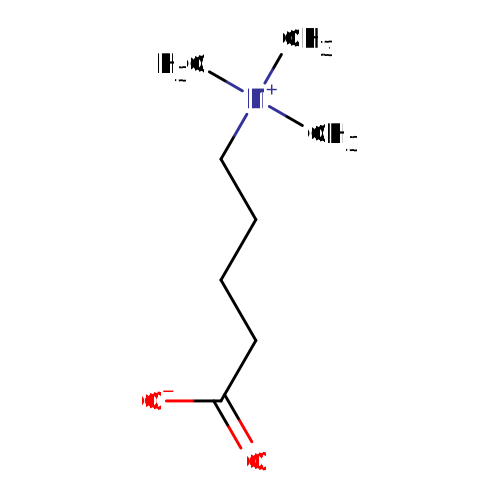
| Record Information |
|---|
| Version | 5.0 |
|---|
| Status | Detected but not Quantified |
|---|
| Creation Date | 2020-11-01 18:42:21 UTC |
|---|
| Update Date | 2022-03-07 03:18:21 UTC |
|---|
| HMDB ID | HMDB0240732 |
|---|
| Secondary Accession Numbers | None |
|---|
| Metabolite Identification |
|---|
| Common Name | 5-amino valeric acid betaine |
|---|
| Description | 5-amino valeric acid betaine (5-AVAB), also known as delta-valerobetaine and δ-valerobetaine, belongs to the class of organic compounds known as straight chain fatty acids. These are fatty acids with a straight aliphatic chain. 5-AVAB is also classified as a betaine. Betaines are neutral chemical compounds with a positively charged cationic functional group, such as a quaternary ammonium or phosphonium cation. 5-AVAB is a weakly acidic compound (based on its pKa). There is considerable confusion over the nomenclature of this molecule, with widely varying synonyms appearing in databases and the literature (PMID: 30158657 ). 5-AVAB is sometimes (incorrectly) referred to as simply “aminovaleric acid betaine” or “trimethylaminovaleric acid” or TMAVA. The fact that there is a known, unnatural isomer (4-amino valeric acid betaine) requires that the position of the betaine/acidic group be properly identified. 5-AVAB has also been called 5-trimethylaminovaleric acid (PMID: 921982 ) and 5-[trimethylammonio]pentanoate (PMID: 24571165 ) in earlier literature. 5-AVAB is associated with the consumption of foods or diets that are rich in whole grains and vegetables (PMID: 30158657 ). 5-AVAB is a gut microbial metabolite that arises from the breakdown of trimethyllysine (PMID: 35365608 ). Trimethyllysine is particularly abundant in vegetables and grains as a free amino acid (PMID: 24454731 ), although it may also be derived from the endogenous breakdown of proteins in the body during starvation or fasting (PMID: 24454731 ). 5-AVAB tends to accumulate in metabolically active tissues including the heart, muscle and brown adipose tissue (PMID: 30158657 ). 5-AVAB has similar molecular structure with meldonium (mildronate), a drug that inhibits β-oxidation of fatty acids (PMID: 30158657 ). Meldonium has been associated with improved cardiac mitochondrial function after ischemia and is considered a potential performance enhancing drug (PMID: 27465696 ). Meldonium has been shown to have beneficial effects in cardiovascular, neurological and metabolic diseases due to its anti-ischaemic and cardioprotective properties, which are ascribed mainly to its inhibition of β-oxidation and its activation of glycolysis. Among athletes, meldonium is used with the purpose of increasing recovery rate or exercise performance (PMID: 27465696 ). In particular, meldonium protects cardiac mtDNA from oxidative stress during exhaustive exercise (PMID: 33930377 ). Like meldonium, 5-AVAB appears to block the cell membrane carnitine transporter (OCTN2) and reduces biosynthesis of L-carnitine from γ-butyrobetaine by inhibiting γ-butyrobetaine hydroxylase (PMID: 30158657 ). This leads to reduced β-oxidation of fatty acids. For healthy individuals, 5-AVAB may provide a beneficial effect with improved cardiac metabolism and improved recovery from physical exercise. However, its effect may be deleterious for individuals with heart disease. In particular, 5-AVAB has been found to be elevated in patients with heart failure and its levels correlate with an increased risk of cardiac mortality and heart transplantation in patients with heart failure (PMID: 35365608 ). Furthermore, 5-AVAB treatment has been shown to aggravate cardiac hypertrophy and dysfunction in high-fat diet-fed mice (PMID: 35365608 ). Overall, 5-AVAB decreases fatty acid oxidation (FAO). FAO is a hallmark of metabolic reprogramming in the diseased heart and contributes to impaired myocardial energetics and contractile dysfunction. A contrarian view of the associative effects of 5-AVAB and heart disease is that 5-AVAB accumulates in heart tissues in diseased individuals as a protective chemical. The more diseased the heart, the more 5-AVAB is generated to stave off mitochondrial collapse in the heart tissue. Clearly more research on the cause and effects of 5-AVAB is needed. |
|---|
| Structure | InChI=1S/C8H17NO2/c1-9(2,3)7-5-4-6-8(10)11/h4-7H2,1-3H3 |
|---|
| Synonyms | | Value | Source |
|---|
| 5-Amino valerate betaine | Generator | | Δ-valerobetaine | HMDB | | 5-Aminovaleric acid betaine | HMDB | | N-Trimethyl-5-aminovalerate | HMDB | | 5-Trimethylaminovalerate | HMDB | | N,N,N-Trimethyl-5-aminovaleric acid | HMDB | | N,N,N-Trimethyl-5-aminovalerate | HMDB | | X-21365 | HMDB | | 5-AVAB | HMDB | | ΔVB | HMDB | | GBB-5 | HMDB | | TMAVA | HMDB | | TMAV | HMDB |
|
|---|
| Chemical Formula | C8H17NO2 |
|---|
| Average Molecular Weight | 159.229 |
|---|
| Monoisotopic Molecular Weight | 159.125928791 |
|---|
| IUPAC Name | 5-(trimethylazaniumyl)pentanoate |
|---|
| Traditional Name | 5-(trimethylammonio)pentanoate |
|---|
| CAS Registry Number | Not Available |
|---|
| SMILES | C[N+](C)(C)CCCCC([O-])=O |
|---|
| InChI Identifier | InChI=1S/C8H17NO2/c1-9(2,3)7-5-4-6-8(10)11/h4-7H2,1-3H3 |
|---|
| InChI Key | CDLVFVFTRQPQFU-UHFFFAOYSA-N |
|---|
| Chemical Taxonomy |
|---|
| Description | Belongs to the class of organic compounds known as straight chain fatty acids. These are fatty acids with a straight aliphatic chain. |
|---|
| Kingdom | Organic compounds |
|---|
| Super Class | Lipids and lipid-like molecules |
|---|
| Class | Fatty Acyls |
|---|
| Sub Class | Fatty acids and conjugates |
|---|
| Direct Parent | Straight chain fatty acids |
|---|
| Alternative Parents | |
|---|
| Substituents | - Straight chain fatty acid
- Quaternary ammonium salt
- Tetraalkylammonium salt
- Carboxylic acid salt
- Monocarboxylic acid or derivatives
- Carboxylic acid
- Carboxylic acid derivative
- Hydrocarbon derivative
- Organic salt
- Organic oxygen compound
- Organic nitrogen compound
- Organooxygen compound
- Organonitrogen compound
- Carbonyl group
- Amine
- Organic oxide
- Organic cation
- Aliphatic acyclic compound
|
|---|
| Molecular Framework | Aliphatic acyclic compounds |
|---|
| External Descriptors | Not Available |
|---|
| Ontology |
|---|
| Physiological effect | Not Available |
|---|
| Disposition | |
|---|
| Process | Not Available |
|---|
| Role | Not Available |
|---|
| Physical Properties |
|---|
| State | Not Available |
|---|
| Experimental Molecular Properties | | Property | Value | Reference |
|---|
| Melting Point | Not Available | Not Available | | Boiling Point | Not Available | Not Available | | Water Solubility | Not Available | Not Available | | LogP | Not Available | Not Available |
|
|---|
| Experimental Chromatographic Properties | Not Available |
|---|
| Predicted Molecular Properties | |
|---|
| Predicted Chromatographic Properties | Predicted Collision Cross Sections| Predictor | Adduct Type | CCS Value (Å2) | Reference |
|---|
| DeepCCS | [M+H]+ | 132.628 | 30932474 | | DeepCCS | [M-H]- | 129.122 | 30932474 | | DeepCCS | [M-2H]- | 166.169 | 30932474 | | DeepCCS | [M+Na]+ | 141.466 | 30932474 |
Predicted Retention Times Underivatized| Chromatographic Method | Retention Time | Reference |
|---|
| Predicted by Siyang on May 30, 2022 | 9.2095 minutes | 33406817 | | Predicted by Siyang using ReTip algorithm on June 8, 2022 | 6.9 minutes | 32390414 | | Fem_Long = Waters ACQUITY UPLC HSS T3 C18 with Water:MeOH and 0.1% Formic Acid | 683.5 seconds | 40023050 | | Fem_Lipids = Ascentis Express C18 with (60:40 water:ACN):(90:10 IPA:ACN) and 10mM NH4COOH + 0.1% Formic Acid | 244.9 seconds | 40023050 | | Life_Old = Waters ACQUITY UPLC BEH C18 with Water:(20:80 acetone:ACN) and 0.1% Formic Acid | 120.8 seconds | 40023050 | | Life_New = RP Waters ACQUITY UPLC HSS T3 C18 with Water:(30:70 MeOH:ACN) and 0.1% Formic Acid | 169.0 seconds | 40023050 | | RIKEN = Waters ACQUITY UPLC BEH C18 with Water:ACN and 0.1% Formic Acid | 73.8 seconds | 40023050 | | Eawag_XBridgeC18 = XBridge C18 3.5u 2.1x50 mm with Water:MeOH and 0.1% Formic Acid | 271.9 seconds | 40023050 | | BfG_NTS_RP1 =Agilent Zorbax Eclipse Plus C18 (2.1 mm x 150 mm, 3.5 um) with Water:ACN and 0.1% Formic Acid | 286.5 seconds | 40023050 | | HILIC_BDD_2 = Merck SeQuant ZIC-HILIC with ACN(0.1% formic acid):water(16 mM ammonium formate) | 787.3 seconds | 40023050 | | UniToyama_Atlantis = RP Waters Atlantis T3 (2.1 x 150 mm, 5 um) with ACN:Water and 0.1% Formic Acid | 878.8 seconds | 40023050 | | BDD_C18 = Hypersil Gold 1.9µm C18 with Water:ACN and 0.1% Formic Acid | 63.8 seconds | 40023050 | | UFZ_Phenomenex = Kinetex Core-Shell C18 2.6 um, 3.0 x 100 mm, Phenomenex with Water:MeOH and 0.1% Formic Acid | 1144.3 seconds | 40023050 | | SNU_RIKEN_POS = Waters ACQUITY UPLC BEH C18 with Water:ACN and 0.1% Formic Acid | 170.8 seconds | 40023050 | | RPMMFDA = Waters ACQUITY UPLC BEH C18 with Water:ACN and 0.1% Formic Acid | 209.3 seconds | 40023050 | | MTBLS87 = Merck SeQuant ZIC-pHILIC column with ACN:Water and :ammonium carbonate | 714.0 seconds | 40023050 | | KI_GIAR_zic_HILIC_pH2_7 = Merck SeQuant ZIC-HILIC with ACN:Water and 0.1% FA | 422.5 seconds | 40023050 | | Meister zic-pHILIC pH9.3 = Merck SeQuant ZIC-pHILIC column with ACN:Water 5mM NH4Ac pH9.3 and 5mM ammonium acetate in water | 124.3 seconds | 40023050 |
Predicted Kovats Retention IndicesUnderivatized |
|---|
| GC-MS Spectra| Spectrum Type | Description | Splash Key | Deposition Date | Source | View |
|---|
| Predicted GC-MS | Predicted GC-MS Spectrum - 5-amino valeric acid betaine GC-MS (Non-derivatized) - 70eV, Positive | Not Available | 2021-10-12 | Wishart Lab | View Spectrum |
MS/MS Spectra| Spectrum Type | Description | Splash Key | Deposition Date | Source | View |
|---|
| Predicted LC-MS/MS | Predicted LC-MS/MS Spectrum - 5-amino valeric acid betaine 10V, Positive-QTOF | splash10-03di-6900000000-297eb6c159ef917120d0 | 2021-09-22 | Wishart Lab | View Spectrum | | Predicted LC-MS/MS | Predicted LC-MS/MS Spectrum - 5-amino valeric acid betaine 20V, Positive-QTOF | splash10-0a4i-9000000000-de15b04540f2d1dd3675 | 2021-09-22 | Wishart Lab | View Spectrum | | Predicted LC-MS/MS | Predicted LC-MS/MS Spectrum - 5-amino valeric acid betaine 40V, Positive-QTOF | splash10-0a4i-9000000000-f7f643e07d983bd67ced | 2021-09-22 | Wishart Lab | View Spectrum | | Predicted LC-MS/MS | Predicted LC-MS/MS Spectrum - 5-amino valeric acid betaine 10V, Negative-QTOF | splash10-0a4i-0900000000-706e735ab28a6583fcd9 | 2021-09-23 | Wishart Lab | View Spectrum | | Predicted LC-MS/MS | Predicted LC-MS/MS Spectrum - 5-amino valeric acid betaine 20V, Negative-QTOF | splash10-0a4i-0900000000-f19c0117449e32ce3d57 | 2021-09-23 | Wishart Lab | View Spectrum | | Predicted LC-MS/MS | Predicted LC-MS/MS Spectrum - 5-amino valeric acid betaine 40V, Negative-QTOF | splash10-0a4i-9100000000-c21974e03aad78922216 | 2021-09-23 | Wishart Lab | View Spectrum |
NMR Spectra| Spectrum Type | Description | Deposition Date | Source | View |
|---|
| Predicted 1D NMR | 1H NMR Spectrum (1D, 100 MHz, D2O, predicted) | 2021-09-25 | Wishart Lab | View Spectrum | | Predicted 1D NMR | 13C NMR Spectrum (1D, 100 MHz, D2O, predicted) | 2021-09-25 | Wishart Lab | View Spectrum | | Predicted 1D NMR | 1H NMR Spectrum (1D, 1000 MHz, D2O, predicted) | 2021-09-25 | Wishart Lab | View Spectrum | | Predicted 1D NMR | 13C NMR Spectrum (1D, 1000 MHz, D2O, predicted) | 2021-09-25 | Wishart Lab | View Spectrum | | Predicted 1D NMR | 1H NMR Spectrum (1D, 200 MHz, D2O, predicted) | 2021-09-25 | Wishart Lab | View Spectrum | | Predicted 1D NMR | 13C NMR Spectrum (1D, 200 MHz, D2O, predicted) | 2021-09-25 | Wishart Lab | View Spectrum | | Predicted 1D NMR | 1H NMR Spectrum (1D, 300 MHz, D2O, predicted) | 2021-09-25 | Wishart Lab | View Spectrum | | Predicted 1D NMR | 13C NMR Spectrum (1D, 300 MHz, D2O, predicted) | 2021-09-25 | Wishart Lab | View Spectrum | | Predicted 1D NMR | 1H NMR Spectrum (1D, 400 MHz, D2O, predicted) | 2021-09-25 | Wishart Lab | View Spectrum | | Predicted 1D NMR | 13C NMR Spectrum (1D, 400 MHz, D2O, predicted) | 2021-09-25 | Wishart Lab | View Spectrum | | Predicted 1D NMR | 1H NMR Spectrum (1D, 500 MHz, D2O, predicted) | 2021-09-25 | Wishart Lab | View Spectrum | | Predicted 1D NMR | 13C NMR Spectrum (1D, 500 MHz, D2O, predicted) | 2021-09-25 | Wishart Lab | View Spectrum | | Predicted 1D NMR | 1H NMR Spectrum (1D, 600 MHz, D2O, predicted) | 2021-09-25 | Wishart Lab | View Spectrum | | Predicted 1D NMR | 13C NMR Spectrum (1D, 600 MHz, D2O, predicted) | 2021-09-25 | Wishart Lab | View Spectrum | | Predicted 1D NMR | 1H NMR Spectrum (1D, 700 MHz, D2O, predicted) | 2021-09-25 | Wishart Lab | View Spectrum | | Predicted 1D NMR | 13C NMR Spectrum (1D, 700 MHz, D2O, predicted) | 2021-09-25 | Wishart Lab | View Spectrum | | Predicted 1D NMR | 1H NMR Spectrum (1D, 800 MHz, D2O, predicted) | 2021-09-25 | Wishart Lab | View Spectrum | | Predicted 1D NMR | 13C NMR Spectrum (1D, 800 MHz, D2O, predicted) | 2021-09-25 | Wishart Lab | View Spectrum | | Predicted 1D NMR | 1H NMR Spectrum (1D, 900 MHz, D2O, predicted) | 2021-09-25 | Wishart Lab | View Spectrum | | Predicted 1D NMR | 13C NMR Spectrum (1D, 900 MHz, D2O, predicted) | 2021-09-25 | Wishart Lab | View Spectrum |
|
|---|