| Record Information |
|---|
| Version | 5.0 |
|---|
| Status | Detected and Quantified |
|---|
| Creation Date | 2006-05-22 15:12:23 UTC |
|---|
| Update Date | 2022-03-07 02:49:17 UTC |
|---|
| HMDB ID | HMDB0002972 |
|---|
| Secondary Accession Numbers | - HMDB0062451
- HMDB02972
- HMDB62451
|
|---|
| Metabolite Identification |
|---|
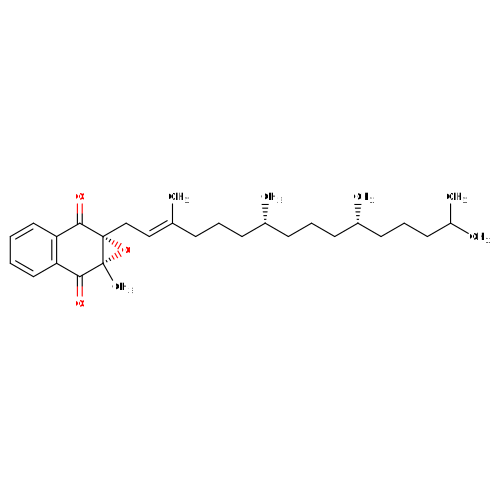
| Common Name | Vitamin K1 2,3-epoxide |
|---|
| Description | Vitamin K1 2,3-epoxide (CAS: 25486-55-9) is a vitamin K derivative. Vitamin K is needed for the posttranslational modification of certain proteins, mostly required for blood coagulation. Within the cell, vitamin K undergoes electron reduction to a reduced form of vitamin K (called vitamin K hydroquinone) by the enzyme vitamin K epoxide reductase (or VKOR). Another enzyme then oxidizes vitamin K hydroquinone to allow carboxylation of glutamate into gamma-carboxyglutamate (Gla). This enzyme is called the gamma-glutamyl carboxylase or the vitamin K-dependent carboxylase. The carboxylation reaction will only proceed if the carboxylase enzyme is able to oxidize vitamin K hydroquinone into vitamin K epoxide at the same time; the carboxylation and epoxidation reactions are said to be coupled reactions. Vitamin K epoxide is then re-converted into vitamin K by the vitamin K epoxide reductase. These two enzymes comprise the so-called vitamin K cycle. One of the reasons why vitamin K is rarely deficient in a human diet is because vitamin K is continually recycled in our cells. Vitamin K 2,3-epoxide is the substrate for vitamin K 2,3-epoxide reductase (VKOR) complex. Significantly increased level of serum vitamin K epoxide has been found in patients with familial multiple coagulation factor deficiency (PMID: 12384421 ). Accumulation of vitamin K1-2,3-epoxide in plasma is also a sensitive marker of the coumarin-like activity of drugs (PMID: 2401753 ). |
|---|
| Structure | CC(C)CCC[C@@H](C)CCC[C@@H](C)CCC\C(C)=C\C[C@@]12O[C@]1(C)C(=O)C1=C(C=CC=C1)C2=O InChI=1S/C31H46O3/c1-22(2)12-9-13-23(3)14-10-15-24(4)16-11-17-25(5)20-21-31-29(33)27-19-8-7-18-26(27)28(32)30(31,6)34-31/h7-8,18-20,22-24H,9-17,21H2,1-6H3/b25-20+/t23-,24-,30-,31+/m1/s1 |
|---|
| Synonyms | | Value | Source |
|---|
| (2,3-Epoxyphytyl)menaquinone | HMDB | | 2,3-Epoxy-2,3-dihydro-2-methyl-3-phytyl-1,4-naphthoquinone | HMDB | | 2,3-Epoxyphylloquinone | HMDB | | 1a,7a-Dihydro-1a-methyl-7a-(3,7,11,15-tetramethyl-2-hexadecenyl)-naphth[2,3-b]oxirene-2,7-dione | HMDB | | Phylloquinone oxide | HMDB | | Phylloquinone epoxide | HMDB | | Phylloquinone-2,3-epoxide | HMDB | | Vitamin K1 oxide | HMDB | | Vitamin K epoxide | HMDB | | Vitamin K(1) oxide | HMDB | | Vitamin K1 epoxide | HMDB | | 1,4-Naphthoquinone, 2,3-epoxy-2,3-dihydro-2-methyl-3-phytyl-2,3-epoxyphylloquinone | HMDB | | Naphth[2,3-b]oxirene-2,7-dione, 1a,7a-dihydro-1a-methyl-7a-(3,7,11,15-tetramethyl-2-hexadecenyl)-phylloquinone oxide | HMDB | | Phylloquinone, epoxide | HMDB | | Vitamin K 2,3-epoxide | HMDB | | Vitamin K1, epoxide | HMDB | | Phylloquinone 2,3-epoxide | HMDB | | Vitamin K oxide | HMDB | | Vitamin K1 2,3-epoxide | HMDB |
|
|---|
| Chemical Formula | C31H46O3 |
|---|
| Average Molecular Weight | 466.706 |
|---|
| Monoisotopic Molecular Weight | 466.344695341 |
|---|
| IUPAC Name | (1aS,7aR)-1a-methyl-7a-[(2E,7R,11R)-3,7,11,15-tetramethylhexadec-2-en-1-yl]-1aH,2H,7H,7aH-naphtho[2,3-b]oxirene-2,7-dione |
|---|
| Traditional Name | (1aS,7aR)-1a-methyl-7a-[(2E,7R,11R)-3,7,11,15-tetramethylhexadec-2-en-1-yl]naphtho[2,3-b]oxirene-2,7-dione |
|---|
| CAS Registry Number | 85955-78-8 |
|---|
| SMILES | CC(C)CCC[C@@H](C)CCC[C@@H](C)CCC\C(C)=C\C[C@@]12O[C@]1(C)C(=O)C1=C(C=CC=C1)C2=O |
|---|
| InChI Identifier | InChI=1S/C31H46O3/c1-22(2)12-9-13-23(3)14-10-15-24(4)16-11-17-25(5)20-21-31-29(33)27-19-8-7-18-26(27)28(32)30(31,6)34-31/h7-8,18-20,22-24H,9-17,21H2,1-6H3/b25-20+/t23-,24-,30-,31+/m1/s1 |
|---|
| InChI Key | KUTXFBIHPWIDJQ-BTPXSFBUSA-N |
|---|
| Chemical Taxonomy |
|---|
| Description | Belongs to the class of organic compounds known as vitamin k compounds. These are quinone lipids containing a methylated naphthoquinone ring structure, and vary in the aliphatic side chain attached at the 3-position. |
|---|
| Kingdom | Organic compounds |
|---|
| Super Class | Lipids and lipid-like molecules |
|---|
| Class | Prenol lipids |
|---|
| Sub Class | Quinone and hydroquinone lipids |
|---|
| Direct Parent | Vitamin K compounds |
|---|
| Alternative Parents | |
|---|
| Substituents | - Diterpenoid
- Naphthoquinone
- Naphthalene
- Tetralin
- Quinone
- Aryl ketone
- Aryl alkyl ketone
- Benzenoid
- Ketone
- Oxacycle
- Ether
- Oxirane
- Dialkyl ether
- Organoheterocyclic compound
- Organooxygen compound
- Hydrocarbon derivative
- Organic oxide
- Organic oxygen compound
- Aromatic heteropolycyclic compound
|
|---|
| Molecular Framework | Aromatic heteropolycyclic compounds |
|---|
| External Descriptors | Not Available |
|---|
| Ontology |
|---|
| Physiological effect | Not Available |
|---|
| Disposition | |
|---|
| Process | |
|---|
| Role | |
|---|
| Physical Properties |
|---|
| State | Solid |
|---|
| Experimental Molecular Properties | | Property | Value | Reference |
|---|
| Melting Point | Not Available | Not Available | | Boiling Point | Not Available | Not Available | | Water Solubility | Not Available | Not Available | | LogP | Not Available | Not Available |
|
|---|
| Experimental Chromatographic Properties | Not Available |
|---|
| Predicted Molecular Properties | |
|---|
| Predicted Chromatographic Properties | Predicted Collision Cross SectionsPredicted Retention Times Underivatized| Chromatographic Method | Retention Time | Reference |
|---|
| Measured using a Waters Acquity ultraperformance liquid chromatography (UPLC) ethylene-bridged hybrid (BEH) C18 column (100 mm × 2.1 mm; 1.7 μmparticle diameter). Predicted by Afia on May 17, 2022. | 10.44 minutes | 32390414 | | Predicted by Siyang on May 30, 2022 | 32.1358 minutes | 33406817 | | Predicted by Siyang using ReTip algorithm on June 8, 2022 | 0.65 minutes | 32390414 | | AjsUoB = Accucore 150 Amide HILIC with 10mM Ammonium Formate, 0.1% Formic Acid | 46.0 seconds | 40023050 | | Fem_Long = Waters ACQUITY UPLC HSS T3 C18 with Water:MeOH and 0.1% Formic Acid | 4462.7 seconds | 40023050 | | Fem_Lipids = Ascentis Express C18 with (60:40 water:ACN):(90:10 IPA:ACN) and 10mM NH4COOH + 0.1% Formic Acid | 951.4 seconds | 40023050 | | Life_Old = Waters ACQUITY UPLC BEH C18 with Water:(20:80 acetone:ACN) and 0.1% Formic Acid | 384.1 seconds | 40023050 | | Life_New = RP Waters ACQUITY UPLC HSS T3 C18 with Water:(30:70 MeOH:ACN) and 0.1% Formic Acid | 461.0 seconds | 40023050 | | RIKEN = Waters ACQUITY UPLC BEH C18 with Water:ACN and 0.1% Formic Acid | 747.4 seconds | 40023050 | | Eawag_XBridgeC18 = XBridge C18 3.5u 2.1x50 mm with Water:MeOH and 0.1% Formic Acid | 1661.7 seconds | 40023050 | | BfG_NTS_RP1 =Agilent Zorbax Eclipse Plus C18 (2.1 mm x 150 mm, 3.5 um) with Water:ACN and 0.1% Formic Acid | 1642.4 seconds | 40023050 | | HILIC_BDD_2 = Merck SeQuant ZIC-HILIC with ACN(0.1% formic acid):water(16 mM ammonium formate) | 108.5 seconds | 40023050 | | UniToyama_Atlantis = RP Waters Atlantis T3 (2.1 x 150 mm, 5 um) with ACN:Water and 0.1% Formic Acid | 2888.2 seconds | 40023050 | | BDD_C18 = Hypersil Gold 1.9µm C18 with Water:ACN and 0.1% Formic Acid | 979.6 seconds | 40023050 | | UFZ_Phenomenex = Kinetex Core-Shell C18 2.6 um, 3.0 x 100 mm, Phenomenex with Water:MeOH and 0.1% Formic Acid | 2584.7 seconds | 40023050 | | SNU_RIKEN_POS = Waters ACQUITY UPLC BEH C18 with Water:ACN and 0.1% Formic Acid | 1102.1 seconds | 40023050 | | RPMMFDA = Waters ACQUITY UPLC BEH C18 with Water:ACN and 0.1% Formic Acid | 725.2 seconds | 40023050 | | MTBLS87 = Merck SeQuant ZIC-pHILIC column with ACN:Water and :ammonium carbonate | 733.9 seconds | 40023050 | | KI_GIAR_zic_HILIC_pH2_7 = Merck SeQuant ZIC-HILIC with ACN:Water and 0.1% FA | 861.7 seconds | 40023050 | | Meister zic-pHILIC pH9.3 = Merck SeQuant ZIC-pHILIC column with ACN:Water 5mM NH4Ac pH9.3 and 5mM ammonium acetate in water | 9.3 seconds | 40023050 |
Predicted Kovats Retention IndicesUnderivatized |
|---|
| General References | - Komatsu K, Kayashima N, Ariyoshi N, Shirahata A: [Vitamin K]. Nihon Rinsho. 1993 Apr;51(4):943-51. [PubMed:8483276 ]
- Hirauchi K, Sakano T, Nagaoka T, Morimoto A: Simultaneous determination of vitamin K1, vitamin K1 2,3-epoxide and menaquinone-4 in human plasma by high-performance liquid chromatography with fluorimetric detection. J Chromatogr. 1988 Aug 19;430(1):21-9. [PubMed:2851012 ]
- McBurney A, Shearer MJ, Barkhan P: Changes in the urinary metabolites of phylloquinone (vitamin K1) in man following therapeutic anticoagulation with warfarin. Biochem Pharmacol. 1978 Feb 1;27(3):273-8. [PubMed:619911 ]
- Fregin A, Rost S, Wolz W, Krebsova A, Muller CR, Oldenburg J: Homozygosity mapping of a second gene locus for hereditary combined deficiency of vitamin K-dependent clotting factors to the centromeric region of chromosome 16. Blood. 2002 Nov 1;100(9):3229-32. [PubMed:12384421 ]
- Trenk D, Wagner F, Bechtold H, Nies B, Jahnchen E: Lack of effect of cefixime on the metabolism of vitamin K1. J Clin Pharmacol. 1990 Aug;30(8):737-42. [PubMed:2401753 ]
|
|---|