| Record Information |
|---|
| Version | 5.0 |
|---|
| Status | Detected and Quantified |
|---|
| Creation Date | 2006-08-12 19:15:31 UTC |
|---|
| Update Date | 2023-02-21 17:16:37 UTC |
|---|
| HMDB ID | HMDB0003352 |
|---|
| Secondary Accession Numbers | |
|---|
| Metabolite Identification |
|---|
| Common Name | Menthol |
|---|
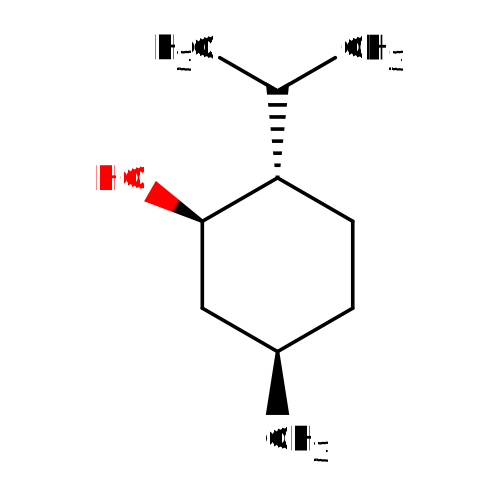
| Description | Menthol is an alcohol produced from mint oils or prepared synthetically. Menthol is a covalent organic compound made synthetically or obtained from peppermint or other mint oils. It is a waxy, crystalline substance, clear or white in color, which is solid at room temperature and melts slightly above. The main form of menthol occurring in nature is (-)-menthol, which is assigned the (1R,2S,5R) configuration. Menthol has local anesthetic and counterirritant qualities, and it is widely used to relieve minor throat irritation. |
|---|
| Structure | CC(C)[C@@H]1CC[C@@H](C)C[C@H]1O InChI=1S/C10H20O/c1-7(2)9-5-4-8(3)6-10(9)11/h7-11H,4-6H2,1-3H3/t8-,9+,10-/m1/s1 |
|---|
| Synonyms | | Value | Source |
|---|
| (-)-(1R,3R,4S)-Menthol | ChEBI | | (1alpha,2beta,5alpha)-5-Methyl-2(1-methylethyl)cyclohexanol | ChEBI | | (1R,3R,4S)-(-)-Menthol | ChEBI | | (1R-(1-alpha,2-beta,5-alpha))-5-Methyl-2-(1-methylethyl)cyclohexanol | ChEBI | | L-Menthol | ChEBI | | Levomenthol | ChEBI | | Levomentholum | ChEBI | | Levomentol | ChEBI | | (1a,2b,5a)-5-Methyl-2(1-methylethyl)cyclohexanol | Generator | | (1Α,2β,5α)-5-methyl-2(1-methylethyl)cyclohexanol | Generator | | (1R-(1-a,2-b,5-a))-5-Methyl-2-(1-methylethyl)cyclohexanol | Generator | | (1R-(1-Α,2-β,5-α))-5-methyl-2-(1-methylethyl)cyclohexanol | Generator | | (-)-Menthyl alcohol | HMDB | | (-)-trans-p-Menthan-cis-ol | HMDB | | (1R)-(-)-Menthol | HMDB | | (1R,2S,5R)-(-)-Menthol | HMDB | | (R)-(-)-Menthol | HMDB | | 1-Menthol | HMDB | | 2-Isopropyl-5-methylcyclohexanol | HMDB | | 5-Methyl-2-(1-methylethyl)cyclohexanol | HMDB | | 5-Methyl-2-propan-2-ylcyclohexan-1-ol | HMDB | | D-(-)-Menthol | HMDB | | Hexahydrothymol | HMDB | | L-(-)-Menthol | HMDB | | Menthacamphor | HMDB | | Menthomenthol | HMDB | | p-Menthan-3-ol | HMDB | | Peppermint camphor | HMDB | | U.S.p. menthol | HMDB | | Kerasal | HMDB | | Menthol, (1alpha,2beta,5alpha)-isomer | HMDB | | Menthol | MeSH |
| Show more...
|---|
| Chemical Formula | C10H20O |
|---|
| Average Molecular Weight | 156.269 |
|---|
| Monoisotopic Molecular Weight | 156.151415264 |
|---|
| IUPAC Name | (1R,2S,5R)-5-methyl-2-(propan-2-yl)cyclohexan-1-ol |
|---|
| Traditional Name | menthol |
|---|
| CAS Registry Number | 2216-51-5 |
|---|
| SMILES | CC(C)[C@@H]1CC[C@@H](C)C[C@H]1O |
|---|
| InChI Identifier | InChI=1S/C10H20O/c1-7(2)9-5-4-8(3)6-10(9)11/h7-11H,4-6H2,1-3H3/t8-,9+,10-/m1/s1 |
|---|
| InChI Key | NOOLISFMXDJSKH-KXUCPTDWSA-N |
|---|
| Chemical Taxonomy |
|---|
| Description | Belongs to the class of organic compounds known as menthane monoterpenoids. These are monoterpenoids with a structure based on the o-, m-, or p-menthane backbone. P-menthane consists of the cyclohexane ring with a methyl group and a (2-methyl)-propyl group at the 1 and 4 ring position, respectively. The o- and m- menthanes are much rarer, and presumably arise by alkyl migration of p-menthanes. |
|---|
| Kingdom | Organic compounds |
|---|
| Super Class | Lipids and lipid-like molecules |
|---|
| Class | Prenol lipids |
|---|
| Sub Class | Monoterpenoids |
|---|
| Direct Parent | Menthane monoterpenoids |
|---|
| Alternative Parents | |
|---|
| Substituents | - P-menthane monoterpenoid
- Monocyclic monoterpenoid
- Cyclohexanol
- Cyclic alcohol
- Secondary alcohol
- Organic oxygen compound
- Hydrocarbon derivative
- Organooxygen compound
- Alcohol
- Aliphatic homomonocyclic compound
|
|---|
| Molecular Framework | Aliphatic homomonocyclic compounds |
|---|
| External Descriptors | |
|---|
| Ontology |
|---|
| Physiological effect | Not Available |
|---|
| Disposition | |
|---|
| Process | Not Available |
|---|
| Role | |
|---|
| Physical Properties |
|---|
| State | Solid |
|---|
| Experimental Molecular Properties | | Property | Value | Reference |
|---|
| Melting Point | 43 °C | Not Available | | Boiling Point | Not Available | Not Available | | Water Solubility | 0.49 mg/mL at 25 °C | Not Available | | LogP | 3.40 | GRIFFIN,S ET AL. (1999) |
|
|---|
| Experimental Chromatographic Properties | Not Available |
|---|
| Predicted Molecular Properties | | Show more...
|---|
| Predicted Chromatographic Properties | Predicted Collision Cross SectionsPredicted Kovats Retention IndicesUnderivatizedDerivatized | Show more...
|---|
| Spectra |
|---|
| GC-MS Spectra| Spectrum Type | Description | Splash Key | Deposition Date | Source | View |
|---|
| Experimental GC-MS | GC-MS Spectrum - Menthol GC-MS (1 TMS) | splash10-0006-1900000000-cc06fe70d7649d059f92 | 2014-06-16 | HMDB team, MONA, MassBank | View Spectrum | | Experimental GC-MS | GC-MS Spectrum - Menthol EI-B (Non-derivatized) | splash10-00ea-9100000000-0be605183591bf5f33a0 | 2017-09-12 | HMDB team, MONA, MassBank | View Spectrum | | Experimental GC-MS | GC-MS Spectrum - Menthol EI-B (Non-derivatized) | splash10-00ea-9100000000-977cf0c036d597693beb | 2017-09-12 | HMDB team, MONA, MassBank | View Spectrum | | Experimental GC-MS | GC-MS Spectrum - Menthol GC-MS (Non-derivatized) | splash10-0006-1900000000-cc06fe70d7649d059f92 | 2017-09-12 | HMDB team, MONA, MassBank | View Spectrum | | Experimental GC-MS | GC-MS Spectrum - Menthol GC-EI-Q (Non-derivatized) | splash10-00ym-9100000000-ff2f7ebe48769147a112 | 2020-07-08 | HMDB team, MONA, MassBank | View Spectrum | | Predicted GC-MS | Predicted GC-MS Spectrum - Menthol GC-MS (Non-derivatized) - 70eV, Positive | splash10-0a4l-9600000000-fcf4b2a96455b111f889 | 2017-07-27 | Wishart Lab | View Spectrum | | Predicted GC-MS | Predicted GC-MS Spectrum - Menthol GC-MS (1 TMS) - 70eV, Positive | splash10-01w0-9520000000-26cc8cab97979ec9fb4d | 2017-10-06 | Wishart Lab | View Spectrum | | Predicted GC-MS | Predicted GC-MS Spectrum - Menthol GC-MS (Non-derivatized) - 70eV, Positive | Not Available | 2021-10-12 | Wishart Lab | View Spectrum | | Predicted GC-MS | Predicted GC-MS Spectrum - Menthol GC-MS (Non-derivatized) - 70eV, Positive | Not Available | 2021-10-12 | Wishart Lab | View Spectrum | | MS | Mass Spectrum (Electron Ionization) | splash10-00ea-9100000000-602436010653202a4da9 | 2014-09-20 | Not Available | View Spectrum |
MS/MS Spectra| Spectrum Type | Description | Splash Key | Deposition Date | Source | View |
|---|
| Experimental LC-MS/MS | LC-MS/MS Spectrum - Menthol Quattro_QQQ 10V, Positive-QTOF (Annotated) | splash10-053r-9300000000-d9c35833e73c8655fb23 | 2012-07-25 | HMDB team, MONA | View Spectrum | | Experimental LC-MS/MS | LC-MS/MS Spectrum - Menthol Quattro_QQQ 25V, Positive-QTOF (Annotated) | splash10-0ldl-9000000000-abf2f837df49fbedc53c | 2012-07-25 | HMDB team, MONA | View Spectrum | | Experimental LC-MS/MS | LC-MS/MS Spectrum - Menthol Quattro_QQQ 40V, Positive-QTOF (Annotated) | splash10-0007-9000000000-adee6385265c6606326d | 2012-07-25 | HMDB team, MONA | View Spectrum | | Experimental LC-MS/MS | LC-MS/MS Spectrum - Menthol EI-B (JEOL JMS-D-3000) , Positive-QTOF | splash10-00ea-9100000000-e3f1b7b69a021063fabb | 2012-08-31 | HMDB team, MONA | View Spectrum | | Experimental LC-MS/MS | LC-MS/MS Spectrum - Menthol EI-B (JEOL JMS-DX-300) , Positive-QTOF | splash10-00ea-9100000000-d69777874c9615b7e751 | 2012-08-31 | HMDB team, MONA | View Spectrum | | Predicted LC-MS/MS | Predicted LC-MS/MS Spectrum - Menthol 10V, Positive-QTOF | splash10-052r-0900000000-39d327015211bdc2b4e8 | 2017-06-28 | Wishart Lab | View Spectrum | | Predicted LC-MS/MS | Predicted LC-MS/MS Spectrum - Menthol 20V, Positive-QTOF | splash10-052r-6900000000-67e6c41c2a8d759d6caf | 2017-06-28 | Wishart Lab | View Spectrum | | Predicted LC-MS/MS | Predicted LC-MS/MS Spectrum - Menthol 40V, Positive-QTOF | splash10-0aor-9200000000-88888989ba15a9dc0269 | 2017-06-28 | Wishart Lab | View Spectrum | | Predicted LC-MS/MS | Predicted LC-MS/MS Spectrum - Menthol 10V, Negative-QTOF | splash10-0a4i-0900000000-3a700dc611fb070e6b45 | 2017-06-28 | Wishart Lab | View Spectrum | | Predicted LC-MS/MS | Predicted LC-MS/MS Spectrum - Menthol 20V, Negative-QTOF | splash10-0a4i-0900000000-86ed17c709dc4636ad41 | 2017-06-28 | Wishart Lab | View Spectrum | | Predicted LC-MS/MS | Predicted LC-MS/MS Spectrum - Menthol 40V, Negative-QTOF | splash10-0bti-6900000000-fc116bf41f068d3f6f75 | 2017-06-28 | Wishart Lab | View Spectrum | | Predicted LC-MS/MS | Predicted LC-MS/MS Spectrum - Menthol 10V, Positive-QTOF | splash10-05mk-9800000000-bb8a9e58bdc61e2654e6 | 2021-09-22 | Wishart Lab | View Spectrum | | Predicted LC-MS/MS | Predicted LC-MS/MS Spectrum - Menthol 20V, Positive-QTOF | splash10-053e-9100000000-6405f7fe35f6f6bdc8c5 | 2021-09-22 | Wishart Lab | View Spectrum | | Predicted LC-MS/MS | Predicted LC-MS/MS Spectrum - Menthol 40V, Positive-QTOF | splash10-0006-9000000000-fee5c7d55bf523973cbf | 2021-09-22 | Wishart Lab | View Spectrum | | Predicted LC-MS/MS | Predicted LC-MS/MS Spectrum - Menthol 10V, Negative-QTOF | splash10-0a4i-0900000000-f6034c6a8245c68a37ac | 2021-09-22 | Wishart Lab | View Spectrum | | Predicted LC-MS/MS | Predicted LC-MS/MS Spectrum - Menthol 20V, Negative-QTOF | splash10-0a4i-0900000000-7efa42d43b7858e2c2ce | 2021-09-22 | Wishart Lab | View Spectrum | | Predicted LC-MS/MS | Predicted LC-MS/MS Spectrum - Menthol 40V, Negative-QTOF | splash10-0zfr-0900000000-b6eef0a7f66ac7e97e78 | 2021-09-22 | Wishart Lab | View Spectrum |
NMR Spectra| Spectrum Type | Description | Deposition Date | Source | View |
|---|
| Experimental 2D NMR | [1H, 13C]-HSQC NMR Spectrum (2D, 600 MHz, CDCl3, experimental) | 2012-12-05 | Wishart Lab | View Spectrum |
IR Spectra| Spectrum Type | Description | Deposition Date | Source | View |
|---|
| Predicted IR Spectrum | IR Ion Spectrum (Predicted IRIS Spectrum, Adduct: [M-H]-) | 2023-02-03 | FELIX lab | View Spectrum | | Predicted IR Spectrum | IR Ion Spectrum (Predicted IRIS Spectrum, Adduct: [M+H]+) | 2023-02-03 | FELIX lab | View Spectrum | | Predicted IR Spectrum | IR Ion Spectrum (Predicted IRIS Spectrum, Adduct: [M+Na]+) | 2023-02-03 | FELIX lab | View Spectrum |
| Show more...
|---|
| Biological Properties |
|---|
| Cellular Locations | - Extracellular
- Membrane (predicted from logP)
|
|---|
| Biospecimen Locations | |
|---|
| Tissue Locations | - Bladder
- Epidermis
- Neuron
- Skeletal Muscle
|
|---|
| Pathways | |
|---|
| Normal Concentrations |
|---|
| |
| Blood | Detected and Quantified | 0.064 (0.033 - 0.159) uM | Adult (>18 years old) | Both | Normal | | details | | Feces | Detected but not Quantified | Not Quantified | Adult (>18 years old) | Both | Normal | | details | | Feces | Detected but not Quantified | Not Quantified | Children (1-13 years old) | Both | Normal | | details | | Feces | Detected but not Quantified | Not Quantified | Adult (>18 years old) | Female | Normal | | details | | Feces | Detected but not Quantified | Not Quantified | Adult (>18 years old) | Both | Normal | | details | | Saliva | Detected but not Quantified | Not Quantified | Children (1-13 years old) | Both | Normal | | details | | Saliva | Detected but not Quantified | Not Quantified | Adult (>18 years old) | Not Specified | Normal | | details | | Urine | Detected but not Quantified | Not Quantified | Adult (>18 years old) | Both | Normal | | details | | Urine | Detected but not Quantified | Not Quantified | Adult (>18 years old) | Both | Normal | | details | | Urine | Detected but not Quantified | Not Quantified | Adult (>18 years old) | Both | Normal | | details |
| Show more...
|---|
| Abnormal Concentrations |
|---|
| |
| Feces | Detected but not Quantified | Not Quantified | Adult (>18 years old) | Both | Immunoglobulin A nephropathy (IgAN) non progressor | | details | | Feces | Detected but not Quantified | Not Quantified | Adult (>18 years old) | Both | Immunoglobulin A nephropathy (IgAN) progressor | | details | | Feces | Detected but not Quantified | Not Quantified | Children (1-13 years old) | Both | Pervasive Developmental Disorder Not Otherwise Specified | | details | | Feces | Detected but not Quantified | Not Quantified | Adult (>18 years old) | Female | Nonalcoholic fatty liver disease | | details | | Saliva | Detected but not Quantified | Not Quantified | Children (1-13 years old) | Both | Celiac disease | | details | | Urine | Detected but not Quantified | Not Quantified | Adult (>18 years old) | Both | Breast cancer | | details |
|
|---|
| Predicted Concentrations |
|---|
| |
| Blood | 0.000 umol/mmol creatinine | Adult (>18 years old) | Both | Normal | Predicted based on drug qualities |
|
|---|
| Associated Disorders and Diseases |
|---|
| Disease References | | Nonalcoholic fatty liver disease |
|---|
- Raman M, Ahmed I, Gillevet PM, Probert CS, Ratcliffe NM, Smith S, Greenwood R, Sikaroodi M, Lam V, Crotty P, Bailey J, Myers RP, Rioux KP: Fecal microbiome and volatile organic compound metabolome in obese humans with nonalcoholic fatty liver disease. Clin Gastroenterol Hepatol. 2013 Jul;11(7):868-75.e1-3. doi: 10.1016/j.cgh.2013.02.015. Epub 2013 Feb 27. [PubMed:23454028 ]
| | Pervasive developmental disorder not otherwise specified |
|---|
- De Angelis M, Piccolo M, Vannini L, Siragusa S, De Giacomo A, Serrazzanetti DI, Cristofori F, Guerzoni ME, Gobbetti M, Francavilla R: Fecal microbiota and metabolome of children with autism and pervasive developmental disorder not otherwise specified. PLoS One. 2013 Oct 9;8(10):e76993. doi: 10.1371/journal.pone.0076993. eCollection 2013. [PubMed:24130822 ]
| | Celiac disease |
|---|
- Francavilla R, Ercolini D, Piccolo M, Vannini L, Siragusa S, De Filippis F, De Pasquale I, Di Cagno R, Di Toma M, Gozzi G, Serrazanetti DI, De Angelis M, Gobbetti M: Salivary microbiota and metabolome associated with celiac disease. Appl Environ Microbiol. 2014 Jun;80(11):3416-25. doi: 10.1128/AEM.00362-14. Epub 2014 Mar 21. [PubMed:24657864 ]
| | Perillyl alcohol administration for cancer treatment |
|---|
- Silva CL, Passos M, Camara JS: Solid phase microextraction, mass spectrometry and metabolomic approaches for detection of potential urinary cancer biomarkers--a powerful strategy for breast cancer diagnosis. Talanta. 2012 Jan 30;89:360-8. doi: 10.1016/j.talanta.2011.12.041. Epub 2011 Dec 22. [PubMed:22284503 ]
|
|
|---|
| Associated OMIM IDs | |
|---|
| External Links |
|---|
| DrugBank ID | DB00825 |
|---|
| Phenol Explorer Compound ID | Not Available |
|---|
| FooDB ID | FDB014499 |
|---|
| KNApSAcK ID | C00000810 |
|---|
| Chemspider ID | 15803 |
|---|
| KEGG Compound ID | C00400 |
|---|
| BioCyc ID | --MENTHOL |
|---|
| BiGG ID | Not Available |
|---|
| Wikipedia Link | Menthol |
|---|
| METLIN ID | Not Available |
|---|
| PubChem Compound | 16666 |
|---|
| PDB ID | Not Available |
|---|
| ChEBI ID | 15409 |
|---|
| Food Biomarker Ontology | Not Available |
|---|
| VMH ID | Not Available |
|---|
| MarkerDB ID | Not Available |
|---|
| Good Scents ID | Not Available |
|---|
| References |
|---|
| Synthesis Reference | Bergner, Eike Johannes; Ebel, Klaus; Johann, Thorsten; Loeber, Oliver. Method for the production of menthol. PCT Int. Appl. (2006), 32 pp. |
|---|
| Material Safety Data Sheet (MSDS) | Not Available |
|---|
| General References | - Story GM, Peier AM, Reeve AJ, Eid SR, Mosbacher J, Hricik TR, Earley TJ, Hergarden AC, Andersson DA, Hwang SW, McIntyre P, Jegla T, Bevan S, Patapoutian A: ANKTM1, a TRP-like channel expressed in nociceptive neurons, is activated by cold temperatures. Cell. 2003 Mar 21;112(6):819-29. [PubMed:12654248 ]
- Stein RJ, Santos S, Nagatomi J, Hayashi Y, Minnery BS, Xavier M, Patel AS, Nelson JB, Futrell WJ, Yoshimura N, Chancellor MB, De Miguel F: Cool (TRPM8) and hot (TRPV1) receptors in the bladder and male genital tract. J Urol. 2004 Sep;172(3):1175-8. [PubMed:15311065 ]
- Eccles R: Menthol and related cooling compounds. J Pharm Pharmacol. 1994 Aug;46(8):618-30. [PubMed:7529306 ]
- Haeseler G, Maue D, Grosskreutz J, Bufler J, Nentwig B, Piepenbrock S, Dengler R, Leuwer M: Voltage-dependent block of neuronal and skeletal muscle sodium channels by thymol and menthol. Eur J Anaesthesiol. 2002 Aug;19(8):571-9. [PubMed:12200946 ]
- Stich HF, Stich W: Chromosome-damaging activity of saliva of betel nut and tobacco chewers. Cancer Lett. 1982 Mar-Apr;15(3):193-202. [PubMed:7116324 ]
- Haahr AM, Bardow A, Thomsen CE, Jensen SB, Nauntofte B, Bakke M, Adler-Nissen J, Bredie WL: Release of peppermint flavour compounds from chewing gum: effect of oral functions. Physiol Behav. 2004 Sep 15;82(2-3):531-40. [PubMed:15276819 ]
- Mukerji G, Yiangou Y, Corcoran SL, Selmer IS, Smith GD, Benham CD, Bountra C, Agarwal SK, Anand P: Cool and menthol receptor TRPM8 in human urinary bladder disorders and clinical correlations. BMC Urol. 2006 Mar 6;6:6. [PubMed:16519806 ]
- Rohacs T, Lopes CM, Michailidis I, Logothetis DE: PI(4,5)P2 regulates the activation and desensitization of TRPM8 channels through the TRP domain. Nat Neurosci. 2005 May;8(5):626-34. Epub 2005 Apr 24. [PubMed:15852009 ]
- Valdez JS, Martin DK, Mayersohn M: Sensitive and selective gas chromatographic methods for the quantitation of camphor, menthol and methyl salicylate from human plasma. J Chromatogr B Biomed Sci Appl. 1999 Jun 11;729(1-2):163-71. [PubMed:10410939 ]
- Gelal A, Jacob P 3rd, Yu L, Benowitz NL: Disposition kinetics and effects of menthol. Clin Pharmacol Ther. 1999 Aug;66(2):128-35. [PubMed:10460066 ]
- Grigoleit HG, Grigoleit P: Pharmacology and preclinical pharmacokinetics of peppermint oil. Phytomedicine. 2005 Aug;12(8):612-6. [PubMed:16121523 ]
- Xu H, Blair NT, Clapham DE: Camphor activates and strongly desensitizes the transient receptor potential vanilloid subtype 1 channel in a vanilloid-independent mechanism. J Neurosci. 2005 Sep 28;25(39):8924-37. [PubMed:16192383 ]
- Narishetty ST, Panchagnula R: Effect of L-menthol and 1,8-cineole on phase behavior and molecular organization of SC lipids and skin permeation of zidovudine. J Control Release. 2005 Jan 20;102(1):59-70. [PubMed:15653134 ]
- Prescott J: The generalizability of capsaicin sensitization and desensitization. Physiol Behav. 1999 Jul;66(5):741-9. [PubMed:10405101 ]
- Liu Y, Ye X, Feng X, Zhou G, Rong Z, Fang C, Chen H: Menthol facilitates the skin analgesic effect of tetracaine gel. Int J Pharm. 2005 Nov 23;305(1-2):31-6. Epub 2005 Oct 10. [PubMed:16219435 ]
| Show more...
|---|