| Record Information |
|---|
| Version | 5.0 |
|---|
| Status | Expected but not Quantified |
|---|
| Creation Date | 2012-09-06 15:16:51 UTC |
|---|
| Update Date | 2022-03-07 02:51:50 UTC |
|---|
| HMDB ID | HMDB0015043 |
|---|
| Secondary Accession Numbers | |
|---|
| Metabolite Identification |
|---|
| Common Name | Cocaine |
|---|
| Description | Cocaine, also known as coke, is an alkaloid ester obtained from the leaves of the coca plant (PMID: 20857618 ). It is a weakly alkaline compound and can therefore combine with acidic compounds to form white salts or powders (which is how it is typically sold and consumed). Cocaine is a strong stimulant that is most frequently used as a recreational drug. It is the second most frequently used illegal drug globally, after cannabis. The stimulant and hunger suppression properties of cocaine and coca leaf extracts have been known for thousands of years by indigenous groups in central and South America. The coca leaf was, and still is, chewed almost universally by some indigenous communities. Cocaine acts by inhibiting the reuptake of serotonin, norepinephrine, and dopamine. This inhibition leads to a number of mental and physical effects that may include loss of contact with reality, an intense feeling of happiness, periods of agitation, along with a rapid heart rate, sweating, and dialated pupils. Cocaine is highly addictive due to its effect on the reward pathway in the brain (PMID: 22856655 ). Cocaine addiction occurs through overexpression of the FosB protein in the nucleus accumbens of the brain, which results in altered transcriptional regulation in neurons within the nucleus accumbens. Cocaine is harmful. Its use increases the risk of stroke, myocardial infarction, lung problems (in those who smoke it), blood infections, and sudden cardiac death. Medically, cocaine is infrequently used as a local anesthetic and vasoconstrictor to cause loss of feeling or numbness before certain medical procedures (e.g., biopsy, stitches, wound cleaning) (PMID: 28956316 ). Topical cocaine is occasionally used as a local numbing agent to help with painful procedures in the mouth or nose. Cocaine is now predominantly used for nasal and lacrimal duct surgery. It works quickly to numb certain areas of the body (e.g., nose, ear, or throat) about 1-2 minutes after application. Cocaine functions as an anesthesia by reversibly binding to and inactivating sodium channels, thereby inhibiting excitation of nerve endings or by blocking conduction in peripheral nerves. Cocaine and its major metabolites are only found in individuals that have used or taken this drug. |
|---|
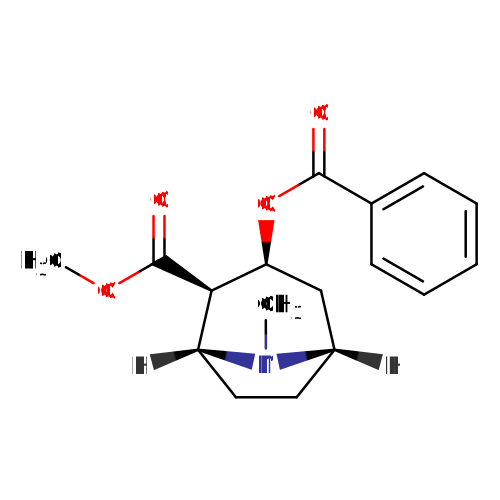
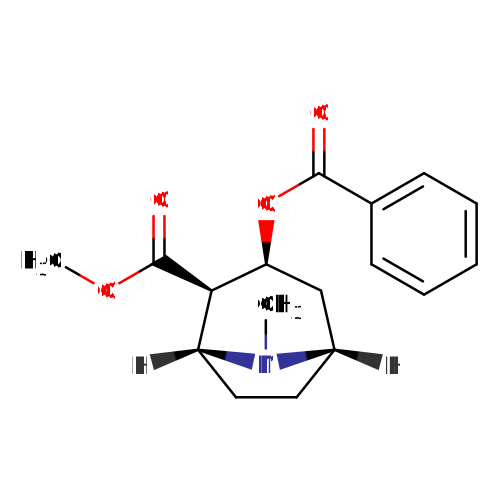
| Structure | [H][C@]12CC[C@]([H])([C@H]([C@H](C1)OC(=O)C1=CC=CC=C1)C(=O)OC)N2C InChI=1S/C17H21NO4/c1-18-12-8-9-13(18)15(17(20)21-2)14(10-12)22-16(19)11-6-4-3-5-7-11/h3-7,12-15H,8-10H2,1-2H3/t12-,13+,14-,15+/m0/s1 |
|---|
| Synonyms | | Value | Source |
|---|
| (-)-Cocaine | ChEBI | | 2-Methyl-3beta-hydroxy-1alphah,5alphah-tropane-2beta-carboxylate benzoate (ester) | ChEBI | | [1R-(exo,exo)]-3-(Benzoyloxy)-8-methyl-8-azabicyclo[3.2.1]octane-2-carboxylic acid, methyl ester | ChEBI | | Benzoylmethylecgonine | ChEBI | | beta-Cocain | ChEBI | | Cocain | ChEBI | | Cocaina | ChEBI | | Cocainum | ChEBI | | Kokain | ChEBI | | L-Cocain | ChEBI | | L-Cocaine | ChEBI | | Methyl [1R-(exo,exo)]-3-(benzoyloxy)-8-methyl-8-azabicyclo[3.2.1]octane-2-carboxylate | ChEBI | | Methyl benzoylecgonine | ChEBI | | Neurocaine | ChEBI | | 2-Methyl-3b-hydroxy-1alphah,5alphah-tropane-2b-carboxylate benzoate (ester) | Generator | | 2-Methyl-3b-hydroxy-1alphah,5alphah-tropane-2b-carboxylic acid benzoic acid (ester) | Generator | | 2-Methyl-3beta-hydroxy-1alphah,5alphah-tropane-2beta-carboxylic acid benzoic acid (ester) | Generator | | 2-Methyl-3β-hydroxy-1alphah,5alphah-tropane-2β-carboxylate benzoate (ester) | Generator | | 2-Methyl-3β-hydroxy-1alphah,5alphah-tropane-2β-carboxylic acid benzoic acid (ester) | Generator | | [1R-(exo,exo)]-3-(Benzoyloxy)-8-methyl-8-azabicyclo[3.2.1]octane-2-carboxylate, methyl ester | Generator | | b-Cocain | Generator | | Β-cocain | Generator | | Methyl [1R-(exo,exo)]-3-(benzoyloxy)-8-methyl-8-azabicyclo[3.2.1]octane-2-carboxylic acid | Generator | | (−)-cocaine | HMDB | | Cocaine HCL | HMDB | | Hydrochloride, cocaine | HMDB | | Cocaine hydrochloride | HMDB | | HCL, Cocaine | HMDB |
|
|---|
| Chemical Formula | C17H21NO4 |
|---|
| Average Molecular Weight | 303.3529 |
|---|
| Monoisotopic Molecular Weight | 303.147058165 |
|---|
| IUPAC Name | methyl (1R,2R,3S,5S)-3-(benzoyloxy)-8-methyl-8-azabicyclo[3.2.1]octane-2-carboxylate |
|---|
| Traditional Name | cocaine |
|---|
| CAS Registry Number | 50-36-2 |
|---|
| SMILES | [H][C@]12CC[C@]([H])([C@H]([C@H](C1)OC(=O)C1=CC=CC=C1)C(=O)OC)N2C |
|---|
| InChI Identifier | InChI=1S/C17H21NO4/c1-18-12-8-9-13(18)15(17(20)21-2)14(10-12)22-16(19)11-6-4-3-5-7-11/h3-7,12-15H,8-10H2,1-2H3/t12-,13+,14-,15+/m0/s1 |
|---|
| InChI Key | ZPUCINDJVBIVPJ-LJISPDSOSA-N |
|---|
| Chemical Taxonomy |
|---|
| Description | Belongs to the class of organic compounds known as benzoic acid esters. These are ester derivatives of benzoic acid. |
|---|
| Kingdom | Organic compounds |
|---|
| Super Class | Benzenoids |
|---|
| Class | Benzene and substituted derivatives |
|---|
| Sub Class | Benzoic acids and derivatives |
|---|
| Direct Parent | Benzoic acid esters |
|---|
| Alternative Parents | |
|---|
| Substituents | - Benzoate ester
- Piperidinecarboxylic acid
- Tropane alkaloid
- Benzoyl
- Dicarboxylic acid or derivatives
- Piperidine
- N-alkylpyrrolidine
- Methyl ester
- Pyrrolidine
- Amino acid or derivatives
- Carboxylic acid ester
- Tertiary aliphatic amine
- Tertiary amine
- Carboxylic acid derivative
- Azacycle
- Organoheterocyclic compound
- Organonitrogen compound
- Hydrocarbon derivative
- Organic oxide
- Amine
- Carbonyl group
- Organopnictogen compound
- Organic oxygen compound
- Organooxygen compound
- Organic nitrogen compound
- Aromatic heteropolycyclic compound
|
|---|
| Molecular Framework | Aromatic heteropolycyclic compounds |
|---|
| External Descriptors | |
|---|
| Ontology |
|---|
| Physiological effect | Not Available |
|---|
| Disposition | |
|---|
| Process | |
|---|
| Role | |
|---|
| Physical Properties |
|---|
| State | Solid |
|---|
| Experimental Molecular Properties | | Property | Value | Reference |
|---|
| Melting Point | 195 °C | Not Available | | Boiling Point | Not Available | Not Available | | Water Solubility | 5.03 g/L | Not Available | | LogP | 2.3 | Not Available |
|
|---|
| Experimental Chromatographic Properties | Experimental Collision Cross Sections| Adduct Type | Data Source | CCS Value (Å2) | Reference |
|---|
| [M+H]+ | CBM | 169.8 | 30932474 |
|
|---|
| Predicted Molecular Properties | |
|---|
| Predicted Chromatographic Properties | Predicted Collision Cross SectionsPredicted Retention Times Underivatized| Chromatographic Method | Retention Time | Reference |
|---|
| Measured using a Waters Acquity ultraperformance liquid chromatography (UPLC) ethylene-bridged hybrid (BEH) C18 column (100 mm × 2.1 mm; 1.7 μmparticle diameter). Predicted by Afia on May 17, 2022. Predicted by Afia on May 17, 2022. | 5.74 minutes | 32390414 | | Predicted by Siyang on May 30, 2022 | 10.8333 minutes | 33406817 | | Predicted by Siyang using ReTip algorithm on June 8, 2022 | 2.55 minutes | 32390414 | | AjsUoB = Accucore 150 Amide HILIC with 10mM Ammonium Formate, 0.1% Formic Acid | 109.0 seconds | 40023050 | | Fem_Long = Waters ACQUITY UPLC HSS T3 C18 with Water:MeOH and 0.1% Formic Acid | 1714.4 seconds | 40023050 | | Fem_Lipids = Ascentis Express C18 with (60:40 water:ACN):(90:10 IPA:ACN) and 10mM NH4COOH + 0.1% Formic Acid | 215.2 seconds | 40023050 | | Life_Old = Waters ACQUITY UPLC BEH C18 with Water:(20:80 acetone:ACN) and 0.1% Formic Acid | 148.5 seconds | 40023050 | | Life_New = RP Waters ACQUITY UPLC HSS T3 C18 with Water:(30:70 MeOH:ACN) and 0.1% Formic Acid | 170.9 seconds | 40023050 | | RIKEN = Waters ACQUITY UPLC BEH C18 with Water:ACN and 0.1% Formic Acid | 78.0 seconds | 40023050 | | Eawag_XBridgeC18 = XBridge C18 3.5u 2.1x50 mm with Water:MeOH and 0.1% Formic Acid | 328.0 seconds | 40023050 | | BfG_NTS_RP1 =Agilent Zorbax Eclipse Plus C18 (2.1 mm x 150 mm, 3.5 um) with Water:ACN and 0.1% Formic Acid | 403.8 seconds | 40023050 | | HILIC_BDD_2 = Merck SeQuant ZIC-HILIC with ACN(0.1% formic acid):water(16 mM ammonium formate) | 512.3 seconds | 40023050 | | UniToyama_Atlantis = RP Waters Atlantis T3 (2.1 x 150 mm, 5 um) with ACN:Water and 0.1% Formic Acid | 931.4 seconds | 40023050 | | BDD_C18 = Hypersil Gold 1.9µm C18 with Water:ACN and 0.1% Formic Acid | 368.0 seconds | 40023050 | | UFZ_Phenomenex = Kinetex Core-Shell C18 2.6 um, 3.0 x 100 mm, Phenomenex with Water:MeOH and 0.1% Formic Acid | 1200.1 seconds | 40023050 | | SNU_RIKEN_POS = Waters ACQUITY UPLC BEH C18 with Water:ACN and 0.1% Formic Acid | 220.4 seconds | 40023050 | | RPMMFDA = Waters ACQUITY UPLC BEH C18 with Water:ACN and 0.1% Formic Acid | 331.5 seconds | 40023050 | | MTBLS87 = Merck SeQuant ZIC-pHILIC column with ACN:Water and :ammonium carbonate | 327.3 seconds | 40023050 | | KI_GIAR_zic_HILIC_pH2_7 = Merck SeQuant ZIC-HILIC with ACN:Water and 0.1% FA | 260.7 seconds | 40023050 | | Meister zic-pHILIC pH9.3 = Merck SeQuant ZIC-pHILIC column with ACN:Water 5mM NH4Ac pH9.3 and 5mM ammonium acetate in water | 93.6 seconds | 40023050 |
Predicted Kovats Retention IndicesUnderivatized |
|---|
| General References | - Siegel RK, Elsohly MA, Plowman T, Rury PM, Jones RT: Cocaine in herbal tea. JAMA. 1986 Jan 3;255(1):40. [PubMed:3940302 ]
- Volkow ND, Wang GJ, Fischman MW, Foltin R, Fowler JS, Franceschi D, Franceschi M, Logan J, Gatley SJ, Wong C, Ding YS, Hitzemann R, Pappas N: Effects of route of administration on cocaine induced dopamine transporter blockade in the human brain. Life Sci. 2000 Aug 11;67(12):1507-15. [PubMed:10983846 ]
- Uz T, Akhisaroglu M, Ahmed R, Manev H: The pineal gland is critical for circadian Period1 expression in the striatum and for circadian cocaine sensitization in mice. Neuropsychopharmacology. 2003 Dec;28(12):2117-23. [PubMed:12865893 ]
- Dimitrijevic N, Dzitoyeva S, Manev H: An automated assay of the behavioral effects of cocaine injections in adult Drosophila. J Neurosci Methods. 2004 Aug 30;137(2):181-4. [PubMed:15262059 ]
- McClung CA, Sidiropoulou K, Vitaterna M, Takahashi JS, White FJ, Cooper DC, Nestler EJ: Regulation of dopaminergic transmission and cocaine reward by the Clock gene. Proc Natl Acad Sci U S A. 2005 Jun 28;102(26):9377-81. Epub 2005 Jun 20. [PubMed:15967985 ]
- Lippi G, Plebani M, Cervellin G: Cocaine in acute myocardial infarction. Adv Clin Chem. 2010;51:53-70. doi: 10.1016/s0065-2423(10)51003-5. [PubMed:20857618 ]
- Pomara C, Cassano T, D'Errico S, Bello S, Romano AD, Riezzo I, Serviddio G: Data available on the extent of cocaine use and dependence: biochemistry, pharmacologic effects and global burden of disease of cocaine abusers. Curr Med Chem. 2012;19(33):5647-57. doi: 10.2174/092986712803988811. [PubMed:22856655 ]
- Beaulieu P: Anesthetic implications of recreational drug use. Can J Anaesth. 2017 Dec;64(12):1236-1264. doi: 10.1007/s12630-017-0975-0. Epub 2017 Sep 27. [PubMed:28956316 ]
|
|---|