Hmdb loader
Record Information
Version5.0
StatusExpected but not Quantified
Creation Date2013-05-17 00:54:25 UTC
Update Date2023-02-21 17:29:53 UTC
HMDB IDHMDB0060333
Secondary Accession Numbers
  • HMDB60333
Metabolite Identification
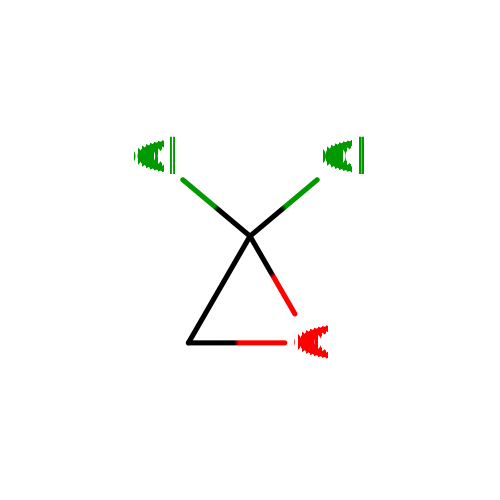
Common Name1,1-Dichloroethylene epoxide
Description1,1-Dichloroethylene epoxide, also known as DCE epoxide is a compound belonging to the family of compounds known as orthocarboxylic acid derivatives. These are organic compounds containing the orhtocarboxylic acid functional group, with the RC(X)(X)X (R=H, alkyl,aryl; X=OH,alkoxy,aryloxy, (substituted amino), etc. (PMID: 16098521 ). Epoxides are compounds containing a cyclic ether with three ring atoms (one oxygen and two carbon atoms). DCE epoxide is a urinary metabolite of 1,1-Dichloroethene (DCE), or vinylidine chloride (PMID: 15319346 , 11270662 ). DCE is mainly used as a comonomer in the production and polymerization of plastics such as polyvinyl chloride, acrylonitrile, and acrylates. As a result, DCE is widely distributed in the environment and in plastics. DCE was the precursor to the original form of saran-wrap or cling-wrap (clear plastic wrap used to preserve foods), but this has been phased out due to concerns over the carcinogenicity of DCE.
Structure
Data?1677000593
Synonyms
ValueSource
2,2-DichlorooxiraneKegg
Chemical FormulaC2H2Cl2O
Average Molecular Weight112.943
Monoisotopic Molecular Weight111.9482701
IUPAC Name2,2-dichlorooxirane
Traditional NameC2H2cl2O
CAS Registry NumberNot Available
SMILES
ClC1(Cl)CO1
InChI Identifier
InChI=1S/C2H2Cl2O/c3-2(4)1-5-2/h1H2
InChI KeyDPVAHOUXGQHEOI-UHFFFAOYSA-N
Chemical Taxonomy
Description Belongs to the class of organic compounds known as epoxides. Epoxides are compounds containing a cyclic ether with three ring atoms(one oxygen and two carbon atoms).
KingdomOrganic compounds
Super ClassOrganoheterocyclic compounds
ClassEpoxides
Sub ClassNot Available
Direct ParentEpoxides
Alternative Parents
Substituents
  • Oxacycle
  • Ether
  • Oxirane
  • Dialkyl ether
  • Organic oxygen compound
  • Hydrocarbon derivative
  • Organooxygen compound
  • Organochloride
  • Organohalogen compound
  • Alkyl halide
  • Alkyl chloride
  • Aliphatic heteromonocyclic compound
Molecular FrameworkAliphatic heteromonocyclic compounds
External Descriptors
Ontology
Physiological effectNot Available
Disposition
ProcessNot Available
RoleNot Available
Physical Properties
StateNot Available
Experimental Molecular Properties
PropertyValueReference
Melting PointNot AvailableNot Available
Boiling PointNot AvailableNot Available
Water SolubilityNot AvailableNot Available
LogPNot AvailableNot Available
Experimental Chromatographic PropertiesNot Available
Predicted Molecular Properties
PropertyValueSource
Water Solubility22.4 g/LALOGPS
logP0.8ALOGPS
logP1.21ChemAxon
logS-0.7ALOGPS
pKa (Strongest Basic)-4.4ChemAxon
Physiological Charge0ChemAxon
Hydrogen Acceptor Count1ChemAxon
Hydrogen Donor Count0ChemAxon
Polar Surface Area9.23 ŲChemAxon
Rotatable Bond Count0ChemAxon
Refractivity21.28 m³·mol⁻¹ChemAxon
Polarizability8.42 ųChemAxon
Number of Rings1ChemAxon
BioavailabilityYesChemAxon
Rule of FiveYesChemAxon
Ghose FilterNoChemAxon
Veber's RuleYesChemAxon
MDDR-like RuleNoChemAxon
Predicted Chromatographic Properties

Predicted Collision Cross Sections

PredictorAdduct TypeCCS Value (Å2)Reference
DeepCCS[M+H]+123.07530932474
DeepCCS[M-H]-121.21630932474
DeepCCS[M-2H]-156.69130932474
DeepCCS[M+Na]+130.78530932474
AllCCS[M+H]+122.232859911
AllCCS[M+H-H2O]+117.432859911
AllCCS[M+NH4]+126.732859911
AllCCS[M+Na]+128.032859911
AllCCS[M-H]-125.532859911
AllCCS[M+Na-2H]-130.132859911
AllCCS[M+HCOO]-135.232859911

Predicted Retention Times

Underivatized

Chromatographic MethodRetention TimeReference
Measured using a Waters Acquity ultraperformance liquid chromatography (UPLC) ethylene-bridged hybrid (BEH) C18 column (100 mm × 2.1 mm; 1.7 μmparticle diameter). Predicted by Afia on May 17, 2022.3.88 minutes32390414
Predicted by Siyang on May 30, 202214.5425 minutes33406817
Predicted by Siyang using ReTip algorithm on June 8, 20222.79 minutes32390414
Fem_Long = Waters ACQUITY UPLC HSS T3 C18 with Water:MeOH and 0.1% Formic Acid1293.9 seconds40023050
Fem_Lipids = Ascentis Express C18 with (60:40 water:ACN):(90:10 IPA:ACN) and 10mM NH4COOH + 0.1% Formic Acid505.2 seconds40023050
Life_Old = Waters ACQUITY UPLC BEH C18 with Water:(20:80 acetone:ACN) and 0.1% Formic Acid216.3 seconds40023050
Life_New = RP Waters ACQUITY UPLC HSS T3 C18 with Water:(30:70 MeOH:ACN) and 0.1% Formic Acid394.6 seconds40023050
RIKEN = Waters ACQUITY UPLC BEH C18 with Water:ACN and 0.1% Formic Acid223.9 seconds40023050
Eawag_XBridgeC18 = XBridge C18 3.5u 2.1x50 mm with Water:MeOH and 0.1% Formic Acid406.2 seconds40023050
BfG_NTS_RP1 =Agilent Zorbax Eclipse Plus C18 (2.1 mm x 150 mm, 3.5 um) with Water:ACN and 0.1% Formic Acid509.0 seconds40023050
HILIC_BDD_2 = Merck SeQuant ZIC-HILIC with ACN(0.1% formic acid):water(16 mM ammonium formate)475.1 seconds40023050
UniToyama_Atlantis = RP Waters Atlantis T3 (2.1 x 150 mm, 5 um) with ACN:Water and 0.1% Formic Acid914.2 seconds40023050
BDD_C18 = Hypersil Gold 1.9µm C18 with Water:ACN and 0.1% Formic Acid319.7 seconds40023050
UFZ_Phenomenex = Kinetex Core-Shell C18 2.6 um, 3.0 x 100 mm, Phenomenex with Water:MeOH and 0.1% Formic Acid946.8 seconds40023050
SNU_RIKEN_POS = Waters ACQUITY UPLC BEH C18 with Water:ACN and 0.1% Formic Acid356.0 seconds40023050
RPMMFDA = Waters ACQUITY UPLC BEH C18 with Water:ACN and 0.1% Formic Acid362.5 seconds40023050
MTBLS87 = Merck SeQuant ZIC-pHILIC column with ACN:Water and :ammonium carbonate706.9 seconds40023050
KI_GIAR_zic_HILIC_pH2_7 = Merck SeQuant ZIC-HILIC with ACN:Water and 0.1% FA472.2 seconds40023050
Meister zic-pHILIC pH9.3 = Merck SeQuant ZIC-pHILIC column with ACN:Water 5mM NH4Ac pH9.3 and 5mM ammonium acetate in water218.5 seconds40023050

Predicted Kovats Retention Indices

Underivatized

MetaboliteSMILESKovats RI ValueColumn TypeReference
1,1-Dichloroethylene epoxideClC1(Cl)CO11031.3Standard polar33892256
1,1-Dichloroethylene epoxideClC1(Cl)CO1626.6Standard non polar33892256
1,1-Dichloroethylene epoxideClC1(Cl)CO1653.3Semi standard non polar33892256
Spectra
Biological Properties
Cellular LocationsNot Available
Biospecimen LocationsNot Available
Tissue LocationsNot Available
Pathways
Normal Concentrations
Not Available
Abnormal Concentrations
Not Available
Associated Disorders and Diseases
Disease ReferencesNone
Associated OMIM IDsNone
DrugBank IDNot Available
Phenol Explorer Compound IDNot Available
FooDB IDNot Available
KNApSAcK IDNot Available
Chemspider IDNot Available
KEGG Compound IDC14857
BioCyc IDNot Available
BiGG IDNot Available
Wikipedia LinkNot Available
METLIN IDNot Available
PubChem Compound119521
PDB IDNot Available
ChEBI IDNot Available
Food Biomarker OntologyNot Available
VMH IDM00227
MarkerDB IDNot Available
Good Scents IDNot Available
References
Synthesis ReferenceNot Available
Material Safety Data Sheet (MSDS)Not Available
General References
  1. Magrane M: UniProt Knowledgebase: a hub of integrated protein data. Database (Oxford). 2011 Mar 29;2011:bar009. doi: 10.1093/database/bar009. Print 2011. [PubMed:21447597 ]
  2. Feldman HJ, Dumontier M, Ling S, Haider N, Hogue CW: CO: A chemical ontology for identification of functional groups and semantic comparison of small molecules. FEBS Lett. 2005 Aug 29;579(21):4685-91. doi: 10.1016/j.febslet.2005.07.039. [PubMed:16098521 ]
  3. Simmonds AC, Reilly CA, Baldwin RM, Ghanayem BI, Lanza DL, Yost GS, Collins KS, Forkert PG: Bioactivation of 1,1-dichloroethylene to its epoxide by CYP2E1 and CYP2F enzymes. Drug Metab Dispos. 2004 Sep;32(9):1032-9. [PubMed:15319346 ]
  4. Forkert PG: Mechanisms of 1,1-dichloroethylene-induced cytotoxicity in lung and liver. Drug Metab Rev. 2001 Feb;33(1):49-80. doi: 10.1081/dmr-100000140. [PubMed:11270662 ]

Only showing the first 10 proteins. There are 19 proteins in total.

Enzymes

General function:
Involved in glutathione transferase activity
Specific function:
Conjugation of reduced glutathione to a wide number of exogenous and endogenous hydrophobic electrophiles.
Gene Name:
GSTM2
Uniprot ID:
P28161
Molecular weight:
25744.395
Reactions
1,1-Dichloroethylene epoxide + Glutathione → 2-(S-Glutathionyl)acetyl chloride + Hydrochloric aciddetails
General function:
Involved in glutathione transferase activity
Specific function:
Conjugation of reduced glutathione to a wide number of exogenous and endogenous hydrophobic electrophiles.
Gene Name:
GSTM1
Uniprot ID:
P09488
Molecular weight:
25711.555
Reactions
1,1-Dichloroethylene epoxide + Glutathione → 2-(S-Glutathionyl)acetyl chloride + Hydrochloric aciddetails
General function:
Involved in protein disulfide oxidoreductase activity
Specific function:
Significant glutathione conjugating activity is found only with the model substrate, 1-chloro-2,4-dinitrobenzene (CDNB).
Gene Name:
GSTK1
Uniprot ID:
Q9Y2Q3
Molecular weight:
31565.605
Reactions
1,1-Dichloroethylene epoxide + Glutathione → 2-(S-Glutathionyl)acetyl chloride + Hydrochloric aciddetails
General function:
Involved in glutathione transferase activity
Specific function:
Also functions as a glutathione peroxidase.
Gene Name:
MGST3
Uniprot ID:
O14880
Molecular weight:
16516.185
Reactions
1,1-Dichloroethylene epoxide + Glutathione → 2-(S-Glutathionyl)acetyl chloride + Hydrochloric aciddetails
General function:
Involved in glutathione transferase activity
Specific function:
Conjugation of reduced glutathione to a wide number of exogenous and endogenous hydrophobic electrophiles. May govern uptake and detoxification of both endogenous compounds and xenobiotics at the testis and brain blood barriers.
Gene Name:
GSTM3
Uniprot ID:
P21266
Molecular weight:
26559.32
Reactions
1,1-Dichloroethylene epoxide + Glutathione → 2-(S-Glutathionyl)acetyl chloride + Hydrochloric aciddetails
General function:
Involved in glutathione transferase activity
Specific function:
Conjugation of reduced glutathione to a wide number of exogenous and endogenous hydrophobic electrophiles.
Gene Name:
GSTA1
Uniprot ID:
P08263
Molecular weight:
25630.785
Reactions
1,1-Dichloroethylene epoxide + Glutathione → 2-(S-Glutathionyl)acetyl chloride + Hydrochloric aciddetails
General function:
Involved in glutathione transferase activity
Specific function:
Conjugation of reduced glutathione to a wide number of exogenous and endogenous hydrophobic electrophiles. Has a wide substrate specificity.
Gene Name:
MGST1
Uniprot ID:
P10620
Molecular weight:
17598.45
Reactions
1,1-Dichloroethylene epoxide + Glutathione → 2-(S-Glutathionyl)acetyl chloride + Hydrochloric aciddetails
General function:
Involved in glutathione transferase activity
Specific function:
Conjugation of reduced glutathione to a wide number of exogenous and endogenous hydrophobic electrophiles. Active on 1-chloro-2,4-dinitrobenzene.
Gene Name:
GSTM4
Uniprot ID:
Q03013
Molecular weight:
25561.095
Reactions
1,1-Dichloroethylene epoxide + Glutathione → 2-(S-Glutathionyl)acetyl chloride + Hydrochloric aciddetails
General function:
Involved in glutathione transferase activity
Specific function:
Conjugation of reduced glutathione to a wide number of exogenous and endogenous hydrophobic electrophiles.
Gene Name:
GSTM5
Uniprot ID:
P46439
Molecular weight:
25674.455
Reactions
1,1-Dichloroethylene epoxide + Glutathione → 2-(S-Glutathionyl)acetyl chloride + Hydrochloric aciddetails
General function:
Involved in enzyme activator activity
Specific function:
Can catalyze the production of LTC4 from LTA4 and reduced glutathione. Can catalyze the conjugation of 1-chloro-2,4-dinitrobenzene with reduced glutathione.
Gene Name:
MGST2
Uniprot ID:
Q99735
Molecular weight:
16620.4
Reactions
1,1-Dichloroethylene epoxide + Glutathione → 2-(S-Glutathionyl)acetyl chloride + Hydrochloric aciddetails

Only showing the first 10 proteins. There are 19 proteins in total.